

Catholic Workers Cry “Shame” on War, Call for Repair, Healing
Inside: Catholic Workers across the country respond to Iran strikes; two talks from the 2026 Catholic Worker Farm Gathering on regenerative hospitality toward land and guests; Dorothy Day on love
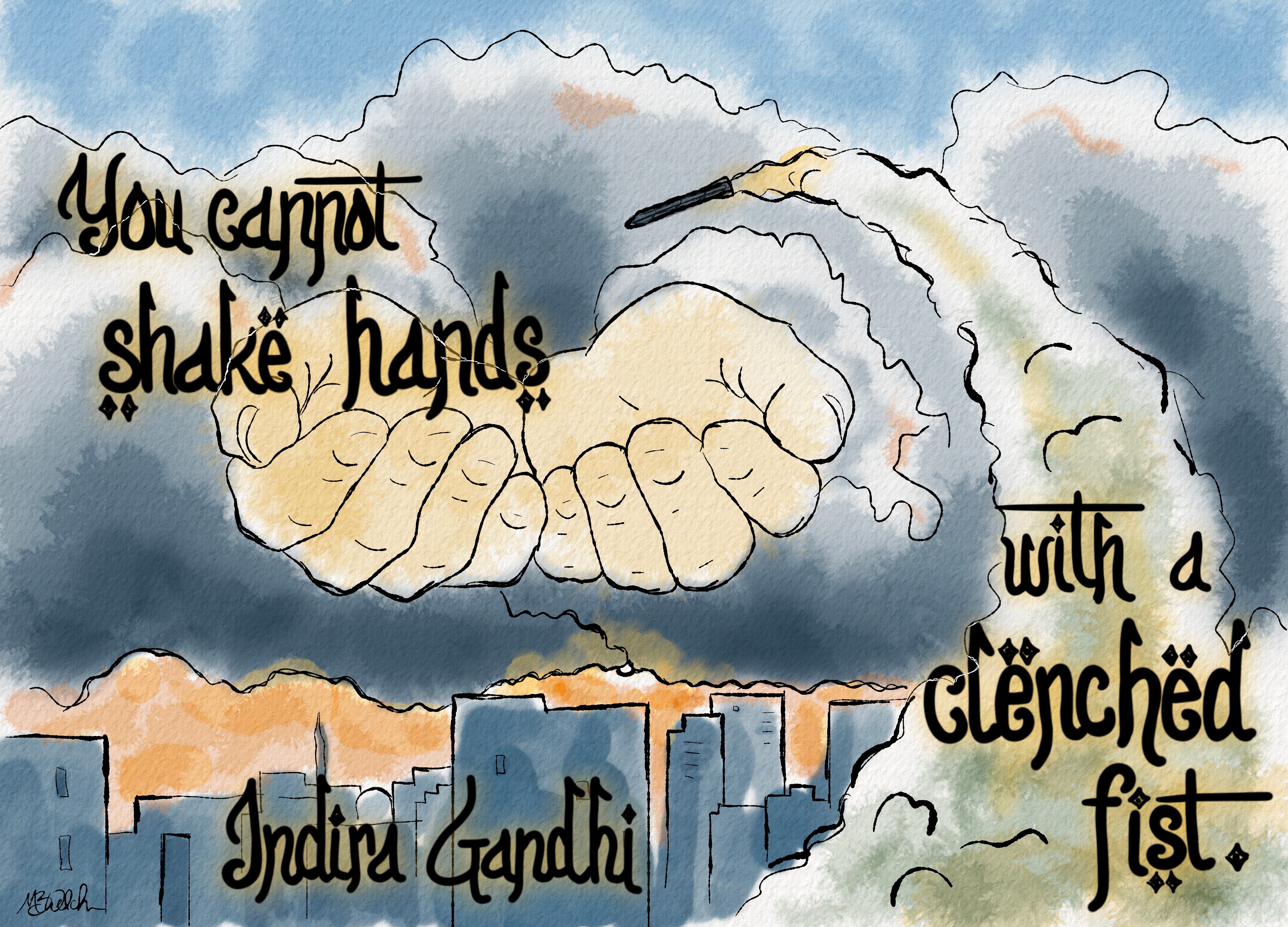
“You cannot shake hands with a clenched fist.”
The unintended consequences of war are far-reaching. My husband was embarking on his journey home from a weeks-long work trip to India when the first bombs fell on Iran. Flights through Dubai were cancelled; he was lucky that his return home—through Australia—was only delayed by two days. But he was safe.
Coworkers who departed the previous day were stuck indefinitely in Dubai as bombs fell there. Wives were home with small children, not knowing when daddy would walk through the door. But they were mostly safe.
These folks were traveling to collaborate on the design of medical diagnostic equipment, yet so many were impacted in concrete ways by bombs falling in Iran—and those effects pale in comparison to the devastation being wrought in the Middle East.
On a weekend in India, Adam visited the home—now a museum—of Indira Gandhi. He brought me home a simple tote bag featuring her quote, “You cannot shake hands with a clenched fist.” What a powerful statement during these days of so many, many clenched fists.
So *much* cannot be done with clenched fists:
You cannot make a meal for a family managing a loved one’s hospitalization.
You cannot hand a mom in need a set of school clothes for her child.
You cannot love your neighbor.
You cannot stop bombs falling.
You cannot bring peace.
This is what I hope to convey in my art structured around the words of Indira Gandhi. I used a lettering style evocative of Persian(Farsi), Urdu, and Hindi—beautiful styles of writing that share common roots, symbolizing the beauty that connects us across cultures. The missile’s trajectory is based in the clenching of fists. The hands, based in the heavens, might seem less substantial than the armaments—but they are larger, resilient, and can stop the violence.
A Muslim friend of mine once asked how Christians pray. She found folded hands to be an odd posture—she, along with many Muslims, prays with her hands open, cupped, ready to receive.
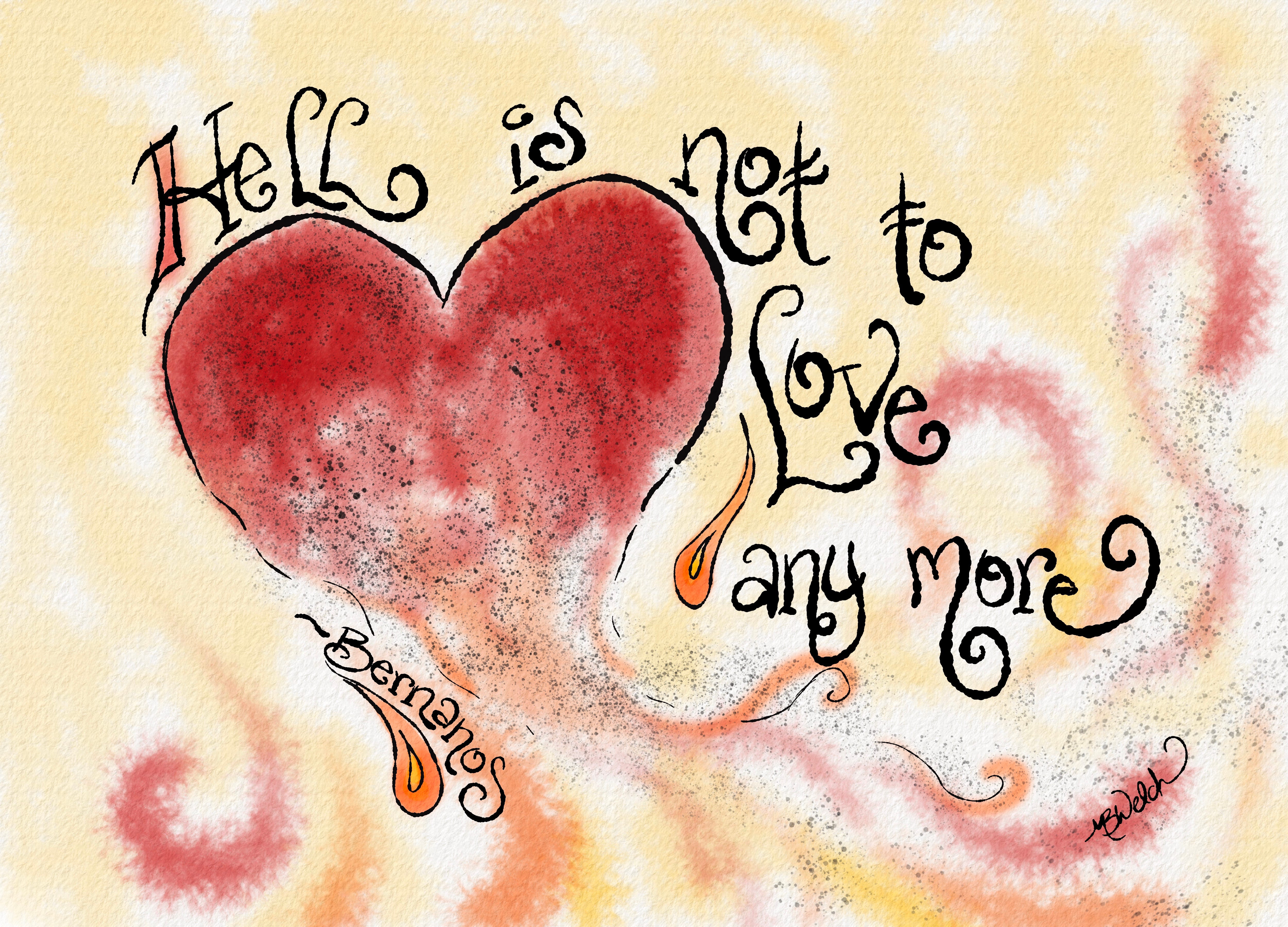
Clenched fists disable love, and—as reflected in my second piece of art, included below with today’s Words from the Elders—“Hell is not to love any more.” May we all open our hands, and accomplish through love what clenched fists cannot achieve.
Monica

FEATURED
CW Reads: War on the Land and the Work of Repair
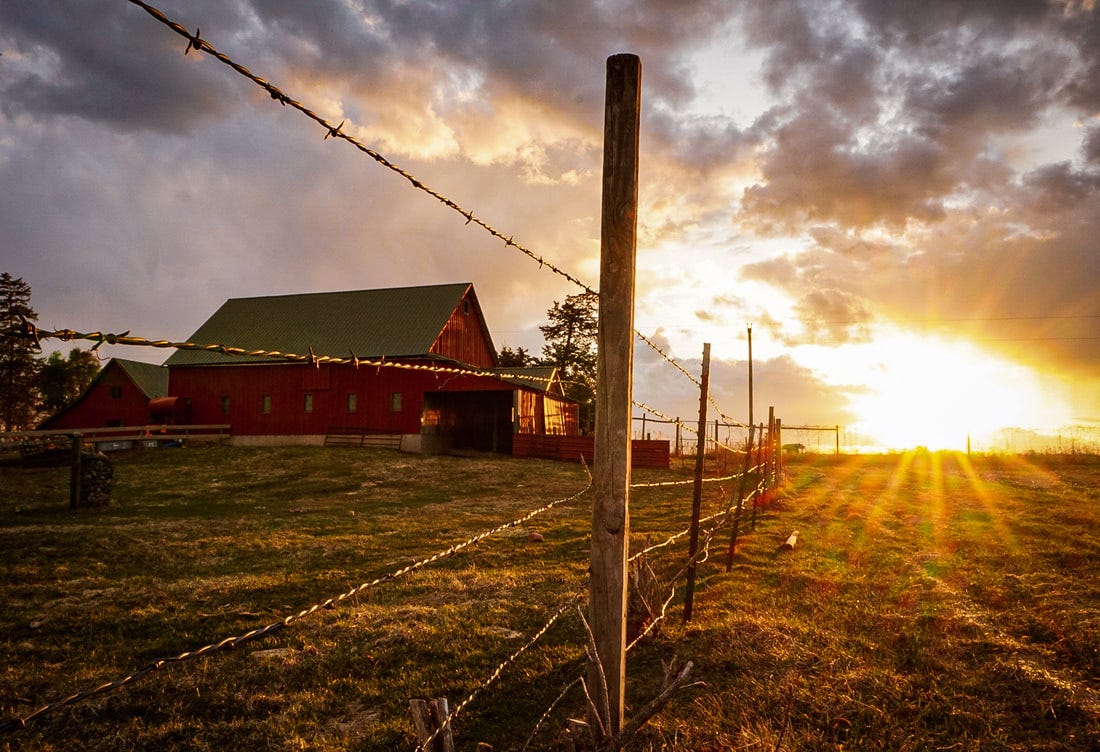
Dan Guenthner, of Common Harvest Farm, gave the keynote address at the Catholic Worker Farm Gathering last month at Anathoth Community Farm in Luck, Wisconsin. Common Harvest Farm has been a neighbor and co-conspirator with the Anathoth community in regenerative, restorative agriculture. Guenthner called on Catholic Worker farmers at the gathering to be chaplains of repair in the “war on the land” happening under our feet. He said:
Some injustices, however, are not so easy to recognize.
The war on the land is an example of a low-intensity conflict being waged against nature and the biological foundations of life on this planet.
The war on the land is cloaked in the narrative of “feeding the world.”
The war on the land is hidden behind patented life forms, intensive synthetic inputs, and the illusion of abundance.
The war on the land is waged through the inhumane treatment of animals.
The casualties of this war on the land are often unseen and out of sight.
We are experiencing an unprecedented decline in global insect populations due to the indiscriminate use of systemic insecticides, with native pollinators and beneficial insects seen as mere collateral damage.
Or undocumented workers who live and work in the shadows with limited rights and few options for living a life of dignity.
Or the injustice of an economic system that keeps farmers buried in debt in support of our cheap food policy.
The battleground for this war is increasingly being waged in rural communities across this country. As retired agricultural economist John Ikerd writes, “We are the only country on earth that has colonized ourselves.”
In response, Guenthner said that it was time to raise up a new generation to carry on the work of the “Rural Chaplains of America,” an ecumenical group that responded to the farm crisis of the 1980’s. He said:
The Rural Chaplains of America disbanded more than two decades ago. I think it is time to train a new generation of listeners to address climate anxiety and the fallout from the continued economic collapse of rural communities across this country.
So let us roll up our sleeves and set about the work of repair. I believe what many of you are doing through establishing Catholic Worker farms across the Midwest and the country can be a model for healing our planet and our communities. I know that the work is often daunting and challenging. But I see your example as a beacon of light that is reaching others who are looking for a lasting alternative for right livelihood and peaceful resistance.
Read the full keynote here.
CW Reads: Hospitality on a Catholic Worker Farm
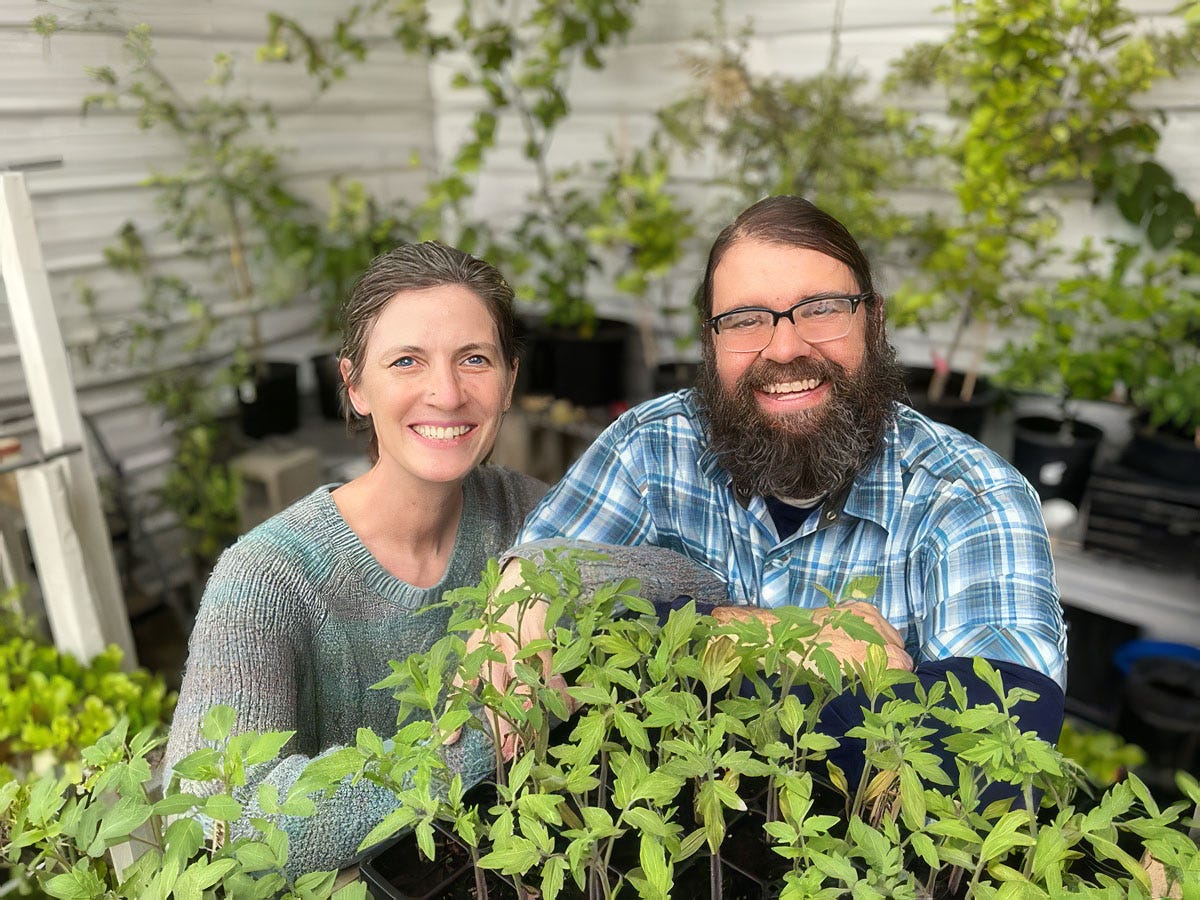
This week’s CW Reads also featured another talk from the Catholic Worker Farm Gathering. This time, Sara Freid, of Lake City Catholic Worker Farm, shared several stories of hospitality on a Catholic Worker farm: what makes it unique and the same as serving in the houses of hospitality in the city. Sara opened with a story of a three sacred interruption:
Hospitality is something that’s integral to the Catholic Worker. Paul and I have found that it’s really core to who we are.
We lived at the Winona Catholic Worker for three to four years, and now we’ve been at our Lake City Catholic Worker for almost 20 years. We have been doing hospitality all of that time—even before then—offering space for people who need a place to stay. I want to share a few stories about what doing hospitality looks like on our farm, because doing hospitality on a farm is very different than doing it in a house of hospitality in the city.
When folks stay with us, most often they stay for longer than a year. At that point they become part of our family. They become integrated into our farm life.
We’ve heard people talk about this idea of tension within the Catholic Worker—tension between hospitality, community, and resistance or peace work. They kind of pull at each other, right? If you’re away from the community doing peace work, then other people are picking up what you would be doing at the community. If you are offering hospitality, it affects different things. If somebody’s staying at your house, are you going to go to a peace vigil? Those different things are held in tension.
I would say that at our farm, we hold those things in tension—specifically community, hospitality, and then farm work being the act of resistance. Because growing things, growing food, good food, and taking care of the land is an act of resistance. Those three things are held in tension.
There’s a story that exemplifies this to the utmost. Sundays are our family days. We hold them pretty sacred. This particular Sunday, a number of years ago, Paul was meeting with somebody to do some marriage prep. So that goes along with our community work, right? He’s doing marriage prep.
Then along came our goat, who decided to give birth on this very day. So myself and the girls are out helping with the birthing of two beautiful little goats. We didn’t know how long this was going to take. Paul is over there talking about marriage prep for this wedding coming up. We’re over here doing birthing of goats.
The third one—hospitality—comes along when a mother dropped off her twenty-year-old son at the end of our driveway and said, “They’ll help you,” and then drove away.
Now, this was a mother who had called us, and Paul said very specifically, “We need to talk to your son to make sure he wants to stay here. Don’t just drop someone off. We need to talk to the person directly.” Well, she ignored that and dropped him off on the day that Paul’s doing marriage prep, I’m helping birth these goat kids, and here comes this twenty-year-old down the driveway with his big backpack saying, “Um, I’m supposed to stay here?”
And we’re like, “Okay, alright.” So, there’s this tension. He ended up staying with us for probably nine months. We try to do months to a year, and we figured it out. We figure those things out—not in the very prettiest way, but they get done.
Read Sara’s full talk here.
Catholic Workers Protest Iran Strikes
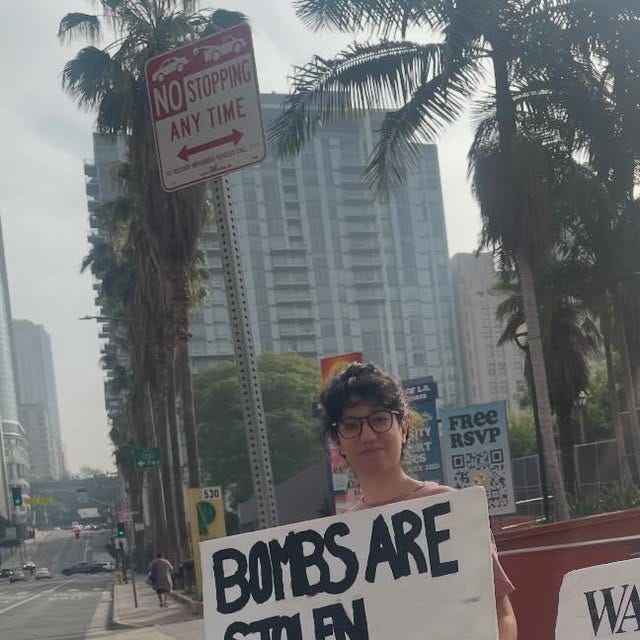
From Los Angeles to New York City, Catholic Worker Communities protested President Trump’s and Israel’s strikes on Iran.
In New York City, Cathy Breen, of Maryhouse, took to Times Square with thousands of others to protest the strikes. “I feel shame for being from the United States right now,” she told Al Jazeera. “We didn’t learn from the Iraq War.” You can watch her interview here.
Ozark Foothills Catholic Worker Farm in Catawissa, Missouri, shared an original piece of art to their Instagram page with the statement “Like water and oil, Christianity and war don’t mix.”
In Des Moines, Mohammed Salah Mahdi shared a Facebook reel posing questions about the tactics and the motivations of President Trump and Israel’s attacks. “How many regimes in the Middle East have been changed by force?” Salah asked. He noted that regimes that were anointed by the United States or sprang up after U.S. regime change still cause pain and suffering. “What does it mean to change a regime?” he asked.
Roundtable reached out to Lincoln Rice (Casa Maria Catholic Worker, Milwaukee) and Chrissy Kirchhoefer (St. Louis Catholic Worker) for an update about interest in tax resistance during this tax season; both work for the National War Tax Resistance Coordinating Committee.
War tax resistance has grown in popularity since October 2023, and as the United States’ support of Israel’s genocidal attacks on Gaza has provoked domestic and international outrage. Rice, national coordinator of the National War Tax Resistance Coordinating Committee, said in an email to Roundtable that, a week in, it is too early to tell whether the attacks on Iran will pique more interest. “But I can state that the recent surge in war tax resistance that began with the ICE invasion in Minnesota has not waned,” Rice added:
Many groups across the United States hosting war tax resistance events on or round Pie Day (3.14) as a nod to the pie charts created by the War Resisters League that illustrate that the US government consistently spends around 50% of the federal budget on current and past military expenses.
For more information about war tax resistance or to find a schedule of Pie Day tax events near you, he urged readers to visit their website or Instagram page.
In Duluth, Minnesota, Michele Naar-Obed of Hildegard House sent the following statement via email to Roundtable:
At Hildegard House, we will continue to build a civil society based on the principles of the Sermon on the Mount, the Works of Mercy and the Beatitudes. We start in ourselves, work our way out into our neighborhood, and into our community and join with other catholic workers who are doing the same in their neighborhoods and towns until the ripple effect spreads worldwide. We will remain intentional and focused and rooted in our faith and follow the lead of the Spirit.
CWers Keep an Eye on Escalating West Bank Violence
Meanwhile, as the war with Iran grabs the world’s attention, Catholic Workers who have spent time in the West Bank have been keeping an eye on the situation there.
Cassandra Dixon, who does prison hospitality at Mary House (Oxford, Wisconsin) and has traveled to the West Bank annually for more than fifteen years with Operation Dove, reports rapidly deteriorating conditions across the occupied territory. Settlers shot and killed one man and critically injured another, while Israeli forces simultaneously locked down all village gates and checkpoints throughout the region—including blocking ambulances from responding to emergencies. The situation is particularly bad in Masafer Yatta, the area where Dixon has built close relationships with Palestinian farming families over many years. According to an update from The Villages Group, settlers have cut the only water pipeline serving the area and routinely damage storage tanks. Organized attacks on villages are occurring at least weekly, with large groups of settlers arriving by vehicle to kill and steal livestock, injure residents, and destroy property.
Brenna Cussen (St. Isidore Catholic Worker), who was among Catholic Workers who spent time in the West Bank this fall, suggests that people interested in following news from the area check out the Popular Resistance blog by Mazin Qumsiyeh, a friend of several Catholic Workers who lives in Beit Sahour. “Mazin is a Palestinian scientist who used to teach at Yale and moved home to Palestine during the 2nd Intifada to be part of the NV resistance,” Cussan says. “He’s amazing.”
COMMUNITY NEWS & NEWSLETTERS
Houston Catholic Worker Issue Highlights “Texas Jesus”
The Houston Catholic Worker featured a cover story by Louise Zwick on a Catholic vision for the reconstruction of the social order. “One would expect the social and economic situation today should be very different from the 1930s when Dorothy Day and Peter Maurin started the Catholic Worker movement,” Zwick writes, and yet she notes the striking similarities between the days of the Depression and today:
A world in which there are a few funds to feed poor children and a lack of a desire to build an economy that will bring relief to struggling families, but billions are available to carry out the massive deportations of people of color and wage wars around the world.
How does the Gospel speak into this world? Zwick asks. Inside the paper, readers receive some clues. A reprint of a Mark Zwicks essay in Our Sunday Visitor on being and doing illuminated the tension of being a contemplative in action. After hearing a Sunday homily emphasizing the importance of “being” rather than the capitalist emphasis on “doing” or achieving, Zwick wrote that the community resolved to concentrate on “being.” However, he wrote:
We don’t know what is going to happen when we tell the 887th person who comes for services this month that we can’t help them because we are concentrating on “being” instead of “doing.”
Inside, the editors share the words of the US Bishops condemning war and encouraging peace and Pope Leo XIV’s recent encomium on Dorothy Day. Herman Sutter shares their poem “Texas Jesus,” on Jesus in the face of the migrants fleeing to the United States:
Texas Jesus walks across borders, bootless, and barefooted, face brown as leather.
He walks from Brownsville to Amarillo on bruised heals and blistering toes,
carrying with Him his only tools: rough hands and a will to walk
Read more at CJD.org.
Casa Cry Encourages War Tax Resistance
Casa Cry, the newsletter of Casa Maria Catholic Worker in Milwaukee, Wisconsin, encouraged readers not to pay taxes and participate in war tax resistance in protest of the Iran strikes.
Do we really want to give our money for things that destroy human life when we know that 3% of money given to the military would be enough to feed everyone on earth? Dorothy Day said that if we gave to Caesar what is owed to Caesar and to God what is owed to God there would be nothing left for Caesar. Just as Christ refused to give assistance to the Roman empire to do war and make weapons of war we, His followers. are called to do the same in our country. Christians are different. They obey Christ’s law of love and forgiveness.
Staten Island Catholic Worker Updates
Staten Island Catholic Worker is in a new season this spring with many new initiatives bearing fruit. Current director Anne-Louise DePalo noted many seeds of new life and initiatives springing the community. She is speaking with Staten Island’s government representatives to install a memorial to Dorothy Day’s residence at Spanish Camp, Day’s last home on her beloved Staten Island. Their most recent newsletter featured invitations to join for sandwich outreach in Tappan Park, a list of Masses for peace at nearby churches, and a reflection on Dorothy Day’s life as a model for Christian Lenten practices. “Dorothy Day lived Lent throughout her life,” DePalo wrote:
Lent is a time for us to take a good hard look at ourselves. Are we living as Christ’s disciple? Lent is not just a private spiritual retreat or renewal for ourselves alone, but it is a time to “put love in action” as Dorothy would say. We can offer our suffering, alms, and prayers for the members of the body of Christ and build up God’s kingdom and proclaim it to the world. Now that is a revolution of the heart! Join this Lent challenge with Dorothy Day.
CW IN THE MEDIA
California Catholic Worker: “We owe nuclear disarmament to our children.”
Scott Fina, a longtime volunteer at Beatitude House Catholic Worker in Guadalupe, California, wrote an op-ed about the importance of Vandenburg Air Force Base in the U.S military’s nuclear program, calling it the “most visible venue for the American nuclear weaponry.” Fina has joined the Los Angeles Catholic Workers and others in regular protests at the base. He emphasizes the importance of protesting the U.S.’ testing of intercontinental ballistic missiles with the ending of the New START treaty last month. The New START treaty limited the world’s two largest nuclear superpowers, the U.S. and Russia, and without a new treaty in place, each nation can expand their already apocalyptic nuclear arsenals. Read Scott’s essay here.
Iowa City Catholic Worker Featured in Immigrant Stories
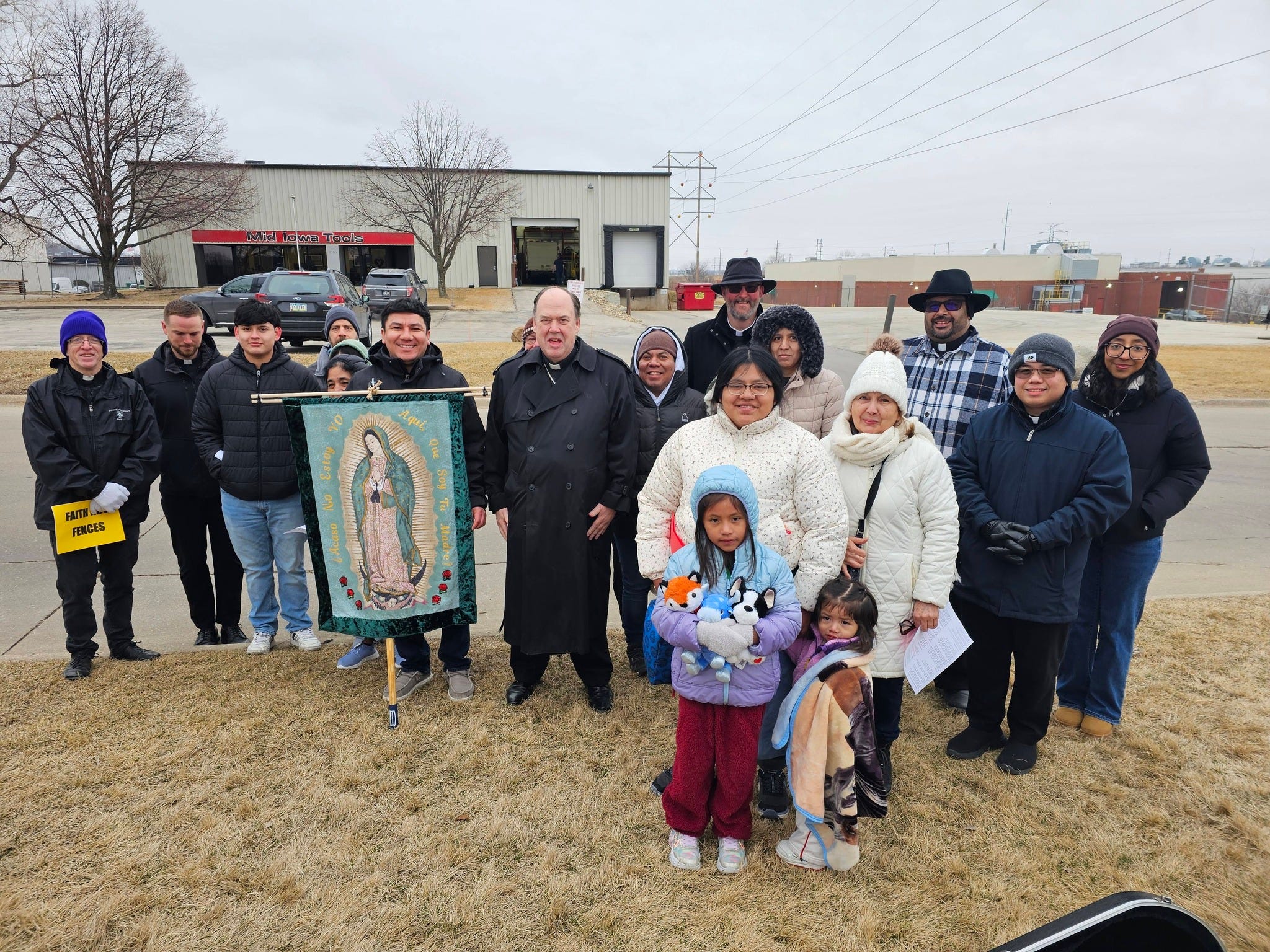
Recently, Bishop Dennis Walsh of Davenport joined Iowa City Catholic Worker outside ICE’s Cedar Rapids Field Office in Iowa on one of their Tuesday vigils to try to bring pastoral care to detainees inside. An ICE agent refused the bishop entry. Little Village Mag has that story here. A man detained in ICE detention in Iowa for more than a year spoke with the Daily Iowan about his story and the horrors that he witnessed. The article addresses the ongoing lawsuits against Muscatine County and federal officials, including the U.S. Secretary of Homeland Security and U.S. Attorney General Pam Bondi, regarding unlawful detainment. One of the lawsuits involves Jorge González Ochoa, a member of Iowa City Catholic Worker’s sister organization Escucha Mí Voz. Read that story here. Iowa City Catholic Worker was also featured in a second Daily Iowan story highlighting grassroots organizations supporting immigrants throughout the state. Read that story here.
Podcasts Feature Catholic Workers
Fr RJ Carr addresses the witness of Dorothy Day and the importance of treating all our neighbors with human dignity. The problem with the church focusing solely on sexual sin, he says, is that the church neglects to form Catholics in offenses against human dignity. Listen on YouTube here. Roundtable’s Renée Roden is featured on a bonus episode of Religion to Reality, talking about voluntary poverty as a means of community building and the works of mercy as a means of putting love into action. Listen here.
Rosette Tiny Village Profiled in Local Paper
Mark and Luz Colville’s Rosette Tiny Village project is featured in their local news site, New Haven Today. The Colvilles opened up six tiny shelters in the backyard of their Catholic Worker house in 2023, after residents of a nearby tent encampment were evicted. Read more about this project of the Amistad Catholic Worker in New Haven, Connecticut, here.
South Bend Catholic Worker Speaks on Homeless Shelter Initiative
Margie Pfeil, co-founder of St. Peter Claver Catholic Worker in South Bend, Indiana, is speaking to the League of Women Voters in South Bend about the community’s project “New Day Intake Center.” The New Day Intake Center, which began in 2020 as “Motels 4 Now,” has become a nonprofit independent from the Catholic Worker community that commits to “dignified housing and supportive services for individuals experiencing chronic homelessness, supporting them as they transition to long-term, stable housing,” according to the South Bend Tribune. Read more at the Tribune here.
MARK YOUR CALENDAR
Catholic Worker to Present Roundtable on Palestine in Winona
Winona, Minn.—Brenna Cussen Anglada will be presenting on her experience in Palestine last fall on Sunday, March 15, at 1:30 p.m. at the Winona Catholic Worker. “Brenna will share how Palestinians, indigenous to the West Bank, are committed to remaining on their land and resisting their own ethnic cleansing. She will also share what Palestinians are asking of internationals who wish to support them,” the community said in a press release published by Winona Post. Learn more online here.
Panel Discussion: Civil Rights and the Catholic Worker
Memphis, Tenn.—Dorothy Day House in Memphis is holding a panel discussion on “The Intersection of the Civil Rights and Catholic Worker Movements in Memphis.” The panel will be on Thursday, March 19 from 6:00–8:00 p.m. at the National Civil Rights Museum. Historians, theologians, and descendants of activists will discuss “how faith and justice movements shaped Memphis history — and continue to inspire change today.” The admission is free but registration is required. Register here.
Roundtable Discussion on the Bishops’ Pact for “a Poor Church”
Harrisburg, Penn. — Come join us for a roundtable Discussion on the Pact of the Catacombs and the Church of the Poor at St. Martin de Porres Catholic Worker (1440 Market Street), Sunday, March 15, at 4 p.m. “How I wish for a Church that is poor and for the poor!” Pope Francis said in March 2013, during the first week of his pontificate. 50 years before that, several Catholic bishops gathered together to commit themselves to being a Church that loves Holy Poverty and loves the poor. Come learn about that “Pact of the Catacombs” and how we can live in that spirit today. Learn more about the Pact of the Catacombs in Renée Roden’s editorial in NCR here.
Faith and Resistance Retreat: Catholic Workers Return to Protest Nuclear Bomb Production in Kansas City
Kansas City — April 24-27, 2026
The Catholic Worker is returning to the Kansas City National Security Campus (KCNSC) for our annual Spring Resistance gathering. The KCNSC is where 80% of the electronic and mechanical parts for U.S. nuclear weapons are produced, including the triggering and guidance systems as part of the $2 trillion “Stockpile Stewardship and Management Plan.”
The danger of nuclear war has never been so imminent. In this time of global instability, the Kansas City National “Security” Campus is providing President Trump with “additional nuclear options” that would end life on this planet as we know it.
Join us for a weekend of prayer, education, discernment, celebration and mourning in preparation for acts of nonviolent direct action for the sake of life on Monday morning, April 27.
Contacts for more information: Henry Stoever, PeaceWorksKC, henrystoever@sbcglobal.net
See more at catholicworker.org here.
WORDS FROM THE ELDERS
“Notes by the Way”
by Dorothy Day, from the January 1944 issue of The Catholic Worker
Pius XII asked us on the feast of the Immaculate Conception to love our enemies; to overcome the spirit of hatred and revenge.
Love is the measure by which we shall be judged. St. John of the Cross.
Hell is not to love any more. Bernanos.
We can only show our love for God by our love for our fellows. St. Teresa.
How can we love God whom we do not see, if we do not love our fellow human beings whom we see? St. John.
Love is a choice, a preference exercised by the will, diligo, so we can be commanded to love, to make choice of, to prefer God to all things. Bede Frost.
The soul that walks in love wearies not, neither is wearied. Love consists not in feeling great things, but in great detachment from things and suffering for the Beloved. St. John of the Cross.
Love is that of a bride for her husband. Consider the Canticle of Canticles.
I love God as much as I love the one I love the least. Fr. Hugo, quoting.
Love in practice is a harsh and dreadful thing compared to love in dreams. Dostoevsky.
To offer the other cheek, to love your neighbor as yourself, not because it pays to do so, but because it is a joy–to love him with fiery emotion, with passion! (The Journal of an Author, Dostoievsky).
Read the full column here.