

Catholic Workers Advocate for Christian Nonviolence
Inside: Houston Catholic Worker on our freedom to reconstruct the social order, even under fascism; a poetic invocation for "Texas Jesus"; and what one volunteer learned at St. Joseph's House in NYC
“War divides; hope unites”
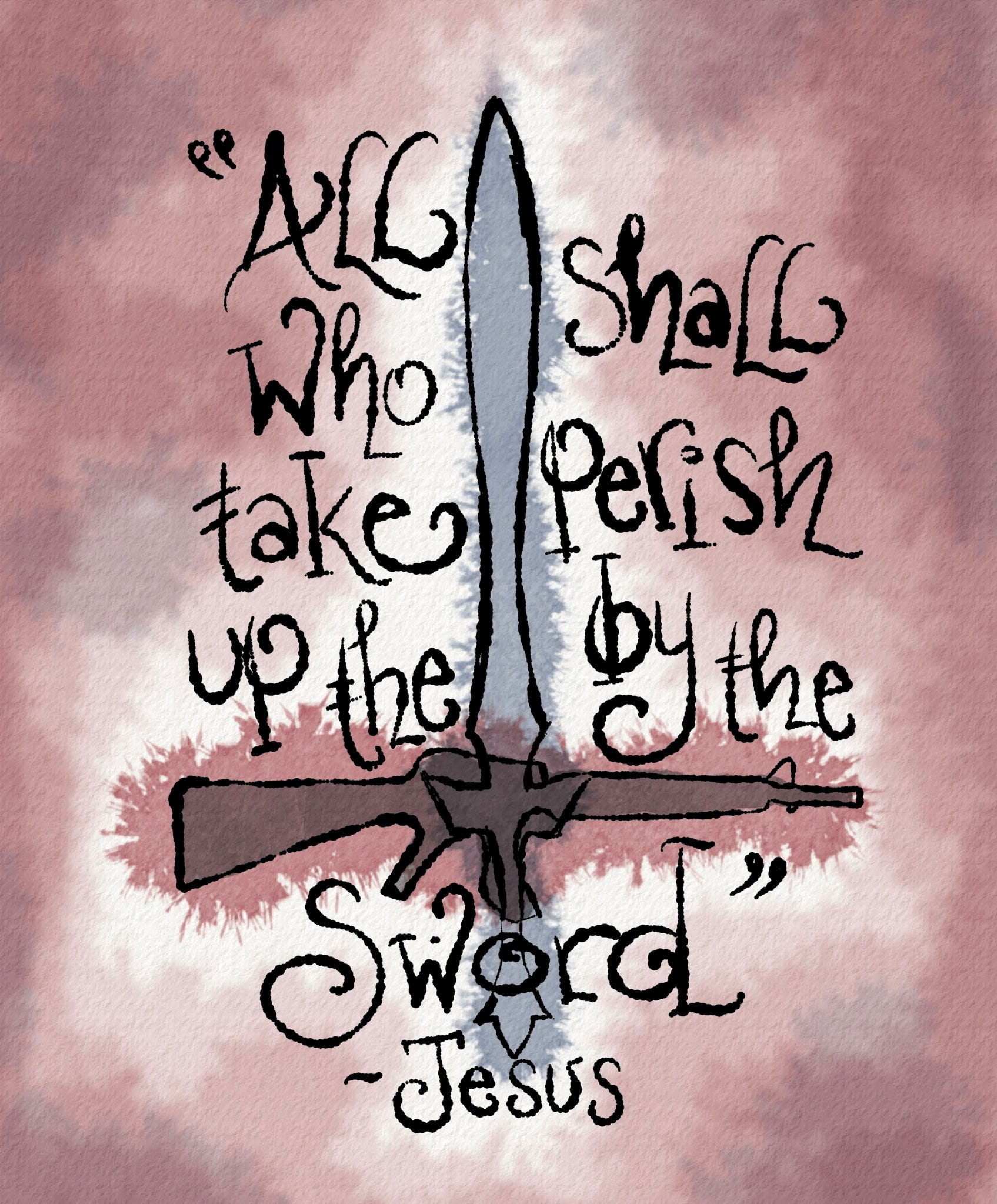
My above “swords” artwork is borne of a constellation of events, beginning with an all-too-common occurrence here in the South—mystifying behavior from the Catholics that guided my formation and influenced my decision to pursue Catholic art as a vocation. A fellow Catholic mom told me: “So proud of our graduating kiddo who has decided to join the Marines!” I was shaken.
I grew up right outside Washington, D.C., surrounded by military families, including many among our close-knit evangelical church community. Even then, the cognitive dissonance disturbed me—how could followers of Jesus be active military? That nagging question resurfaced in the days leading up to Palm Sunday, this time close to home among devout Catholics here in Texas, and at a point when the US had entered this profoundly unjust war with Iran.
I’m not a podcast person, but through another constellation of connected events—my first time messaging with an art customer in Sweden—from where my dad immigrated—who mentioned a podcast on the spiritual life, I queued up a few episodes on a college road trip with my eldest. One episode highlighted how scriptures we’ve read and heard over (and over) can catch our eye (ear) in a fresh way if we’re tuned in.
Thus, at Palm Sunday Mass, I listened, my heart heavy with thoughts of Catholic teens enthusiastically marching off to war, to the readings I’ve heard countless times. And this one verse from that very long Gospel rang loudly in my ears: “All who take up the sword, shall perish by the sword.” Did this verse resonate as deeply with this fellow Catholic mom? My heart was breaking in so many ways.
Thus, my art. To share with you, in this beloved community of ridiculous pacifists, to further build and encourage our community. To share online, that other Catholics and Christians and all those who view Jesus even as just a wise rabbi might ponder his words and their wisdom.
So, even in these dark days, be encouraged. You are not alone. We are not alone. This issue brings more voices to this same conversation: John Barwick recounts initial lessons from his volunteering at St. Joe’s:
So, what does it take to stand up in the name of hope against an ever-present onslaught of systematized, digitized, capitalized annihilation? The answer seems to be finding other people to do it with.
I’m so grateful to have found this community of Catholic Workers, readers, and justice seekers, too!
Louise Zwick shares Liberation wisdom gleaned from Pope Leo XIV, Hans Urs Von Balthasar, Oscar Romero, Gustavo Gutierrez, and Jon Sobrino, summarizing that “The freedom we have been given is a great gift to create alternatives in the culture. Alternatives to institutions and bureaucracies which inhibit vocation and destiny…” How beautiful to know that others recognize, value, and are engaged in this work.
Tiny specks of brightness continue to appear within this gently spreading web of light. The full accounting is beyond the breadth of this editorial open, but is weaving its way into and through new authors, and books, and saints, and conversations—and other new drawings, leading to more connections (and future editorial opens…) Light, connecting us in dark days. So very glad you’re able to join us for this issue.
Monica

FEATURED
CW Reads: Texas Jesus and the Reconstruction of the Social Order
On Thursday, CW Reads featured the writing of Louise Zwick, from the Houston Catholic Worker. She wrote about the unfortunate similarities between our day and the founding of the Catholic Worker. She writes:
It was the Great Depression when the Catholic Worker movement began. The poor, the homeless, including new immigrant families, struggled even to survive. Threats against various groups and threats of war resounded in the world.
It is striking to note the similarities in our time to that of the Depression. Dorothy Day wrote of the Robber Barons and contrasted their lives of extreme wealth with the lives of the poor. The “one percent” of wealthy and powerful today are the Robber Barons of yesterday. The contrasts in what is available to the average or poor person with that of the oligarchs are more than notable; the injustice of the economy is staggering. As during the Depression, even some young college graduates cannot find jobs.
The historical perspective does not help us to accept, but perhaps to perceive, the implication of a world in which there are few funds to feed poor children and a lack of a desire to build an economy that will bring relief to struggling families, but billions are available to carry out massive deportations of people of color, and wage wars around the world.
In the face of current devastating realities, the serious question is how can the Gospel enter more into our lives and our culture today? What can we do when the patterns of our everyday lives often have little to do with the Gospel, when even those who have little are held captive by consumerism and materialism?
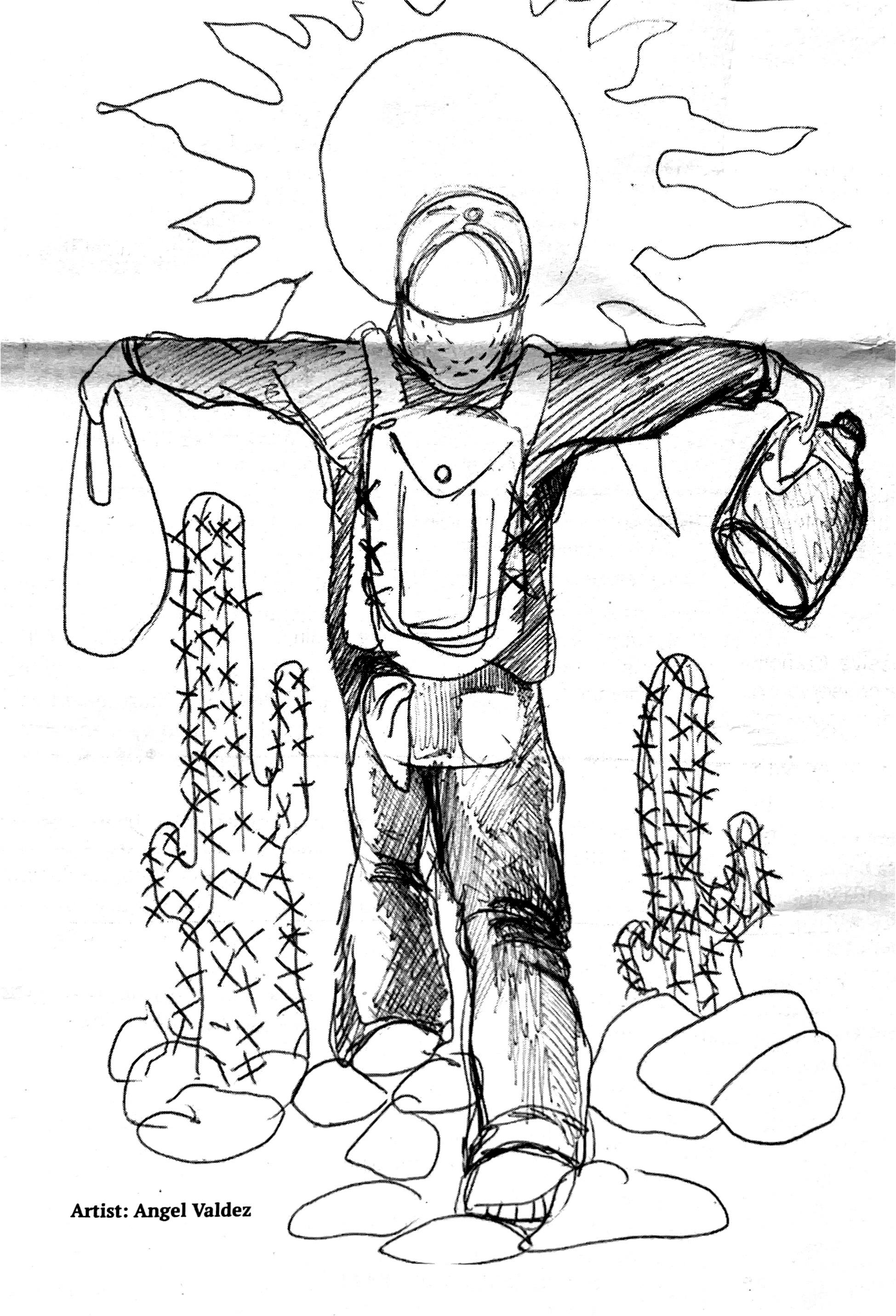
Thursday’s post also featured Herman Sutter’s poem “Texas Jesus”:
Texas Jesus
walks across borders
bootless and bare
footed, face brown as leather,He walks from Brownsville to
Amarillo on bruised heels
and blistering toes,carrying with Him
His only tools: rough
hands and a will to walk,El Paso to Beaumont, leaving
footprints everywhere.
Have you seen Him?
Read the full piece here
CW Reads: What Did I Learn at the Catholic Worker?
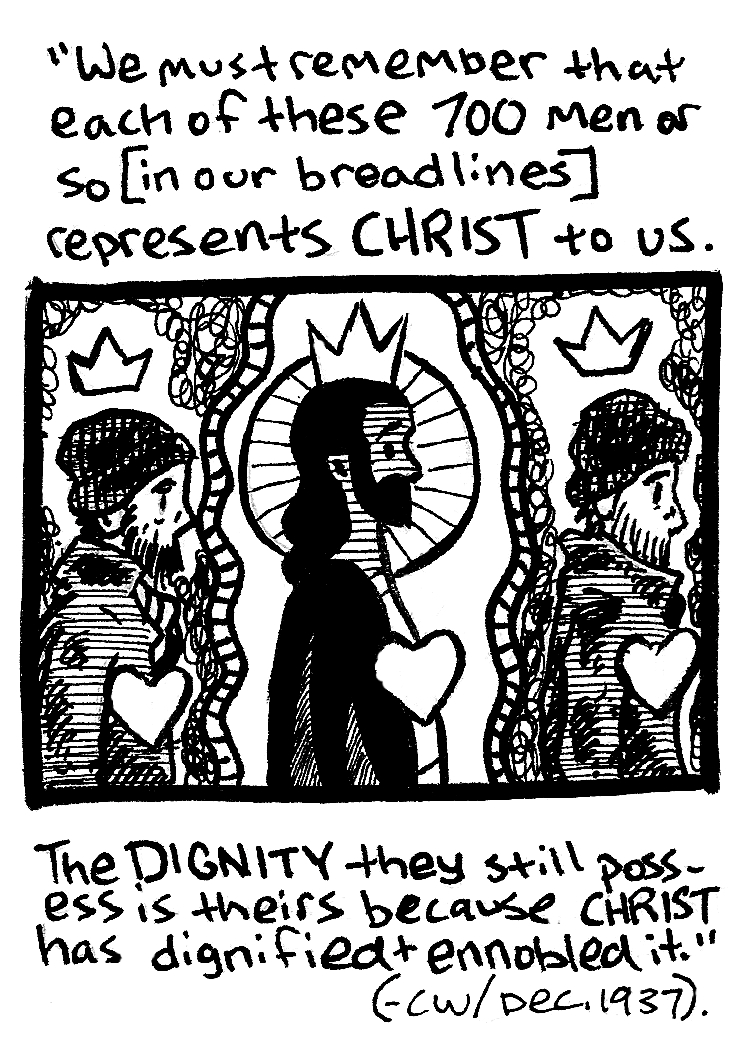
John Barwick, a recent volunteer at St. Joseph’s House of Hospitality, shared his reflections on his time at the Catholic Worker in The Catholic Worker, republished on Friday’s CW Reads:
The folks at St. Joe’s showed me love from the moment I got there. They told a lot of stories. They yelled at me sometimes. They made good soup. They gave me a place to stay, and an education on what it means to be a Catholic Worker. Peter Maurin said it well in an Easy Essay:
“Unemployed college graduates cannot be indoctrinated without first being fed, as well as clothed, as well as sheltered. Houses of Hospitality for unemployed college graduates are a pressing need.”
Am I indoctrinated? Well, who’s to say? I went to St. Joe’s to learn about the Catholic Worker lifestyle, not to stay there forever. My two-month stint flew by without my ever feeling like I scratched the surface of what it means to dedicate one’s life to voluntary poverty and performing the Corporal Works of Mercy. Life at St. Joe’s takes some time for an outsider to adjust to.
Find out what John learned here.
COMMUNITY NEWS & NEWSLETTERS
Introducing “Miramiguoa” New Journal From Ozark Foothills Farm
The Ozark Foothills Catholic Worker Farm in Catawissa, Missouri, has launched the first issue of their house journal, Miramiguoa. Inside, the editors note its origins:
Miramiguoa is a traditional name for what we currently call the Meramec River, in whose watershed we make our home. Early European settlers did not care to note the people whose tongue gave name to the river when they put it to paper. Much of that heritage, wisdom, and culture is now lost. The river, however, remains.
The name captures the ethos of their farm project, which seeks not to perpetuate the colonialism and rugged individualism of United States homesteading (growing in popularity over the past few years, they note), but rather, is rooted in more ancient, indigenous philosophies of interdependence—with one another, and with the land.
Inside, they note how the communal violence permeating our country is infiltrating even our houses of religion:
We kidnap people from our streets in the name of border security. Our leaders impose violence both on the foreign entities we target, soldier and civilian alike, as well as the young American men and women we recruit to fight those wars on our behalf. And through this framing, we convince ourselves to maintain a vast nuclear arsenal, the mere presence of which may be the greatest violence of all, since it represents our ability—and intent—to destroy all life on this planet several times over. Should we be surprised that this outlook permeates our Church? Rather than standing as a bulwark against it, we find the shadow of violence in unexpected corners of Catholicism. We pray to St. Michael to “defend us in battle,” sometimes even in the middle of Mass. Echoes of Christian Nationalism resound in our petitions, in our rosary prayer groups, and occasionally in our homilies. The Knights of Columbus, using the language and imagery of warfare, carry weapons into the sanctuary.
Instead, they propose a new prayer to St. Michael the Archangel. Read it here.
Peace Walk in Holy Week
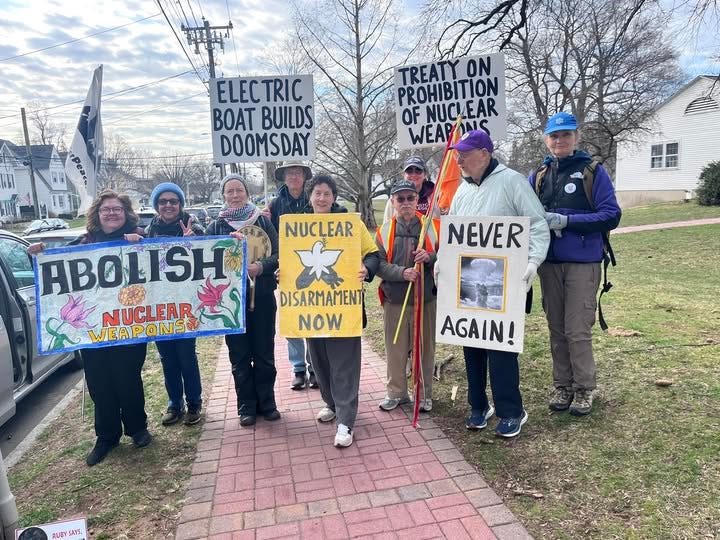
People from the Hartford Catholic Worker participated in a peace walk from New Haven to New London during Holy Week. The Peace Walk was in solidarity with the Nevada Desert Experience Peace Walk occurring in Nevada as well as another Peace Walk happening in Ireland. Watch a video clip on the Hartford Catholic Worker Facebook page.
Good Friday Witness Condemns “Modern forms of crucifixion” at Pentagon
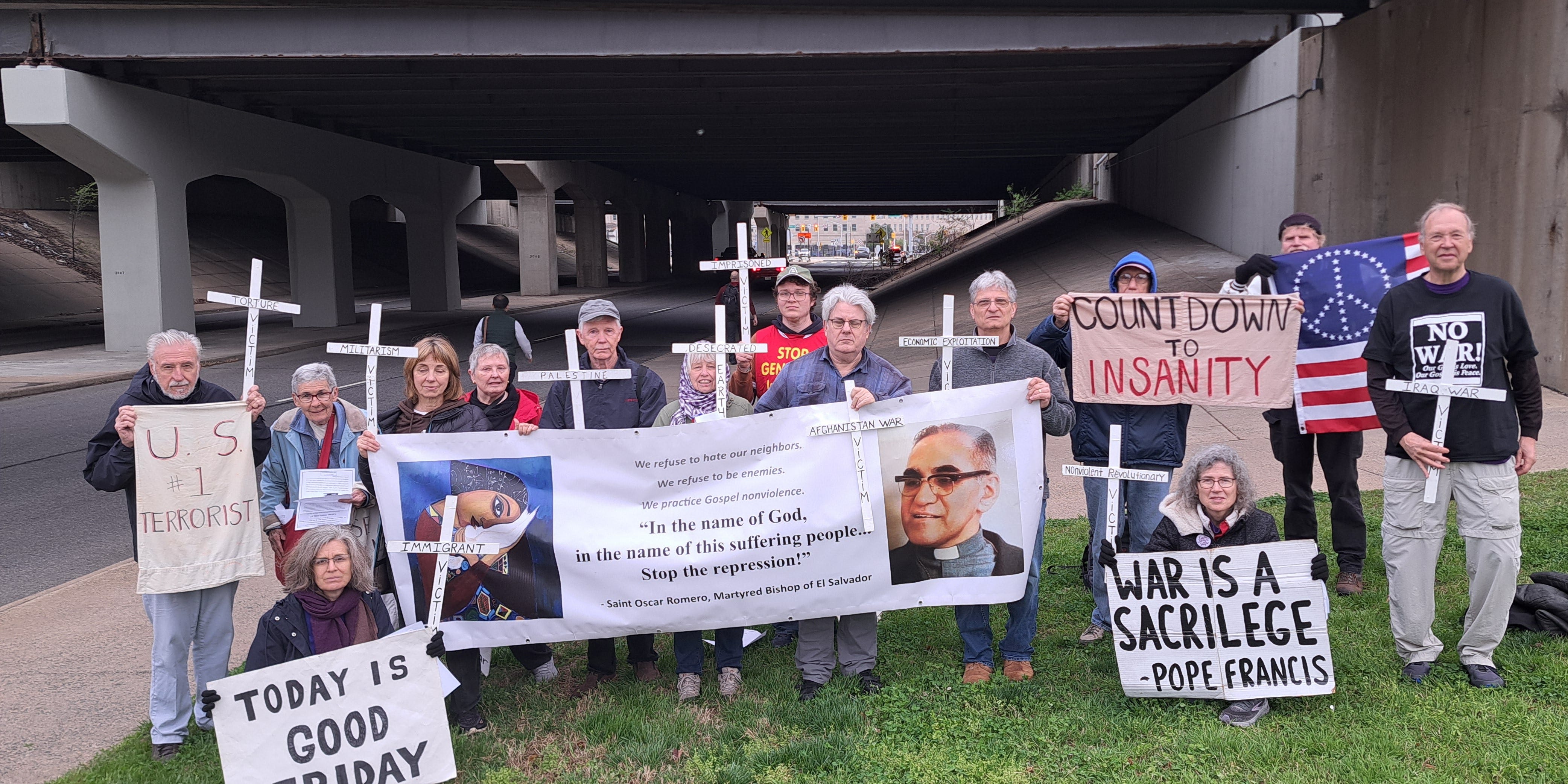
Art Laffin, of the Dorothy Day Catholic Worker in Washington, D.C., shared a report from the Good Friday morning prayer service at the Pentagon that he and roughly 15 other peacemakers attended.
Their prayer vigil, organized by members of Franciscan Action Network, Pax Christi and the Catholic Worker, commemorated Jesus’ passion and called “for an end to modern forms of crucifixion as vast numbers of God’s global family are crucified to a cross of war, militarism, racial hatred, discrimination and economic exploitation,” Laffin wrote in an email to Roundtable. “Our witness was yet another prayer of intercession at the center of warmaking on our planet. We carried in our hearts friends who are engaging in similar acts of public witness elsewhere and many from our extended communities who could not be with us physically but joined us in spirit for this witness,” he said.
“We held this witness near the corner of S. Fern St. and Army Navy Drive,” Laffin explained:
Since October 22, 2025, we’ve been banned from witnessing in the designated protest area near the Pentagon Metro entrance on the southeast side of the building. At this new location, we can hold signs and are still visible to some soldiers and workers going into the Pentagon, as well as to vehicular traffic. […]
As Pentagon police kept a watchful eye on us from a parked vehicle in the distance, and in proximity to some Pentagon workers and soldiers en route to the Pentagon as well as street traffic, we held crosses, signs and a large banner in honor of St. Oscar Romero.
The Personalist Shares Stories of Haitian Mutual Aid
The fourth issue of The Personalist, from St. Martin de Porres House in Harrisburg, Pennsylvania, features a cover story from Rev. Robenson Siquette, SJ, on meeting with Haitian families in Harrisburg during Lent. He spoke to fears, and to the deeper questions of human dignity the community was facing:
We spoke about TPS (Temporary Protected Status), which allows people to work legally and protects them from deportation for a designated period. I explained that TPS is an administrative and political measure. It does not define a person’s value. It says nothing about their dignity, their faith, their courage, or their story.
One TPS seeker, Wendy, shared the story of how she qualified for TPS. Volunteer Lisa Neuhauser writes about accompanying her to her USCIS interview and learning more of Wendy’s story:
She told them how she worked her own business selling used clothes in the marketplace. She then told the story of how one of Haiti's notorious gangs eventually infiltrated her town and began taking over, burning the marketplace, and intimidating residents. She narrated how she became part of a group of neighbors who tried to protect the village by building a makeshift fence around it. She and the others were eventually identified by gang members and began to be threatened. With the help of her brother, Wendy soon received parole to flee to the U.S. under Temporary Protected Status (TPS) parole.
Read the issue online and subscribe here.
CW IN THE MEDIA
New Zealand CW Farm Eschews Fossil Fuels, Works with Māori Leaders
Radio New Zealand’s Country Life program recently profiled the St. Francis Catholic Worker farm located in the Hokianga region of New Zealand’s North Island. The farm is operated by the Land family, who have farmed their six hectares for three generations using bullocks, Clydesdale horses, and hand labor, according to the profile.
Joseph Land, who grew up on the farm after his parents arrived in the 1970s inspired by village life in Fiji, frames the family’s approach in terms of both faith and practicality. “Once you start using fossil fuels, you actually use up more calories than you produce,” he told Radio New Zealand. “So eventually that’s not going to sustain the world.”
The farm grows olives, fruits, and vegetables; raises sheep and cows; makes its own butter; and relies heavily on its staple maize crop, which is ground by hand for bread and porridge.
The family’s Catholic faith and respect for Māori knowledge and values, Joseph said, infuse their way of farming and living. He has earned a place of respect within the local Māori community, where he is regarded as a prayer leader. The Land family acknowledges the ancestral authority of the local Māori clan over the territory where they farm, and says they remain there by the community’s goodwill — a stance that echoes the Catholic Worker understanding of stewardship over ownership.
Read the full story at Radio New Zealand.
Catholic Workers Call for Release of Neighbor from ICE Detention
Harrisburg Catholic Workers held a press conference for their friend Omar, who has been in ICE detention since October 27. Local outlet, PennLive reported on the press conference, held on Tuesday, in front of Harrisburg’s St. Patrick’s Cathedral:
Despite a judge siding with Vidauree Luis that his incarceration was unlawful, he has been denied bond and denied release twice by another judge.
“We can’t pay our bills without his job,” Ramirez said. “Friends and family have had to help us. We need my husband back home.”
She said that her husband had an appointment with doctors to check for bone cancer scheduled for the day after ICE took him. She choked up as she talked about her concerns that his health and safety was not being properly treated while he’s been in custody.
Read more press coverage at WITF, ABC27, Fox43
London Catholic Workers Join Massive Anti-Racism March
The London Catholic Worker was among more than 20 Christian organizations that joined a massive march through London on March 28, bearing witness against racism and the far-right weaponization of Christian identity, according to an article in The Tablet.
The Together Alliance march was organized in response to Tommy Robinson’s nationalist “Unite the Kingdom” rally in September and included Pax Christi, the Jesuit Refugee Service UK, Christian Climate Action, and Christians for a Welcoming Britain, among other faith group participating in the march.
The London Catholic Worker and Christian Climate Action announced plans to pray the Stations of the Cross on Holy Saturday outside what they described as “sites of violence” — oil and gas companies and arms manufacturers in central London.
Read the full story at The Tablet.
Art Laffin Quoted in Religion News Against War
Catholic Workers were among the faith leaders responding to President Donald Trump’s threats of war crimes this week: “A whole civilization will die tonight, never to be brought back again. I don’t want that to happen, but it probably will,” Trump wrote on his Truth Social account.
Art Laffin, a Catholic Worker and peace and nuclear disarmament activist, also condemned Trump’s remarks, calling them “an affront to God and a crime against humanity,” and he urged faith leaders to speak out against the threat of military action. [He] quoted Pope Leo’s Palm Sunday homily, calling for nonviolence, “Lay down your weapons! Remember that you are brothers and sisters!” he wrote.
Read the full article at Religion News here.
Story of “Buffalo Raiders” Draft Card Action Has CW Connections
As the Trump administration moves to streamline draft registration in anticipation of future conflicts, a newly published longform piece in The Atavist Magazine tells the story of a group of young, working-class Catholics who broke into federal draft board offices in 1971 to destroy draft cards. Inspired by the Berrigan brothers and the broader network of Catholic draft resistance, the group that came to be known as the Buffalo Raiders spent more than 24 hours hiding in a federal building before emerging — in their underwear, to muffle the sound of their movement — to pick locks and destroy files.
Five of the seven were arrested and were ultimately convicted — but Judge John Curtin, himself a Catholic from Buffalo, suspended their sentences, publicly praised their courage. In a remarkable courtroom moment, gallery members rose one by one to claim responsibility for the crime in a spontaneous Spartacus-style act of solidarity. The story includes several Catholic Worker connections; read the full story at The Atavist Magazine.
Robert Ellsberg on Dorothy in Fr. James Martin Podcast
Robert Ellsberg, former managing editor of The Catholic Worker newspaper and friend of Dorothy Day, appeared on Fr. James Martin’s “The Spiritual Life,” podcast to speak about the Catholic anarchism of Dorothy Day. Ellsberg shared the story of his own encounter with the Catholic Worker and how he ended up volunteering there and meeting Dorothy Day. Ellsberg spoke about her witness of holiness—her arrests, her passion for justice, and her care for the poor—but, he said, he saw her saintliness more clearly when he edited her diaries: “The substance of her spiritual life was in her daily encounters with other people,” Ellsberg said. He saw her practice of St. Thérèse of Lisieux’s “Little Way,” powerfully lived out in dying to ego, seeing Christ in the other, and practicing nonviolence in daily encounters. Listen to the full podcast here.
Martin Gugino, Peace Activist from Viral 2020 Video, Died Last Month
A local outlet reported the death of Martin Gugino, a peace activist, Catholic Worker, and native of upstate New York, in March. The outlet reported:
Martin Gugino, whose skull was cracked during an encounter with Buffalo police officers at a Black Lives Matter rally, died March 9 of natural causes … in Tampa, Florida. He was 81.
Martin was a member of Upstate Drone Action, which protested military drones at Hancock Air Base. Read more about his life online here.
Catholic Worker Lenten Practice Featured in NCR
Harrisburg Catholic Workers shared their Lenten practice of wearing fake “ankle monitors” with National Catholic Reporter, in solidarity with one of their South American asylum-seeking neighbors who has been wearing an ICE-mandated ankle monitor for four months. Roundtable’s Renée Roden wrote about the practice for Religion News Service last month. Nancy Fitzgerald writes about their friend’s experience:
Just a few weeks earlier, she’d broken her right ankle and now this added insult to injury. “It was terrible for me,” she told the National Catholic Reporter. “The monitor was very heavy and pulled on my leg, and it was difficult to sleep at night. It was hard to navigate stairs with a boot on one ankle and the monitor on the other. It even caused a rash on my skin.”
But the hardest part was the way people responded. “People at my work asked, ‘Do you have a criminal case?’ I would reply that it was for immigration, but they looked at me differently,” she said.
Read the full NCR story here.
Catholic Worker Farm Gathering Profiled
Agri-View recently interviewed Mike Miles (Anathoth Community Farm, Luck, Wisconsin) about February’s Catholic Worker Farm gathering.
Miles described the Anathoth community’s approach to farming as grounded in “the divine intent of creation and how ecological processes work.” The farm practices regenerative and organic agriculture, pasture-raising beef, pork, and chicken, and Miles describes his cattle as “soil engineers” whose purpose is to strengthen the microbiology beneath the pasture.
Read the full story at Agri-View.
MARK YOUR CALENDAR
Live Interview with Robert Ellsberg, Hosted by La Sagrada Familia Catholic Worker
Virtual—April 16, 2026, 7:30 p.m. ET
Duncan Hilton, co-founder of La Sagrada Familia Catholic Worker in Vermont, is interviewing Robert Ellsberg in a live Zoom webinar, about the second volume of his new book “Blessed Among Us.” Learn more and register here.
Faith and Resistance Retreat: Catholic Workers Return to Protest Nuclear Bomb Production in Kansas City
Kansas City — April 24-27, 2026
The Catholic Worker is returning to the Kansas City National Security Campus (KCNSC) for our annual Spring Resistance gathering. The KCNSC is where 80% of the electronic and mechanical parts for U.S. nuclear weapons are produced, including the triggering and guidance systems as part of the $2 trillion “Stockpile Stewardship and Management Plan.”
The danger of nuclear war has never been so imminent. In this time of global instability, the Kansas City National “Security” Campus is providing President Trump with “additional nuclear options” that would end life on this planet as we know it.
Join us for a weekend of prayer, education, discernment, celebration and mourning in preparation for acts of nonviolent direct action for the sake of life on Monday morning, April 27.
Contacts for more information: Henry Stoever, PeaceWorksKC, henrystoever@sbcglobal.net
See more at catholicworker.org here.
Thinking Christianly about Technology
St. Paul, Minn.—Saturday, April 18, 2026 8:30 a.m — 2:45 p.m.
Colin Miller of Maurin House, Minneapolis, Minnesota is hosting a conference, “Thinking Christianly about Technology” at Church of the Assumption in St. Paul, Minnesota. Conference organizers write:
Digital technology is coming to have an increasingly dominant place in our lives. How, as Christians, should we think about this? What effects do our phones have on ourselves and on the world? These three talks will address these issues from a non-technical, layman’s perspective, seeking a faith-informed view on our button-pushing existence.
Conference is free of charge and lunch will be provided. RSVP HERE.
Roundtable is a reader-supported publication. To receive new posts and support our work, consider becoming a free or paid subscriber.
Second Annual Anabaptist-Catholic Ecumenical Dialogue
Lancaster, Penn.—Saturday, April 25, 2026
The Rechabite Catholic Worker invites all to the second annual Anabaptist-Catholic Ecumenical dialogue.
Location: Hall at St. Mary’s Catholic Church
119 S Prince St, Lancaster, PA 17603
From 10 am to 1 pm, Saturday, April 25.
Building on previous international dialogues like Called Together To Be Peacemakers and last year’s inaugural annual meeting, this second annual gathering of Anabaptists and Catholics in Lancaster is aimed to mutually understand our painful history, learn from each other’s traditions of living for the Kingdom, and continue to debate our doctrinal differences as we pray together for the visible reunion of all Christians in the one Faith (Eph 4:5), as Jesus desires (John 17:21). This year our theme will be sharing stories of martyrdom in our traditions.
WORDS FROM THE ELDERS
“The Works of Mercy”
by Dorothy Day, from the May, 1946 issue of The Catholic Worker
We emphasize in this issue of The Catholic Worker the works of mercy. It is our program, our rule of life. The works of mercy include enlightening the ignorant, counseling the doubtful, comforting the afflicted, and to aid in this work we have retreats at Maryfarm, Easton, Pa. We just finished one Easter week, and now the next will begin Monday, May 20, and we would like everyone to be there Sunday, May 19th. Easton is only two hours out of New York, and two hours by bus from Philadelphia. These retreats in silence are joyful experiences, a beginning of heaven, a practicing for heaven.
Elsewhere in this issue there is a chapter from a novel begun 14 years ago, interrupted by these occupations and taken up again now to be finished and published by this fall, we hope, by ourselves. We also intend to publish Peter Maurin’s easy essays again, with a foreword by Monsignor Ligutti, also to be ready this fall.
The chapter from the novel is printed in this issue both because it is a bit of Peter Maurin, our theorist and founder, and it is a bit of the retreat. While we talk of the destitution in Europe and the rest of the world, we are not unmindful of the shanty towns we have all over our own country both during the depression of the thirties, and even now. Much as we detest destitution, we must never cease talking about the love of poverty which was in all the words of our Lord. If we really leave all things to Him, He will care for us because we are of more value than the sparrow, this we know. And in addition to the material help we have to give, we must also give the spiritual help, we must comfort the afflicted by telling them the meaning of suffering, the golden coin hidden in suffering, and this we cannot do unless we ourselves try daily, and forever to practice that poverty we are always talking about. There is no solution without this practice of poverty. We can never be done talking about it, this need of stripping ourselves, or allowing ourselves to be deprived of this world’s goods. We can never give enough, considering the state of the world today.
Read Dorothy’s full column here.