

Bringing Christmas into Context
Inside: Nativity scenes across the country lament ICE; Catholic Workers report on the context of occupation in Palestine, as Palestinians prepare to celebrate Christmas; St. Louis CW on Dilexi Te
Emmanuel in ICE Detention
This Advent, several churches throughout the country have highlighted the horrific abuses that the federal government has inflicted on immigrants in their nativity scenes. Although some church leaders have denounced these depictions as overly political, church communities have insisted that their annual homage to the most famous refugee family of all time must acknowledge what refugees are facing in the United States.
In Dedham, Massachusetts, southwest of Boston, St. Susanna Catholic Church featured a blue and white sign over its creche, declaring “ICE was here.” In Dallas, Texas, a Methodist church displayed its nativity scene on the church steps in a cage. In Claremont, California, another Methodist church displayed Mary, Joseph, and Jesus in separate detention fences—a reference to the family separations caused by ICE detention. ProPublica counted more than 600 children being held in federal detention because of immigration raids. ProPublica noted the average length of stay for a minor in federal detention is six months. “Most of the cases we found involve teenagers, and many of them had been in the United States for years. In those cases, being sent to a shelter can mean separation not only from their families but from schools, friends, churches, doctors and daily routines.”
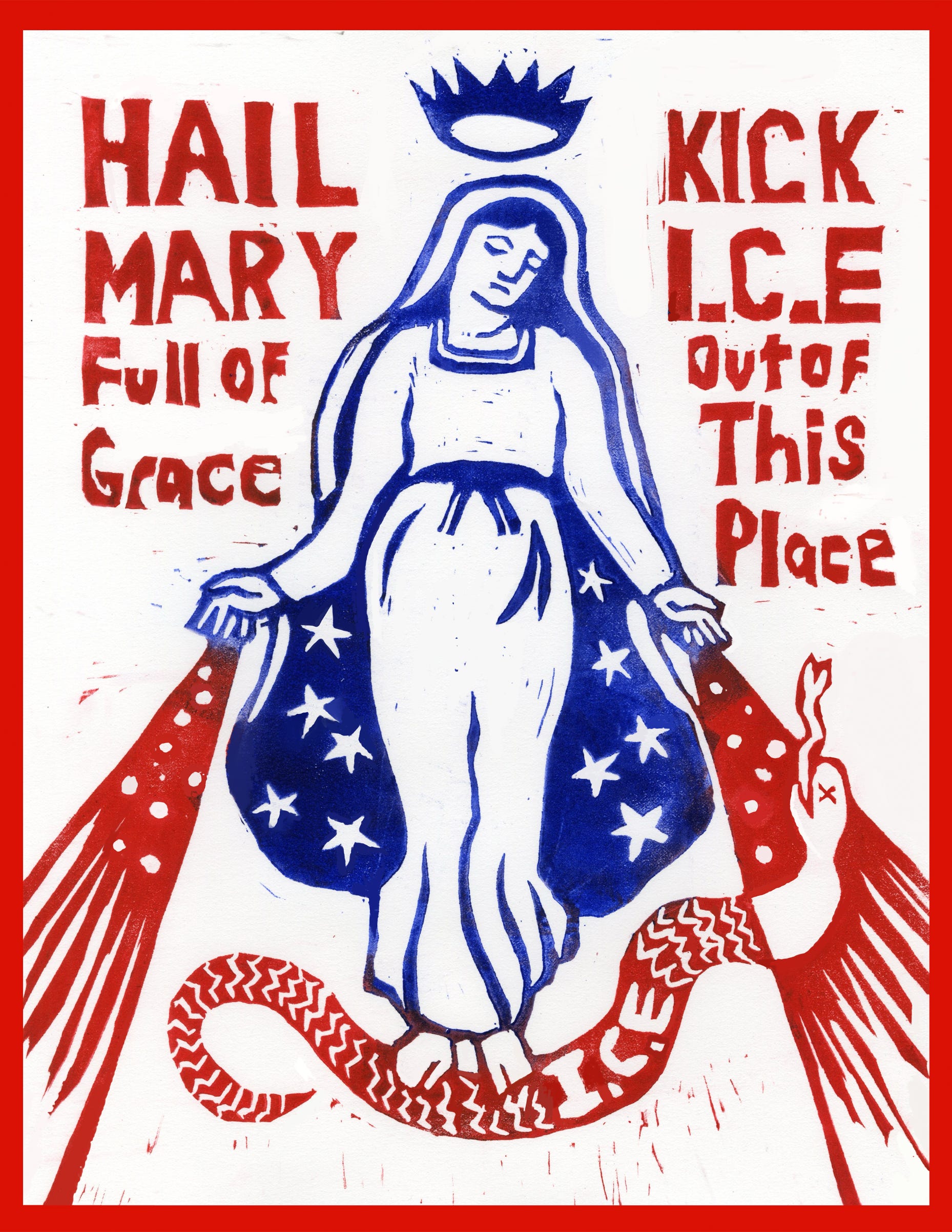
Libby Kercher, an illustrator and student at Moore College of Art & Design in Philadelphia, created the print that provides our cover art. Libby provided the following artist statement to Roundtable:
“Hail Mary, full of grace—kick ICE out of this place” is a print born directly from weekly witness outside the ICE office in Philadelphia, where a small community of women gather every Friday at 3 p.m. to pray the rosary and stand in solidarity with migrants and their families.
At that hour, mirroring the time of Christ’s crucifixion, we replace the sorrowful mysteries with recent news articles documenting abuse and mistreatment of migrants, letting anger, grief, and love for those harmed shape our prayer and our presence on the sidewalk outside the field office.
The slogan at the heart of this piece came to me during a prayer session with this group, while I was reciting the Hail Mary with the group.
I created the design in the Moore College of Art & Design print studio, the school where I am completing my final year as an Illustration student.
This allowed me to translate this public act of faith into a visual form that could travel beyond that one block in Philadelphia for that one hour.
As in my previous work, I try to use Catholic imagery not only as a symbol of piety, but also as an active tool to confront nationalism, queerphobia, and the ways Christianity is weaponized against the very people it commands us to welcome.
This print for me is both a prayer and a demand: an insistence that any honest devotion to Mary and to Christ must stand with migrants, reject the cruelty of detention, and make that resistance visible in the streets and in the living body of Christ.
After several conversations with refugees in his parish, Rev. Stephen Josoma, pastor of St. Susanna in Dedham, told WBUR Boston that he made the decision to incorporate their pains into the Christmas creche. He said he wanted to highlight “the context Christmas is happening in this year,” in a year of “brutal” immigration policies that threaten the legal status of many immigrants and refugees.
Below, Catholic Workers share more of the context of Christmas. Brenna Cussen Anglada and Brian Terrell share the context of their recent witnesses in Palestine. They detail the occupation under which Palestinian Christians are celebrating Christmas: the same condition of occupation into which Emmanuel was born 2,025 years ago. And Mary Ellen Mitchell and Christopher Duçot share the contexts of joy and pain that mark the lives of their Catholic Worker communities and those of their neighbors, the living Body of Christ they live among.
peace,
Renée
Editor’s Note: We will take a break from our regular publishing schedule for the final two weeks of the year. We will be sharing some highlights of the year for the next two Sundays newsletters, in special “Best of Roundtable” issues.
We will resume our regularly scheduled CW Reads and news roundups with our January 11 issue.
Thank you for reading Roundtable! We hope the Christmas and holiday seasons is filled with light and hope for you and yours.

FEATURED
CW Reads: Mary Ellen Mitchell on finding “Gaudete” in Gloomy Weather
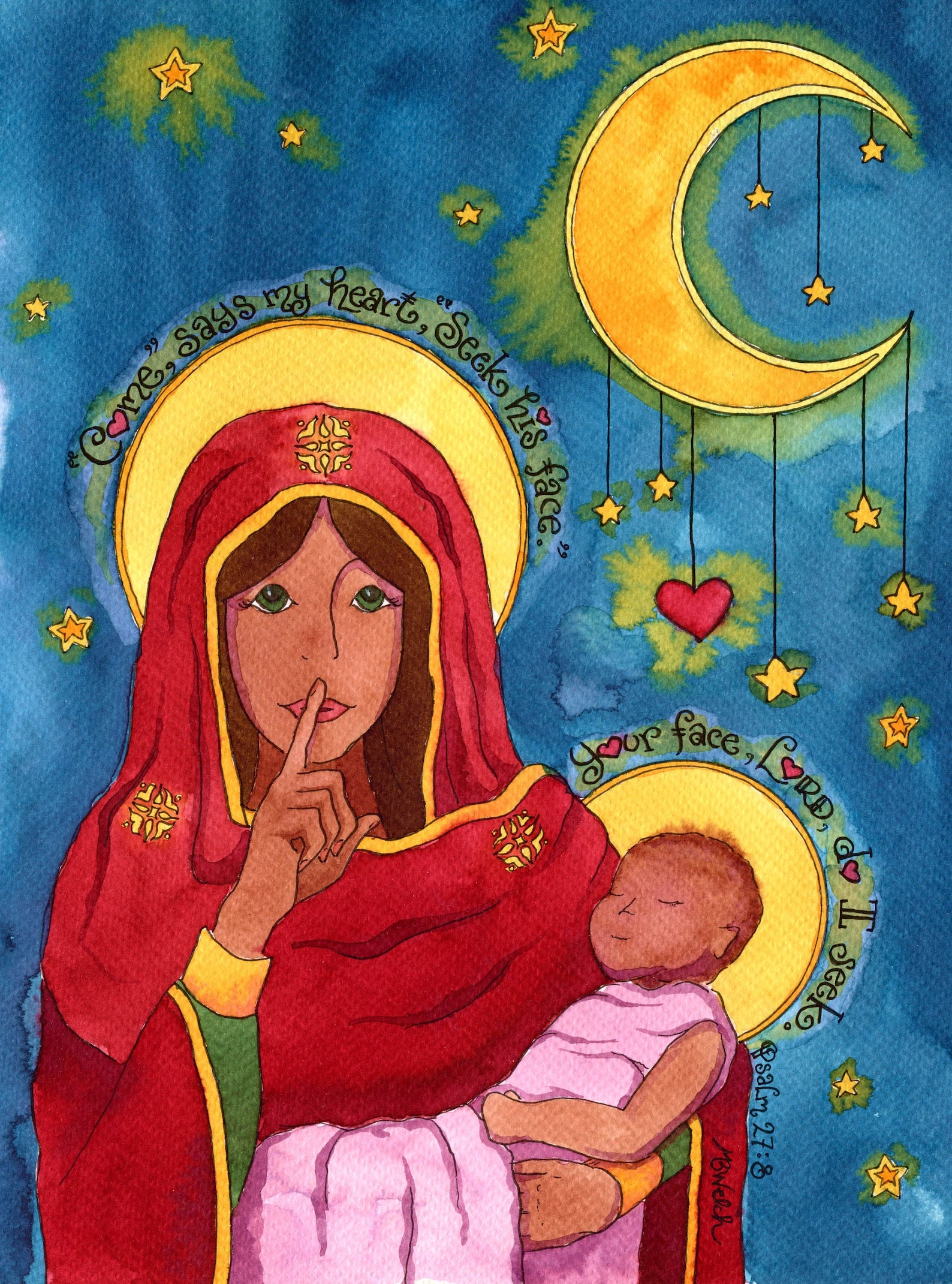
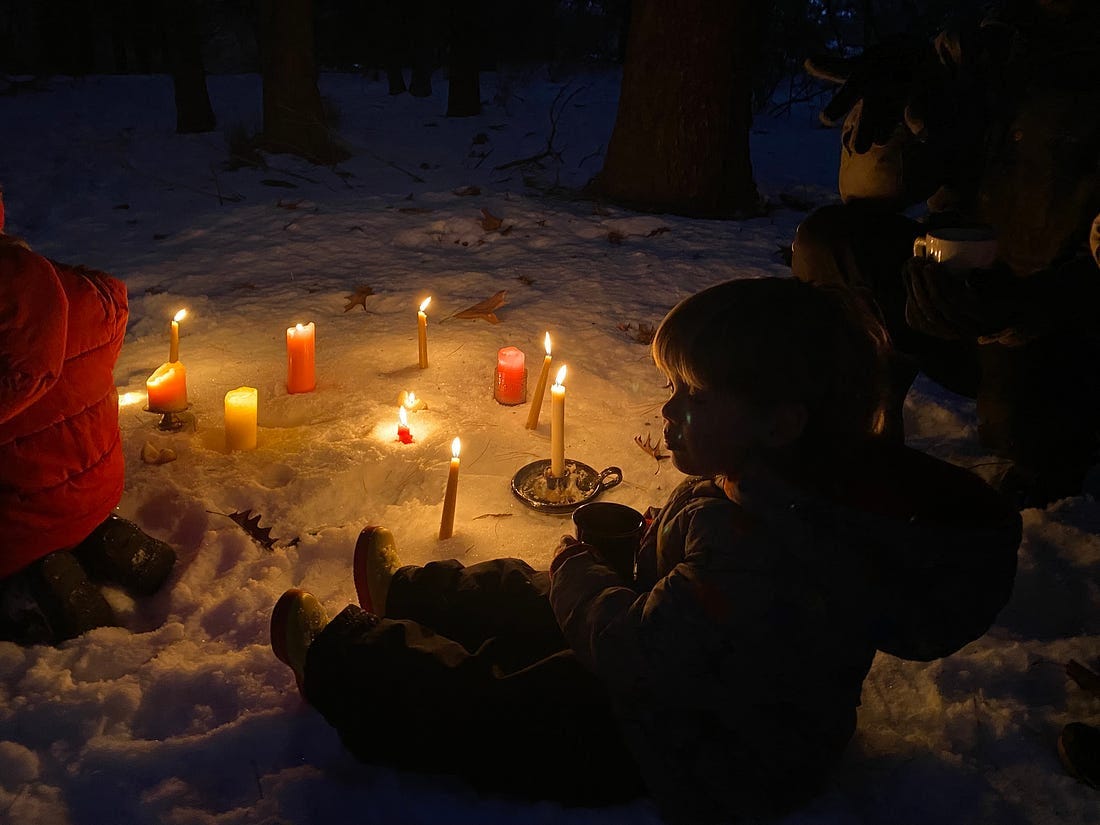
Mary Ellen Mitchell of Lydia’s House in Cincinnati, Ohio, wrote a short reflection in this week’s CW Reads about an unexpected Gaudete Sunday in the midst of a snowstorm:
As the snow started falling last Saturday, I had the constricting feeling of Covid PTSD, namely because it would necessitate making a call about whether to cancel something important. I hate cancelling for snow in Cincinnati, recognizing that any reasonable person from Michigan or Minnesota laughs at us all. The cancellations start days before because of predictions of snow, or sometimes cold, and I feel like we’re making life decisions with Teen Vogue’s horoscope as our guide: be alert for a mysterious white flurry that has a high chance of adding chaos to your plans.
The snowstorm reminded Mitchell of some larger storms circling her own life and wreaking havoc in our nation:
How did God know that the awful things of one Saturday, or this entire fall, would be so awful and the good things so good, that the best response would be to sit with real people and light a pink candle on December 14?
The candle is lit regardless of what happened in staffing last week or if an eviction is filed next week. Joy can come in the morning, no matter the events of the night before, and sometimes because of them. I took solace on the snow-filled Sunday dawn knowing that, because the priests live by the Church, the candles would get lit even if we only see them on YouTube, even if we don’t see them at all, even if not a single parishioner braves the snow.
More importantly, Christmas will come even if Advent is more marked by heavy waiting than by hope, more by tenant tragedy than new babies, more by cancer than by vigor. When they are lit, the response is “Come, Lord Jesus.”
Read Mary Ellen’s full reflection here.
CW Reads: Christopher Duçot on God’s Kin’dom Breaking In
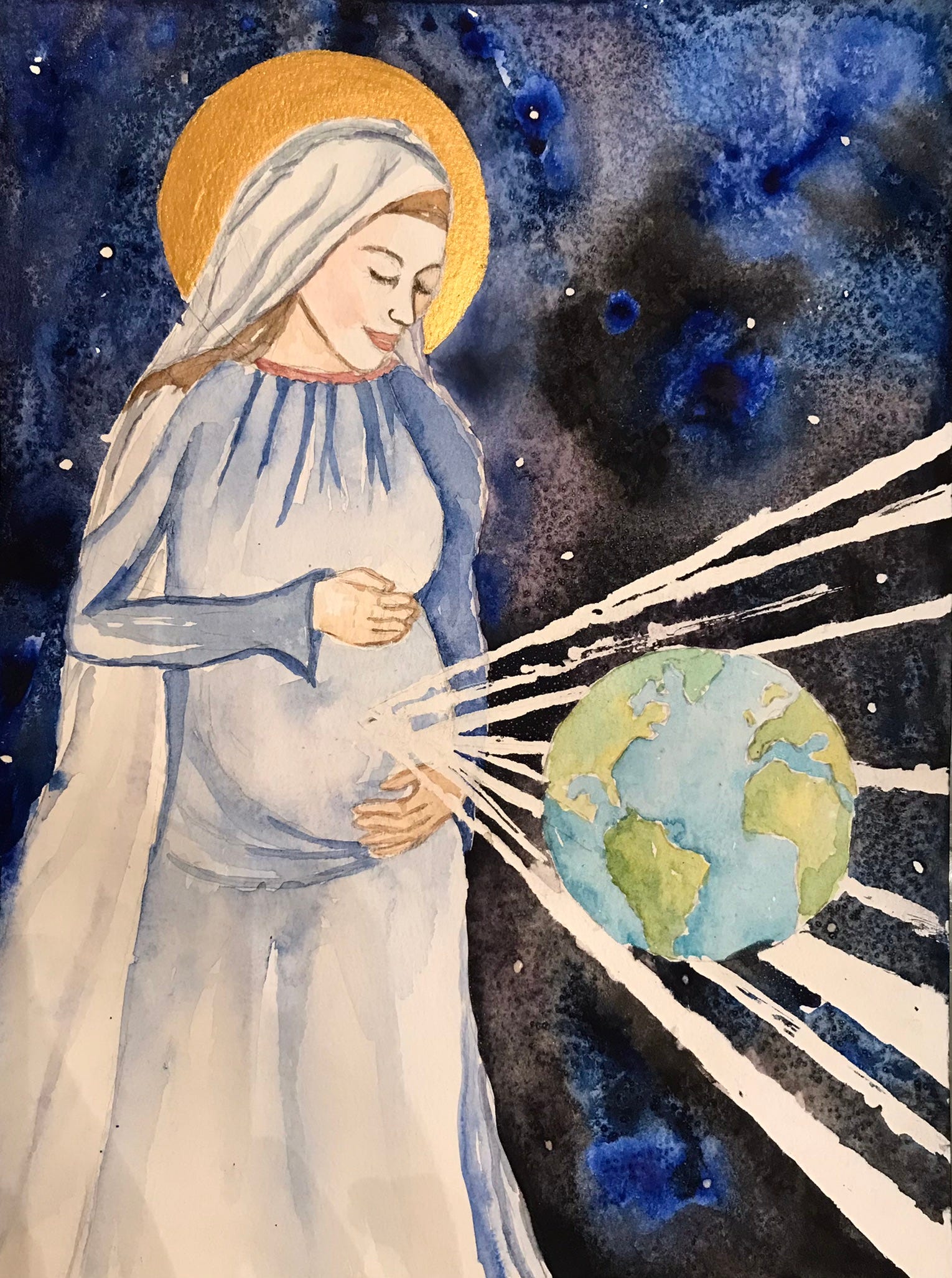
In Thursday’s CW Reads, we shared Christopher Duçot’s poignant essay on a “typical” day at the Hartford Catholic Worker, lamenting the “not-yet-ness” of God’s kin’dom of justice and celebrating the glimpses of good that herald its presence already among us:
While Jackie was cooking, Angel came to the door. Angel’s mom Andrea, a dear woman we wrote about recently, died three weeks ago. Angel was not well. Lil’ Jose let him in… and then skedaddled! (a teachable moment…). Jackie made him lunch and consoled him. After smooching Jackie and greeting Angel I headed up to the third-floor office. I was Andrea’s representative payee responsible for managing her disability check. With her passing I need to log into my Social Security account to let them know—but with the government closed I was, again, denied access to the SSA’s website. I moved on to writing thank-you emails to online donors before opening the postal mail. We had several good ole fashioned paper check donations that I logged.
There was a letter from Connecticut Natural Gas asking me to provide proof that Sedrick (I’m also his representative payee) is still disabled and impoverished so that he can continue receiving heat at a discount. There were two assistance forms completed by neighbors seeking help with their rent, lights, and heat. One family was also requesting help for the commissary account of an incarcerated loved one, the other family asked for prayers for the Ramirez family. Can you please pray for them.
We will be able to help these families but not until January when the second installment of an incredibly generous grant from the Sisters of Mercy arrives. While I was writing to these families to see if they have shut off notices or if they can wait until January, I heard Brian chewing Jackie’s ear. He meandered over from the Purple House with more mail for me. Today’s mail included a $10,000 check from the archdiocese for us to buy food with. Thank God! Thank-you!
While the president is petitioning the Supreme Court to withhold food stamps from the 1 in 8 Americans who depend on them, the Church, the people of God, are stepping up to share that portion of God’s bounty we’ve been entrusted with.
The “not yetness” of the God’s reign lingers when we cling to the values of this world: greed, acquisitiveness, rugged individualism, violence, selfishness, patriarchy, white supremacy and any other justification for human domination.
The “alreadyness” of God’s reign is further revealed when we love, share, forgive, seek and celebrate community, cherish and protect Creation, embrace nonviolence, and infuse the institutions of our society with an egalitarian spirit. To live in hope is participate in the struggle to further reveal the “alreadyness” of God’s kin’dom with confidence that tomorrow can be better than today.
Read Christopher’s full story here.
CW Reads: St. Louis Catholic Worker Discusses Dilexi Te
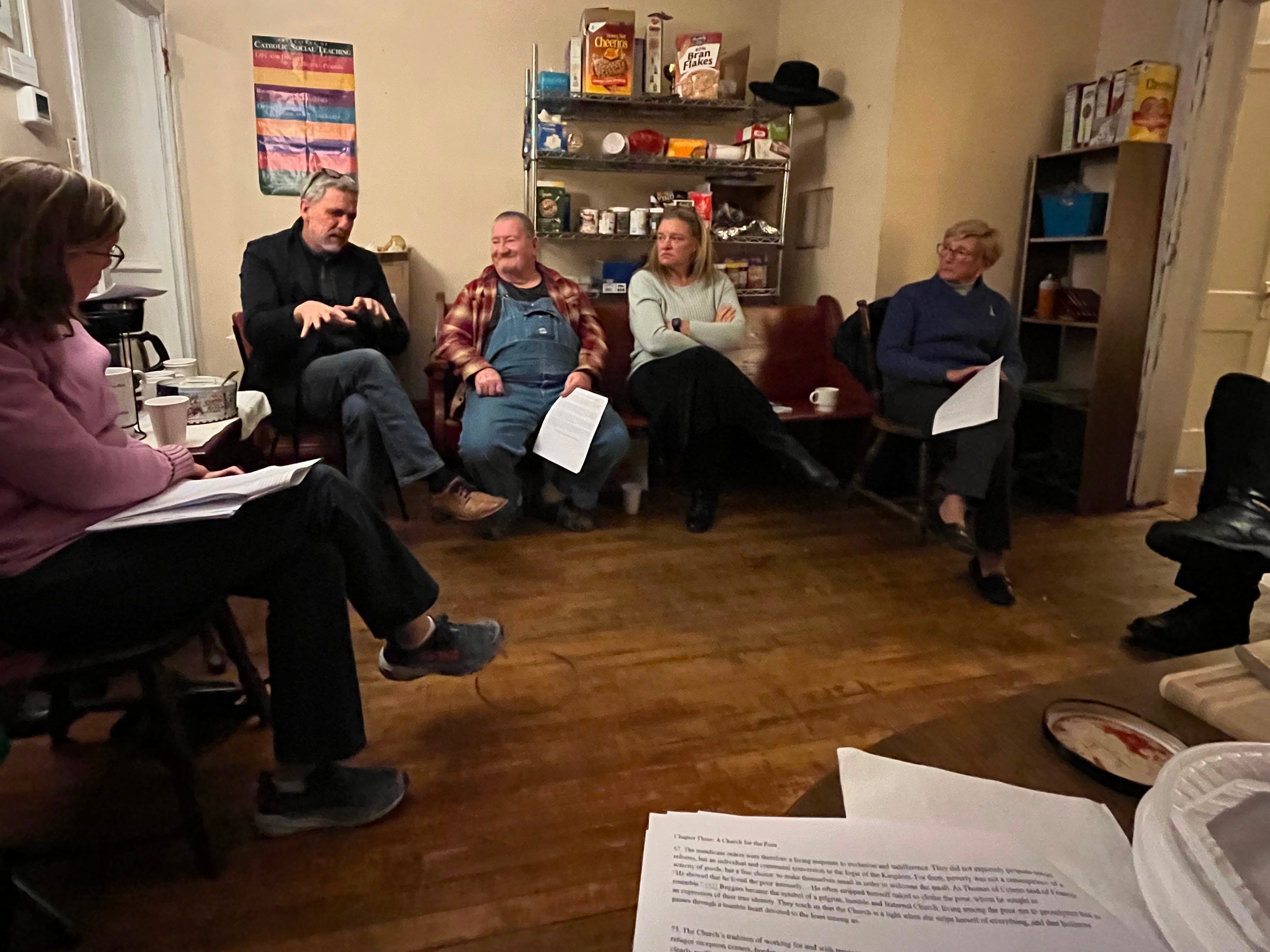
Several Catholic Worker communities held discussions on Pope Leo XIV’s apostolic exhortation “Dilexi Te” this fall. One, Lydia’s House, even created a short summary of the document for interested readers short on time. Chrissy Kirchhoefer shares her takeaways from reading “Dilexi Te” during a Clarification of Thought at the St. Louis Catholic Worker.
The St. Louis Catholic Worker community hosted this discussion on the ninth World Day of the Poor, this past November. She writes about her inspiration from fellow community members:
In this letter, Pope Leo challenged us: “We need to be increasingly committed to resolving the structural causes of poverty...I can only state once more that inequality “is the root of social ills” (DT, §94).
One of the biggest quandaries that emerged from our conversations was how to encounter those we see in need on our streets, at highway intersections holding signs to attest to their needs. We acknowledged the tension we feel in taking right action, motivated by the challenge of “Dilexi Te” and our humanness of not knowing the “right action.”
How do we humanely respond?
Lindsey Myers, a member of the St. Louis Catholic Worker, inspired and motivated me when we were speaking with a group hosted by the St. Louis Archdiocese. This group was interested in issues of poverty and human rights concerns, and so invited us to come speak about the Catholic Worker. Lindsey encouraged that group—and us—to ask the people we encounter on the streets their names, ask what they need, and try to be prepared for those needs by having some basic needs on hand like water, snacks, and socks.
Read Chrissy’s full report here.
CW Reads: The “Little Town of Bethlehem” Resists Settler Encroachment

On Friday’s CW Reads, we shared Brenna Cussen Anglada’s blog post on hope and resistance in Bethlehem. Brenna had traveled to Palestine nearly two decades before, before Israel erected a separation barrier—also called an apartheid wall—in the West Bank. Brenna reflects on the monumental psychic weight of the wall:
The bus dropped us off at the Bethlehem checkpoint - a mechanized opening through the monstrous, 30-foot-high wall that snakes in and around the entire West Bank. It was quite easy to get through, as we discovered, as the Israeli army encourages Palestinians to leave Jerusalem. (It is much harder to return.)
As it had been over 16 years since I had last passed through this way, I was somewhat stunned to be confronted once again with the overwhelming force of this wall that enforces and concretizes apartheid rule. The experience of walking in the shadow of this imposing symbol of oppression overwhelmed us all; one of our team members who had lived and studied in Bethlehem 25 years ago broke down and wept with grief and anger as she witnessed the destruction of this place so beloved to her.
And yet, hope resists and persists in the life of families who continue to love, laugh, and forge their lives in the shadow of the wall:
The Zougbhi family witnessed to us what hope and resistance look like in the face of indescribable oppression. Despite the attacks on their marriage, their employment, and their physical well being (all direct attempts by the Israeli government to make life untenable in Palestine), they have chosen to stay rooted in their family, the community they love, and the land to which they belong - all while offering incredible hospitality to those of us who traveled to stand with them.
Part of the Zoughbi family’s resistance includes a contagious sense of humor. Lookout over the domineering wall just a few hundred feet from their home Zoughbi Zoughbi pointed out a growing Walnut Tree. “We hope the roots of this Walnut tree grow so large,” he said with a smile, “that it will break the ‘wall’ into nuts.”
Read Brenna’s full reflection here.
Special Report: Advent Under Occupation Brings Christmas into Context
Brian Terrell reports from a recent Catholic Worker delegation to Palestine:
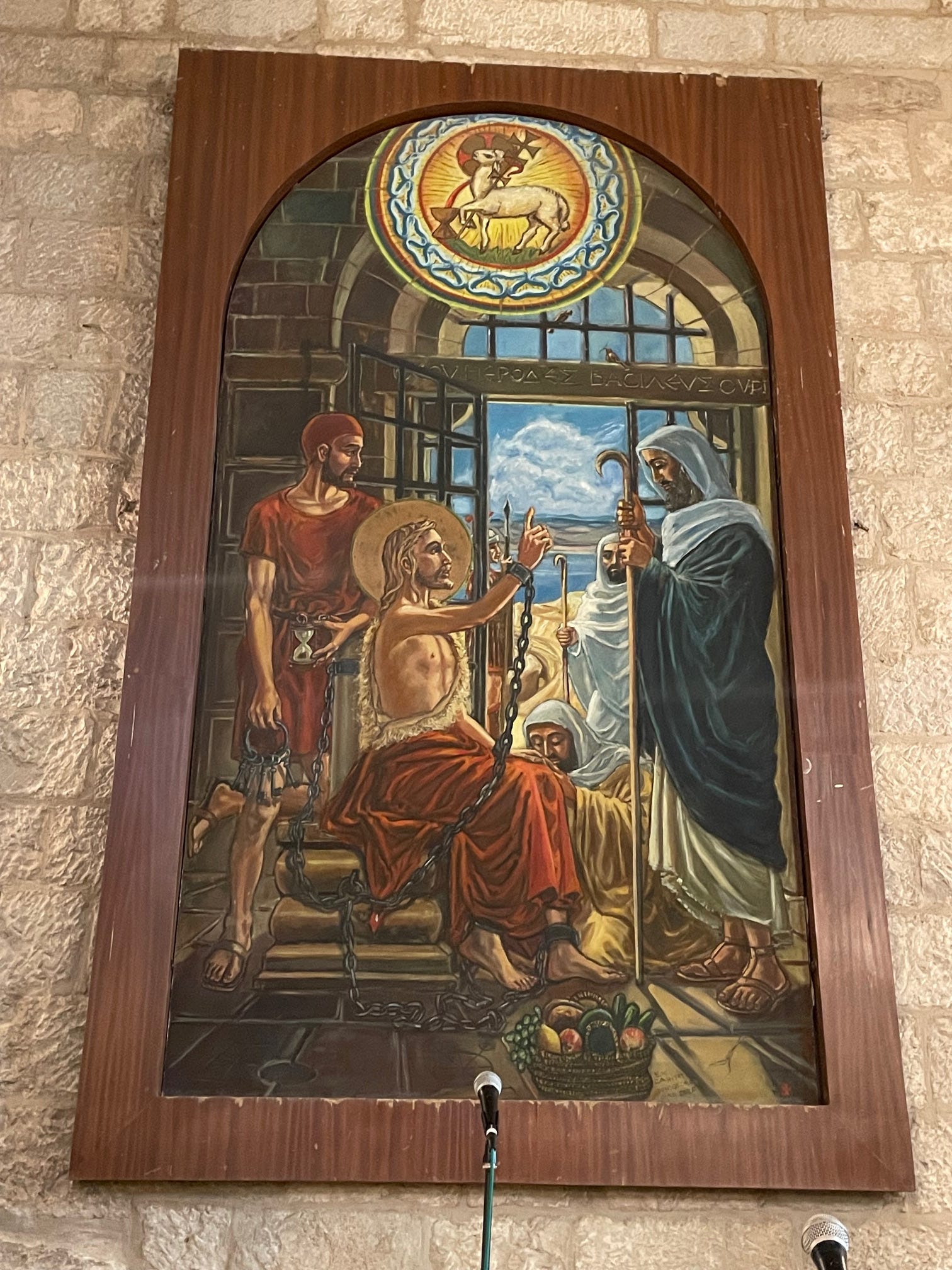
I got home to the farm on Thursday, returning from an Advent delegation of Catholic Workers to Palestine. On Wednesday, when our group was across the Jordan in the town of Madaba, I went by myself to the Shrine of the Beheading of Saint John the Baptist there. In the shrine I saw this mural of John in prison conferring with his disciples: “When John heard in prison of the works of the Messiah, he sent his disciples to him with this question, ‘Are you the one who is to come, or should we look for another?’” Matthew 11:2,3.
Just a few days before, we visited the town of Taybeh in the West Bank. Taybeh is the last community in Palestine with an entirely Christian population and had experienced atrocious acts of violence from Israeli settlers in the days before our arrival. Taybeh, known as Ephraim in the Bible, was where Jesus hid out after his raising of Lazarus from the dead offended the authorities: “So from that day on they planned to kill him. So Jesus no longer walked about in public among the Jews, but he left for the region near the desert, to a town called Ephraim, and there he remained with his disciples.” John 11:53-54
Jim Douglas’ new book, “Martyrs to the Unspeakable, the Assassinations of JFK, Malcolm, Martin, and RFK” has been informing my meditations of late. The prophetic visions of peace and social transformation of John and of Jesus in their time were an affront to those in power, just as it was later in the time of JFK, Malcolm, Martin, and RFK and so, like these four men two millennia later, John and Jesus were marked for elimination.
The Church of the Nativity in Bethlehem, another stop on our journey, remembers the slaughter of the innocent children of the town as it celebrates the birth of Jesus: “When Herod realized that he had been deceived by the magi, he became furious. He ordered the massacre of all the boys in Bethlehem and its vicinity two years old and under, in accordance with the time he had ascertained from the magi.” Matthew 2:16
In Advent of this year 2025, especially, it is essential to recognize the context of Jesus’ life and ministry. Jesus was born under occupation and, with his parents, was made a refugee as a child. His ministry in Galilee, Judea, Samaria and the Greek-speaking towns was always a step ahead of the occupation and it was the occupiers and their collaborators who finally put Jesus to death on a cross.
Forgetting this context, I think, is how Christians through the centuries have found themselves siding with the occupiers and against the refugees, the landless farmers, the poor, those whose side Jesus always took.
COMMUNITY NEWS & NEWSLETTERS
London Catholic Worker’s Christmas Issue: Protest and Presence
“Today I visited one of our guests in a detention centre,” writes Moya Barnett in the latest issue of the London Catholic Worker newsletter. “When asked if he had family in the UK, he said: ‘I have family, not biological, but you are my family.’”
The community’s Christmas issue opens with Francisco Leitão’s essay “Herod Built, Jesus Wept,” which explores the contrast between two kings and two kingdoms through the lens of archaeology and biblical prophecy. In “God is a Starving Man,” Thomas Frost responds to the far right’s appropriation of Christian imagery at recent rallies by examining Pope Leo’s encyclical Dilexi Te and its emphasis on the poor as the “very flesh of Christ.”
In “To Shout or Not to Shout?”, Naomi Orrell wonders about the role of Christians in protest spaces: “Are we there to bring peace, to simply be there as a sign of solidarity with the cause, making the other protesters know that we are ‘not like other Christians’? Is it enough for us to just be there, or do we also need to be willing to be disruptive?”
That’s just a taste of the issue; we hope to bring you many of these articles in future editions of CW Reads, but if you can’t wait, you can read the full issue at the London Catholic Worker website.
Lydia’s House Newsletter Highlights Surprises of Each Day
The Christ child isn’t the only baby that Lydia’s House is welcoming this year. The Cincinnati, Ohio, community shared in a year-end update that, in addition to their new daycare program, “We have 2 newborn baby girls and a 1-year-old boy, a 2-year-old boy, a 3-year-old boy and two 4-year-old girls in house.” They ask for gently used clothes—kids grow fast! Their winter newsletter shares house updates from Mary Ellen Mitchell and two reflections from community members. Gabi Kim, Community Ministry Fellow, writes about the urgency of the political moment in the loss of healthcare and the deaths that will ensue, the SNAP cuts, and the families going undernourished. Gabi finds comfort, she writes, in the witness of Jesus and in the words of Dilexi Te. What’s required, she has learned, is “more than s’mores, but collective action.” Theresa Triebsees, a German post-graduate on a gap year, writes about her favorite part of Lydia’s House: “the contrasts—between the silent hours in the shelter and the lively hours at the daycare and dinner, the variety in each day. The contrast of the clear structure of each week and the unknown of which surprises each day will hold.” Read the full newsletter here.
St. Francis Catholic Worker House Issues Year-End Appeal
St. Francis Catholic Worker in Chicago is seeking support for its hospitality ministry, which serves hundreds of visitors weekly—mostly from nearby tent encampments—with warm meals, showers, rest, and community during the bitter cold. Monthly operations cost approximately $3,000. The house has completed major improvements, including a new roof, boiler, and electrical rewiring, and plans 2026 projects totaling over $23,000. Donations support daily hospitality and infrastructure for this 50-year ministry. Contribute at francishousechicago.org or mail checks to 4652 N Kenmore Ave., Chicago, IL 60640. Donations are not tax-deductible. Learn more on their website here.
Dandelion House Year-End Message
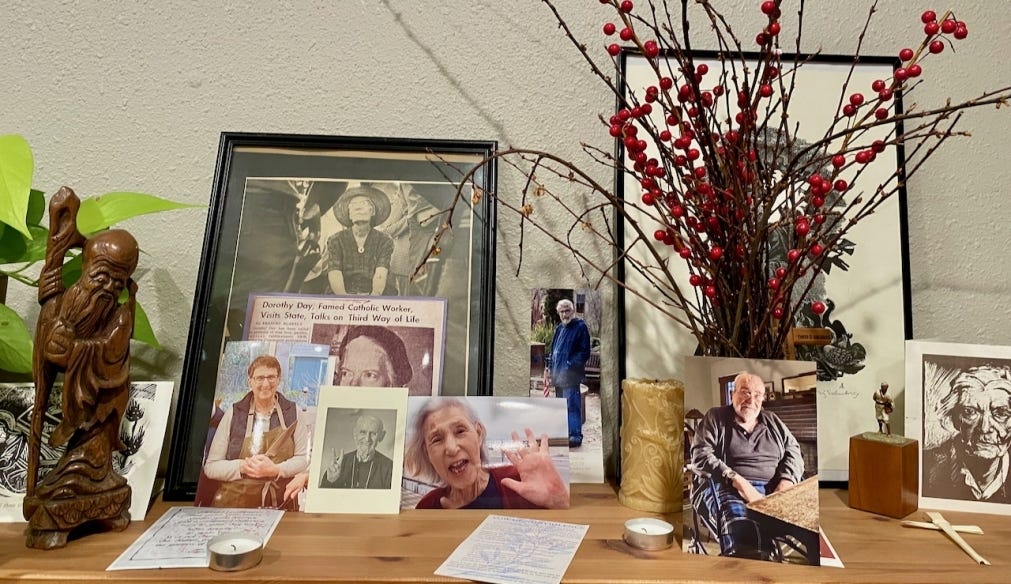
In Dandelion’s House year-end message, the Dandelion House community invites friends and readers to soup suppers, a cosmic liturgy of the feminine divine, and shines the spotlight on John, one of their regular volunteers. Fumi Tosu also commemorates his grandmother, who died this summer at the age of 100. He writes about the intertwined memories of departed ancestors in our lives:
The deep wisdom of the dual feasts of All Saints and All Souls is the recognition that we are all beings-in-progress, and yet, we somehow all belong. Recognizing the shadows our ancestors carry does not have to take away from honoring them and their spirits. And so, at Dandelion House we have our own Ancestor Altar, honoring our personal ancestors as well as our forbearers in the movement for social justice, each of them flawed, each of them holy. On our altar are famous saints like Francis of Assisi and Catholic Worker co-founder Dorothy Day. They share space with less famous but no less holy friends like Father Louie Vitale, the Franciscan priest and activist, Father Robert Hale, a Camoldalese monk who introduced first Julian and Lisa to each other, then me to Julian (and through Julian, Lisa), Barbara Limandri, a meal prep volunteer and our “Chopper-in-Chief,” and, the latest member of our Cloud of Witnesses, Terry Voss, dear friend and mystic.
Read more on Dandelion House’s website here.
John Paul II CW Farm Seeks Community Member
The John Paul II Catholic Worker Farm (Kansas City, Missouri) is “seeking to welcome and support a Worker-Scholar for a short or medium-term stay (and potentially beyond) to help grow food for people in need and to participate in the life of our community.” See the full volunteer listing at CatholicWorker.org.
Roundtable Editor on Voluntary Poverty at Francesco Collaborative Summit
Roundtable co-editor Renée Roden explored the paradox of voluntary poverty at November’s Francesco Collaborative Summit. Speaking in her role as a member of the St. Martin de Porres Catholic Worker (Harrisburg, Pennsylvania), she drew on Peter Maurin’s image of Lady Poverty as beautiful rather than ugly. Roden acknowledged the tension Dorothy Day named: “I abhor poverty and I prescribe it,” and offered some practical advice for beginning to practice voluntary poverty, including reimagining giving as investment in God’s economy, where supporting neighbors’ rent, work permits, and family needs creates the heaven we seek on earth. Watch her 11-minute talk on the Francesco Collaborative YouTube channel or read the address here.
CW IN THE MEDIA
Why a Family of Eight Loves Living Next Door to Catholic Workers
Kathleen Kollman Birch interviews the Wilsons, who live in the “Catholic Worker neighborhood” of South St. Joseph Street near St. Peter Claver Catholic Worker. They shared with Birch how they came to volunteer at St. Peter Claver Catholic Worker in their graduate studies and why they felt drawn to stay involved with the community when they began raising children. Birch writes:
Remaining involved in the community while raising their son required creativity and support from both guests and Worker staff.
“We were trying to take shifts at Our Lady of the Road while figuring out nap schedules, etc.,” Ben recalls. “I’d be serving at the Drop and I’d try to put our son down for a nap in the storage closet, and could never figure out how to rig the baby monitor up in the laundry room, so Al, one of the long-time Worker guests, would help me. He could always figure it out.”
Ben said he soon began to realize that, while complicated, bringing little kids to the Worker had some unforeseen benefits.
“I would walk up to a guest wearing our baby and couldn’t figure out why they were beaming at me. And then I’d realize, oh, it’s not me, it’s my child. I came to sense that having our son there had a pacifying effect as well…sometimes tempers would flare, and guests would end up calming down just because there was a baby there.”
Read more of the interview on Kathleen’s substack below:

A Catholic Worker Response to the “Techno-Capitalism” and Slavery of the Digital Age
Colin Miller of Maurin House wrote about South Korean philosopher Byung Chul Han as a link between the theory of Peter Maurin and Dorothy Day and the context of the digital age’s “totalization” of the drudgery of the factory. Except, in techno-capitalism, the product is not for the common good, but we produce “ourselves,” our “brand.”
In response, Miller writes, Han’s writing offers a critique at the heart of Catholic Worker practice: the idea that there is more to life than self-preservation. “In this way, Day’s and Maurin’s prodigal lives made them walking rejections of the order of totalized work.”
Many veterans of Catholic Worker houses may roll their eyes or chuckle at memories of the inefficiencies or annoyances of communal living. But, in light of this philosophy, the radical commitment to personal encounter against hte idea that time is a limited commodity to sell gives the clunky systems of communal life a theological gloss. Inefficiency, inactivity, is a protest against the all-consuming mandate of capitalism to produce, organize, tame, profit. Miller writes:
Catholic Workers’ lives are fundamentally playful and celebratory, heedless of the conventional (factory) wisdom of maximizing control, optimizing efficiency, and living by holding off death.
Here’s to de-optimizing. Read more at Commonweal.
Family Inspired by Dorothy Day Practices Hospitality
John Miller interviewed the Kelso family of Atlanta, Georgia, for a profile in America Magazine. The Kelsos, along with their young children, have offered “Christ room” hospitality in their home for folks experiencing homelessness. Miller noted the impact that Dorothy Day had on Kelso’s practice of Catholicism when he converted a few years ago. “It was when I became Catholic that my thinking about social justice really flourished,” Kelso told Miller. Miller notes that he was inspired by “Dorothy Day, the 20th-century journalist turned Catholic activist whom the Vatican has proclaimed a Servant of God, a stepping stone to sainthood.” Read more about the Kelso family’s radical hospitality here.
Army Issues Report on Pipeline Jessica Reznicek Fought
The Army Corps of Engineers has issued the environmental impact statement for the Dakota Access Pipeline, recommending its use. The Des Moines Register writes that the statement “is a win for pipeline operator Energy Transfer and a step closer to the end of a lengthy court battle between the company and nearby Native American tribes, who have been fighting for the pipeline's closure.” The full article can be found on the Des Moines Register site here. The Register notes that Jessica Reznicek, a Catholic Worker, spent eight years in jail protesting the pipeline. Jessica wrote a message for the most recent issue of the Via Pacis. You can read her full message online here.
Monica Cornell Remembered in Plough
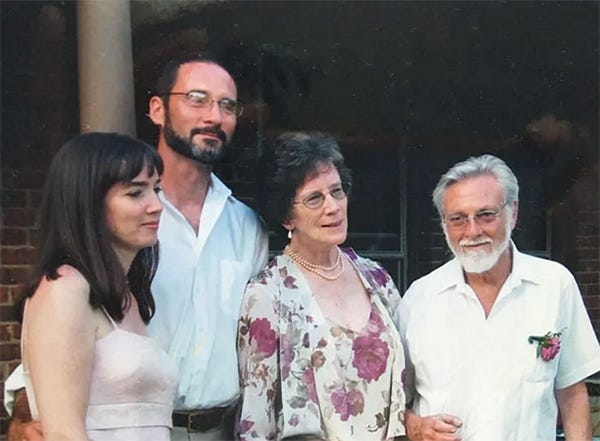
Corretta Thomson, a member of the Bruderhof’s Fox Hill community, wrote a short tribute to Monica Cornell in the latest issue of Plough. The Bruderhof were neighbors of the Cornells in New York’s Hudson Valley. Thomson honors the Cornell’s communal spirit in her memorial. She wrote:
Besides sustaining a welcoming home, Monica joined local religious networks, attended farmers markets, and spent as much time as possible with her five grandchildren. Her spiritual life centered around devotional reading and the lives and feast days of the saints. Tom served as a deacon in their local parish until shortly before his death in 2022. He read daily from scripture, prayed the Psalms, and maintained a lively interest in doctrinal interpretations and current events.
Read the full commemoration here.
MARK YOUR CALENDAR
Today: Winona Catholic Worker Roundtable on Community Agriculture
The Winona Catholic Worker will host a roundtable discussion on Sunday, December 21, from 3 p.m. to 4:30 p.m at the Winona Catholic Worker 832 West Broadway. Dale Hadler, drawing on his discussions with farmers and the insights of Scott Chaskey’s book “Soil and Spirit,” will facilitate a discussion on community-supported agriculture (CSA) with attendees. Come join for a clarification of thought and robust discussion. Refreshments are provided.
Read more details here.
Stop the Slaughter! Pray and Protest at Offutt Air Force Base, December 26 & 27
Nebraska—Come join in prayer and protest to celebrate Holy Innocents and all the innocent lives lost to war in Omaha, Nebraska December 26 and 27. A group will gather on Friday, December 26, at St John’s Church Hall on the Creighton University campus, 2500 California Plaza in Omaha, at 6 p.m. Dinner and sleeping space on the floor are available. On Saturday, December 27, at 8 a.m., Mass will be celebrated in the hall and the group will travel to the base’s gate at 902 Nelson Drive, at roughly 10 a.m.
Brian Terrell writes:
To commemorate “Holy Innocents Day,” when many Christians remember the children of Bethlehem slaughtered by King Herod who perceived the birth of Jesus as a security threat, there will be a nonviolent and prayerful witness at Offutt Air Force Base at Belleville, near Omaha, Nebraska.
Offutt is home to the U.S. Strategic Command’s Command and Control Facility, the bunker from which the destruction of the planet might be orchestrated. The Command and Control Facility is responsible to “aid the president’s nuclear response decision-making process, and, if called upon, deliver a decisive response in all domains.”
For more information call Jim Murphy at 608-617-7379
Craft retreat at Strangers and Guests Catholic Worker
Iowa—Thursday through Monday, January 15 to 19, Strangers and Guests Catholic Worker in Maloy, Iowa, is hosting a craft retreat. Betsy writes: “We are hoping to be able to gather folks who share a vision of life where work can be creative and good, enriching our living and sharing and celebrating. Our craft retreats can only happen through people’s willingness to teach, learn and share our food and skills, stories, music and prayer.” Since space is limited, reach out to Betsy Keenan of Strangers and Guests Catholic Worker at keenanweaving@yahoo.com if interested.
Little Platte CW Launches Annual Participatory Theater Celebration

Platteville, Wisconsin—The Little Platte Catholic Worker is launching its first annual participatory theatrical celebration, “Brigid’s Flame: A Tale of Spring,” on January 30-31, 2026, at Steeple Square in Dubuque, Iowa. The event, a project of the newly formed Groundswell Joy Collective (co-founded by Little Platter Allyson and community member Mary Kay), will feature community singing, dancing, storytelling, silence, and puppetry drawing on Irish myth and tradition to welcome spring, the growing light, and the feminine connection to land.
The celebration, led by community song leader Lyndsey Scott and supported by an Iowa Arts Council grant, incorporates what organizers call the “four universal healing salves” of song, story, dance, and silence. The entire Little Platte farm community is involved in the production, which includes puppet-making and art/set creation workdays held at the farm. Organizers hope to make Brigid’s Flame an annual community touchstone. Tickets are now on sale. Read the entire event announcement at Little Platte Catholic Worker’s Substack newsletter.
WORDS FROM THE ELDERS
“The Meaning of Poverty”
by Dorothy Day, from Reflections During Advent (1966), Week Two, published in a book edition by Ave Maria Press.
It is not right to justify oneself, but we tried to point out how ungrateful we would be to God and to our benefactors if we did not, by hard work and care, improve what we had received in the way of land and house. The very men who had come to get help had stayed to give help and had made the place what it was by constant hard labor.
But the poor, it seems, have no right to beauty, to order. Poverty must be squalor, filth, ugliness, to be esteemed as poverty. But this is destitution, and it was usually from such destitution that our family had come “up in the world.” Our visitors did not recognize true poverty–voluntary poverty now-offered up by these men for the sake of their fellows . . . a poverty on the part of students and volunteers as well as men from the Bowery, which meant no money to jingle in the pocket, no wages, having to ask for tobacco, to wear the clothes which “came in”and to have no privacy, which is the greatest desire, the greatest need of all.
[…]
For a long while, poverty was denied–we just did not have any, according to popular belief, in our affluent society. Many a time I was queried by students, “where is poverty? We do not have any around this prosperous Middle West, for instance.” I was asked this question at Notre Dame, when I spoke there, and to show that there was poverty Julian Pleasants and Norrie Merdzinski, both Notre Dame students, started a House of Hospitality in the off-bounds section of South Bend. With the help of Fr. Putz and Fr. Mathis they kept it going during their student years, to care for unemployed and unemployable men off the road. The same question was asked me in Green Bay, Wisconsin, and I could only point out that where there was a Good Shepherd home for delinquent girls, and an Indian reservation, and a prison and a public ward in the hospital, there was poverty. You could always find poverty at the public dump, or in the prison or hospital. All founders of religious orders and societies searched out poverty.
It was Michael Harrington’s book The Other America, and Dwight McDonald’s long review and analysis of that book in the NewYorker, that made the problem explode in this country, to use an expression of Abbe Pierre, who himself works with the destitute and homeless. This book of Mike’s, which came as a result of his two-year stay with us as one of the editors of the Catholic Worker, started the War on Poverty program.
But it is not to discuss solutions proffered by government or city agencies that I wish to write, though this long introduction was necessary to clarify the subject. War, and the poverty of peoples which leads to war, are the great problems of the day and the fundamental solution is the personal response which each of us makes to the message of Jesus Christ. It is the solution which works from the bottom up rather than from the top down, and makes for readiness to join in larger regional solutions like the organizing of farm workers with Cesar Chavez, community solutions of Saul Alinsky, village solutions like Vinoba Bhave’s in India, etc.
Read all of the week two reflection here.