

Building a Resilient Future with Benedictine and Catholic Worker Communities
"It seems both religious communities and Catholic Worker communities are going through a transition. We are all facing unprecedented challenges globally and locally. We know we need to change."
By Michele Naar-Obed
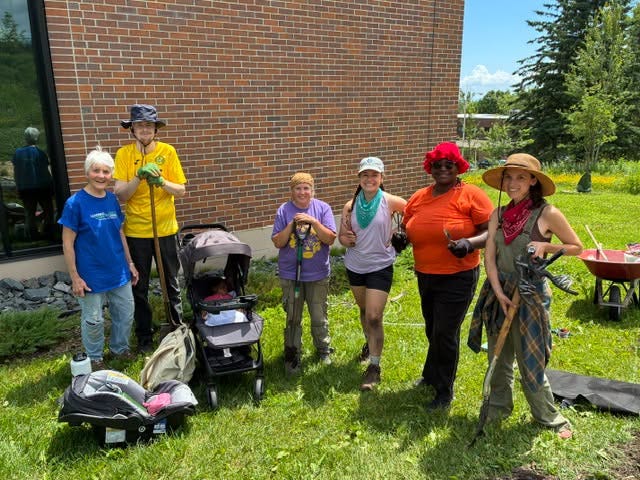
On May 1, 2026, Greg and I turned Hildegard House Catholic Worker over to our guests and live-in volunteers while we moved up to the St. Scholastica Monastery as live-in volunteer Associates for four months. We will return to Hildegard House at the end of August.
What started out as an offer to contribute our talents and energy to working in the monastery gardens, with the trees and on the grounds, is now developing into exploring ways our two communities might develop a deeper relationship.
There are many similarities between the Benedictine Order and the Catholic Worker Movement. We share a commitment to living out the Gospel through radical hospitality and voluntary simplicity with a balance of work and prayer. Both traditions emphasize community living and recognizing Christ in the poor and marginalized
The early Benedictine Monasteries were self-sustaining, often growing all their own food. Catholic Worker farms are really taking root, following Peter Maurin’s vision of the agronomic universities.
These shared values are not accidental. Catholic Worker co-founder Dorothy Day was deeply influenced by the Benedictine tradition and became a Benedictine Oblate. The spirituality of Benedictine monasteries was and still is a great influence on the Catholic Worker Movement. In 2018, I became a Benedictine Oblate attached to the St. Scholastica Monastery in Duluth, Minnesota.
We do have differences, though. The Benedictine Order is a centuries-old formal and hierarchical religious order governed by the Rule of St. Benedict, while the Catholic Worker movement is a grassroots, lay-led movement that was founded by Dorothy Day and Peter Maurin not even 100 years ago, in 1933. There are no formal vows or membership requirements. Workers run autonomous, independent and decentralized communities.
The primary vocation in the Benedictine Order is a life of continuous communal prayer (the Divine Office) and contemplation, balanced with manual labor and study. The Catholic Worker movement’s focus is the active practice of the Works of Mercy (e.g., feeding the hungry, sheltering the homeless) paired with nonviolent social activism and radical pacifism.
Historically, the Benedictine Order is separated from the world to provide centers of peace, stability, and cultural preservation at the monastery, while the Catholic Worker movement actively engages in public life, frequently participating in nonviolent civil disobedience and anti-war protests.
Some Benedictine monasteries have set up houses outside of the monastery grounds where Sisters have lived and worked in the outside community. Some taught in schools, others worked in healthcare and still others volunteered in soup kitchens, shelters, or other social justice-related institutions. Always, they were called to see Christ in everyone that they served.


The Benedictine Sisters of St. Scholastica, Duluth, had a number of community houses throughout the city and were actively engaged at the Damiano Center, the Chum Homeless Center, and the Union Gospel Mission where they served the poor and marginalized in the Central Hillside neighborhood.
As the Sisters got older and smaller in number, they could no longer keep the houses, and they were called back to live in the monastery.
I first met the Sisters in 1997, while I was on supervised release from federal prison following my second Plowshare witness. I maintained a close relationship with them throughout the years, and it was with them that we discerned the development of the Hildegard House Catholic Worker.
The house opened in July 2014 with the blessing of the Sisters. We received our first guests on the Feast of St. Hildegard in September 2014.
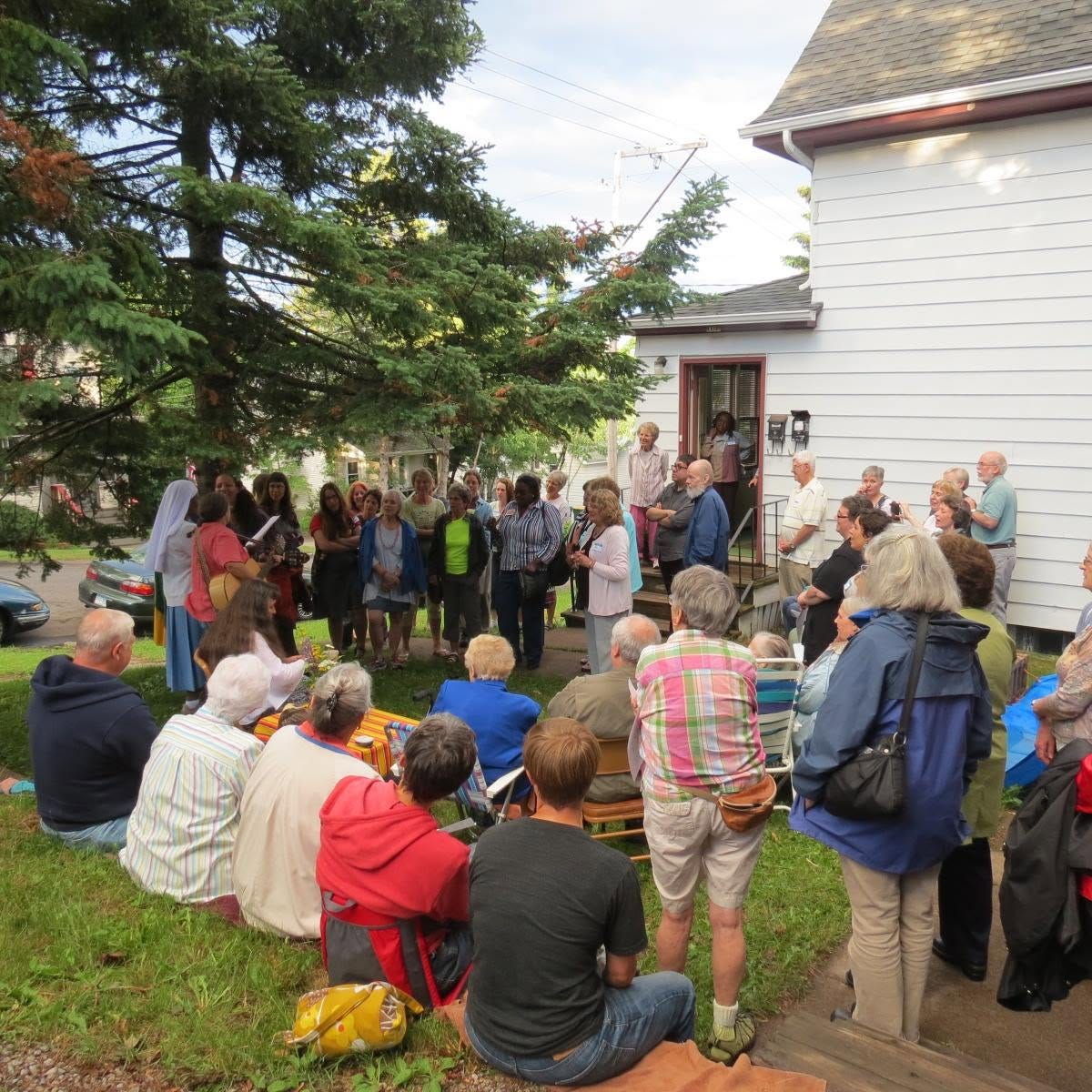
The Sisters have been with us in spirit throughout this past decade, helping us to discern the leadings of the Spirit on how best to live out the Works of Mercy in the spirit of mercy and justice monastery-style, while the teachings of Dorothy Day and Peter Maurin continue to help us discern in the Catholic Worker style. We at Hildegard House have found these to be a powerful combination—both for the Sisters and for us Catholic Workers.
It seems both religious communities and Catholic Worker communities are going through a transition. We are all facing unprecedented challenges globally and locally. We know we need to change how we live and how we respond to these challenges. We are looking for the courage and the faith to make those changes.
Speaking only for Hildegard House, our work is animated and guided by the Spirit. We are not secular in nature, we are not a nonprofit, nor do we operate by religious doctrine. We are spiritual in nature and we try to address the condition of our world through that lens. For this, we need community and help and so we are looking to the Benedictine Sisters of St. Scholastica Monastery.
What that looks like in real terms is yet to be defined. As of now, we look to the Sisters for spiritual mentoring and they look to us to connect them to Christ in the marginalized. They infuse us with God’s mercy and justice through participating with them in communal prayer. We pour that out into our community. They have their spiritual gifts and talents. We have ours and together we just might be able to amplify God’s love in a world that is so deeply wounded.
Hildegard House will continue to offer radical hospitality and we remain committed to resisting and transforming violence into love by acting locally, thinking globally and looking to the Spirit for guidance and direction.
Any other Catholic Worker or communities who have experience or advice with this kind of melding of traditions would be greatly appreciated. We can be contacted at hildegardhouseduluthcw@gmail.com.

Michele Naar-Obed is a member of Hildegard House Catholic Worker in Duluth, Minnesota, and a Benedictine Oblate at St. Scholastica Monastery, Duluth, Minnesota.
Here is a suggestion for a joint experiment:
Try setting up a synodal church discussion group that would start with the question:
How can we help the Catholic school system which is now so expensive that it serves primarily the rich and middle class while leaving the poor in the public schools?