

"First they came for the undocumented. Then they came for workers"
Two essays from the October edition of The Catholic Agitator on the reign of terror coming for our neighbors and ourselves, and the community organizing that fights back against the darkness
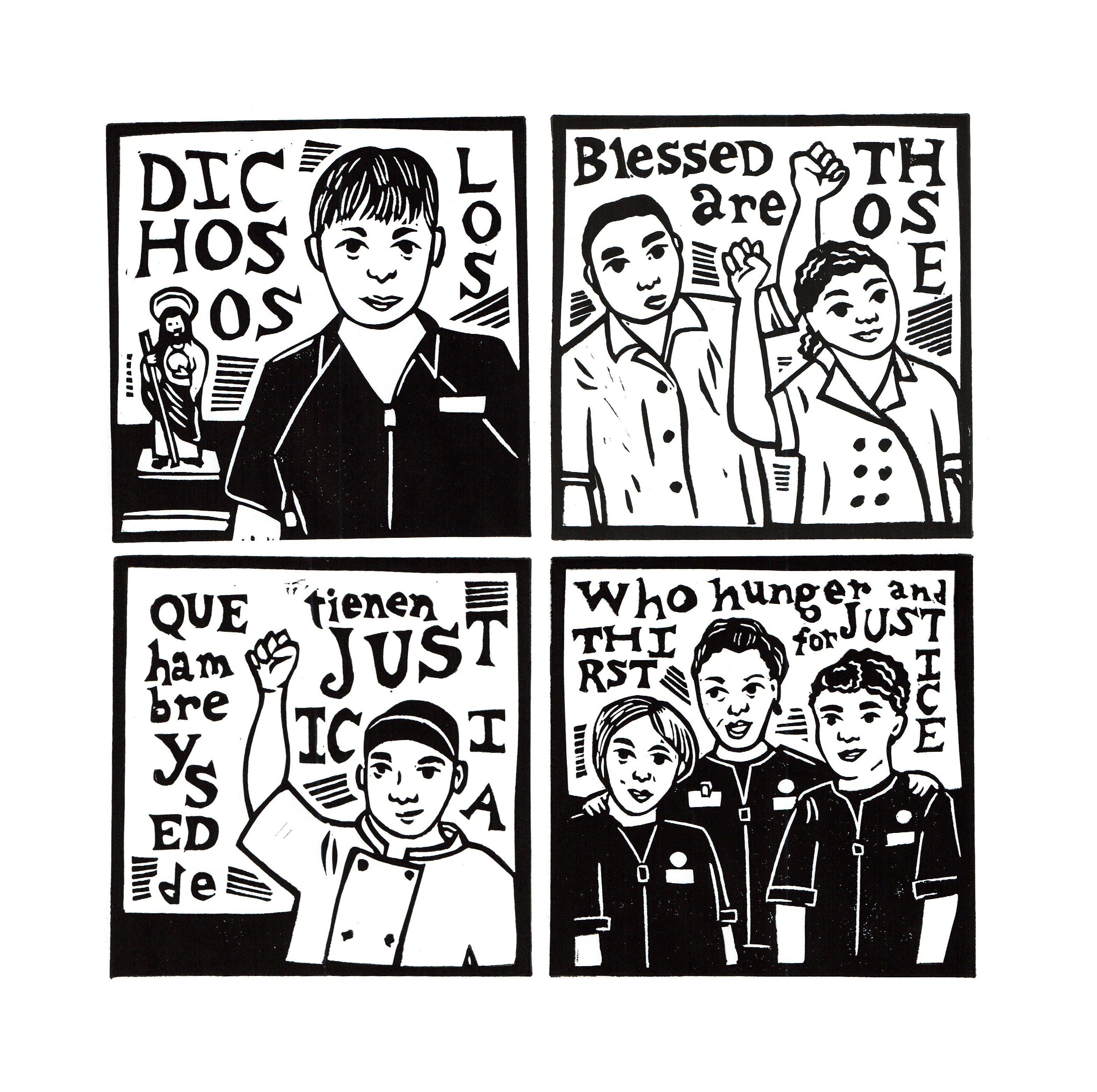
First They Came for the Undocumented
By Hannah Petersen
During World War II, when Martin Niemoller looked at who was being targeted in his community, he saw it was the communists, the Jews, and the trade unionists. When I look around today, I realize:
First they came for the undocumented.
Then they came for workers and worker protections.
Then they came for the environment.
Then they came for queer and trans communities.
Then they came for education, healthcare, DEI programming, and federal funding.
Then they came for our democracy by beginning to dismantle the protections and promises of our Constitution and Amendments.
And then, when they come for me, there will be no one left to stand with me. So, I choose to stand every day with vulnerable communities.
We cannot protect ourselves by hiding in private spaces. The tragedy that is happening in our commons as people are being stolen from our streets, and cast aside on our sidewalks, will not stay “out there.” Our families will know the challenge of poverty, struggling to pay our bills and rent. Our loved ones will be targeted whether they are women, LGBTQ, immigrants, or workers. That is all of us. And so I fight for the protections of workers so that all of our human dignity can be seen, uplifted, protected.
I organize workers because I am also a worker. Surrounding myself with particularly vulnerable people has helped me see how I am also vulnerable. But even if we cannot yet see the precarity in our own lives, I came into this because my Catholic faith recognizes the dignity of work, of co-creating with God. My faith recognizes the sanctity of every life regardless of employment status, documentation, identity, and more. My faith commands me to put the last first, to love my neighbor and even my enemy.
Therefore, for me, Everyday De- mocracy looks like making choices in my personal life to protect my own rights and those of my neighbors, to make sacrifices for those who are at greatest risk, to have hard conversations with my grandparents and fellow union members, to push myself and others. This work does not always look like a public protest.
But as a union organizer, I spend my days bringing people out of the shadows and giving them the space to uncover their power and speak their truths. I bring clergy into the cafeterias of their parishioners and I bring workers into the pulpits of their places of worship. I connect community members to the struggles of their neighbors and invite them to walk together.
Sometimes that looks like playing drums and vuvuzela horns at a picket line, sometimes that looks like asking someone to take their business somewhere else, sometimes that looks like knocking on our neighbors’ door and sharing our struggle and vision for the future. There are many ways to build the world that we dream of. There is a place for all of us, and it touches all parts of our lives. It did for me this past summer in a particularly unique way.
On June 7, I was married surrounded by friends, family, and helicopters as federal agents began their terror in my city and community.
A month after, on July 7, 90 armed soldiers stormed MacArthur Park, a known respite for the unhoused and immigrant communities, walking past a statue of St. Oscar Romero. Their objective was clear—to instill fear, seize immigrants in front of a youth summer camp, send a message to Angelenos that the government holds the power and that we must back down and surrender.
We have not, we did not, and we will not. The very people that our government was trying to isolate and force back into the shadows came out in a powerful way after that invasion.
We brought our real fears, our deep anger, but also we brought our unstoppable joy, our immutable power, and our bodies to reclaim the same MacArthur Park. We refused to have our rights, our dignity, our families taken away without a fight. It is not the government who gives us our rights, it is we who demand and claim them every day.
We have seen this in a big way this summer, but this is the work reality I walk people through day in and day out.
I accompany people who feel trapped, who are afraid of losing their jobs and their livelihoods. Unfortunately, that which will help them can often feel like a risk. I watch people carry that fear around all day, but who still summon the strength to take bold and courageous steps, one at a time, together, believing that they deserve and can gain much more.
That is what we need to be doing in our workspaces, in our pews, in our apartment buildings, and in our parks. This is something I get to do every day and I invite you to join our beloved community.
As supervisors, managers, political leaders, and close-minded neighbors try to intimidate, divide, threaten, dehumanize, and confuse us all, we stand together because we know our lives and wellbeing are intertwined and we refuse to lose. Life is more powerful than death. Ω
Hannah Petersen is an organizer with Unite HERE! Local 11.

This is a speech that was presented at the University of Notre Dame Everyday Democracy Conference. It appeared in the October edition of The Catholic Agitator under the title of “Everyday Democracy.”
There is Power in a Labor Union
By Matt Harper
Every day, workers struggle to be heard and respected. In my practice to encourage and support such behavior, I have chanted with SAG-AFTRA and passed out coffee and rain ponchos to striking UTLA teachers. I have gone undercover to monitor violations in hotels and, in one of my lesser moments, crawled under a privacy barrier at the Chateau Marmont to berate people crossing the picket line to go to Jay-Z and Beyonce’s Gold Party.
Talk to those whose labor and bodies build this country’s economic prowess, and you will see what capitalism’s prioritization of profits over people means. Wage theft forgiven by Congress, workers fired for speaking up, housekeepers who must work through breaks to finish their workloads, and event servers forced to return to guests whose sexual harassment and assaults are too often downplayed and excused.
A care for workers and the dignity of work are seldom at the center of corporate priorities and frequently on the opposite side of their arbitration and litigation. Because they see themselves (and their profits) as being in an antagonistic relationship with workers—and often wield
a disproportionate amount of organized power—it is no surprise that workers desire a different relationship.
As lobbyists, politicians, and judges help to consolidate corporate power and dismantle worker protections, it is inspiring to see what organized labor has been able to accomplish. On the individual level, unions help workers process their experiences, deepen their understanding of the roots of their challenges, imagine alternatives, build connections, and grow their shared skills to be able to respond with strength.
As they build grassroots power, they are able to bring their many voices and demands to the bargaining table to address their grievances and to build a fairer workspace. I have watched them influence zoning decisions and development, shift the investments of pension funds, write or block local, state and national policies, flip the electoral outcomes of states, and win incredible gains in work contracts.
And more than simply improving the lives of their members, they build partnerships with unlikely allies, uplift the wellbeing of all workers, and prioritize the fundamental needs of our full community.
I once asked a movement elder what single change would have the greatest impact on the reality in which we find ourselves. “Democratically controlled workspaces,” was their answer. If everyone had the chance to influence their workplaces, we would be looking at a very different landscape today.
Yet to many, power (and thus organizing as a whole) is seen as something to avoid: something both deeply corrupting and seemingly in conflict with faith and the values of Christ. Many of us feel more comfortable focusing on ourselves than on others and their actions, intentions, and impacts.
And it is good that people want to take responsibility for their individual behaviors. We have the most control over our personal decisions. But this focus is both insufficient and manipulative. In a similar example, the U.S. military and corporations have labored to refocus attention and blame around the crisis of pollution away from their industrial-level waste and onto “litter- bugs” and our “personal carbon footprint.”
However, our individual conservation and recycling habits, though valuable, will not shift the crisis in which we find ourselves. We need to force their hands to change their practices. Is it any surprise that when Indigenous communities led people to grow power, organize their communities, and redirect blame, paramilitary soldiers descended on Standing Rock?
The worst actors want nothing more than for you and me to see coordinated confrontation and strategic pressure as unreasonable and morally inappropriate.
Yet power, as Martin Luther King, Jr. understood it, is simply “the strength required to bring about social, political, and economic change.” And organizing, at its core, is simply “the leadership that enables people to turn the resources they have into the power they need to make the change they want” (Marshall Ganz).
In this moment, people of faith and conscience need to be growing our practice of building power and organizing communities, to be connecting frustrated people together and helping them construct strategic processes to apply pressure to and leverage their strengths against key targets. Our energy must be directed into more than individual action; we need individual leadership that brings more people in and inspires us to act together and over the long haul.
If social movements are going to celebrate unions as they fight within
our economic world, then surely we can uplift the same practices for our political, social, and spiritual worlds as well.
But more than just growing our power, we also need to be expanding our tent. We do that by building up the capacity of those who know we deserve better, deep- ening their understanding, fueling their inspiration and expanding their abilities to listen, ask questions, and agitate. Then, we must commission these disciples to reach out to those who do not yet see how the means they have chosen will never bring about the ends they yearn for.
For Catholics, our evangelization must start with spreading the Gospels not to non- believers but to those spiritual family members whose personal and political practices, as well as their theological priorities, seem to betray the witness of Jesus of Nazareth.
I know that at this moment, it often seems like there is nothing we can do to change the trajectory we are on. What is a few ten thousand-person marches to an aspiring autocrat willing to wield the military against civilians for little reason more than as retaliation for our defiance? But if we want something we have never had, then we all need to be doing things we have never done (or done well).
There is a reason why many of us prefer not to do the work of organizing. It involves a commitment to deep vulnerability, self-reflection and transformation. It asks us to grow skills and practices from which we have long excused ourselves. And it requires hard, long-term work alongside complicated people and conditions. Yet is that not the witness Christ offered us?
We will never get to the Promised Land if we are not bringing a cloud of living witnesses along with us. A union organizer once admitted to me, “We are happy to meet, talk, coordinate, and vision with anyone. But we have not the time for individuals who are not doing the complex work of bringing more people along with them.”
And so we are invited to consider: Will we shelve our self-righteousness? Will we stop looking at the world through our windows and screens and risk becoming more proximate, placing our hand in the very wounds of Christ in our world today, even the wounds of those we prefer to discount and dismiss?
We all come from a legacy of real people who challenged us, invested in us, and showed us a world we did not initially see or understand. Who formed you?
But tradition only remains unbroken if we pass it down. And so we are asked to invite more people to find their way into the good of this work. And knowing the real protagonist is the Holy Spirit, how are we allowing ourselves to be a channel for Her in a time like this?
The massive work stoppages and civil disobedience that many believe are necessary to stop our current trajectory will not be gifted to us in a national “road to Damascus” conversion moment. Though the Spirit will surely be part of it, She needs our minds and hearts and bodies. She calls us to be the workers who go out into the fields to gather the harvest. However, those who glorify working the land often know little of the strenuousness of farm work.
Fortunately, the way forward is not in “the dark of buildings confining and not in some heaven lightyears away” (as the song goes), but here in our lobbies, restaurants, schools, and ports.
I am a Catholic Worker because work is sacred, because to work is to share the creation process with God, and because the workers who produce the riches of our world are unnecessarily poor, exploited, and easily discarded.
Yet remembering, those who are last will become first. They bring Mary’s Canticle to life, putting flesh on the bones of the seemingly preposterous Magnificat: God has looked with favor on these lowly servants, and henceforth all generations will call them blessed. They show us how to link arms with our neighbors and walk into the un- certainty of boardrooms and lobbies to labor together each day to change the material conditions of our world.
If we were created “to know God, to love God, and to serve God...” as the simplistic Baltimore Catechism suggests, I know of no way to do that without laboring with others to usher in paradise for all of God’s creation.
We may not see the fruits of this courage and vision in our lifetime, but we will wake up each day more close- ly resembling that which God created us to be, surrounded by the only thing that has ever protected us: community.
When the union’s inspiration through the worker’s blood shall run,
There can be no power greater anywhere beneath the sun;
Yet what force on earth is weaker than the feeble strength of one,
but [our] union makes us strong. Solidarity forever. (Ralph Chaplin). Ω
Matt Harper is a Los Angeles Catholic Worker community member and co-editor of the Agitator. Read more of his writing at the Los Angeles Catholic Woker’s Catholic Agitator archives here.