

Learning from the Movement to Stop the War on Terror
Review of Jeremy Varon's "Our Grief is not a Cry for War," a history of the movement to resist the Iraq War, which features the direct actions of Catholic Workers and allies in the peace movement

For me and many of my fellow Zillennials, some of the first political images I can recall were the terrorist attacks of September 11, 2001. Absorbing television images of the two planes hitting the towers was the beginning of my political consciousness.
That implosion was the Big Bang that set in motion my first narrative of world history, built out the internationally broadcast chapters of the “War on Terror.” I remember the live footage of Saddam Hussein’s statue toppled in Baghdad; Michael Moore’s anti-war speech at the 2003 Academy Awards, images of a hooded man being tortured at Abu Gharaib, and the shocking hanging of Saddam Hussein.
Much of adulthood—creating a fully fleshed out accounting for the world— consists of, perhaps, filling in the blanks between the still frames.
What were the images left off my television screen? What stories never made front-page headlines? A mature accounting of history perhaps means looking over your shoulder—seeing what action has been played upon the world stage before one’s own entrance. Varon’s first chapter is dedicated to contextualizing the September 11 terrorist attacks in the global conversations already underway about American militarism, colonialism, and empire.
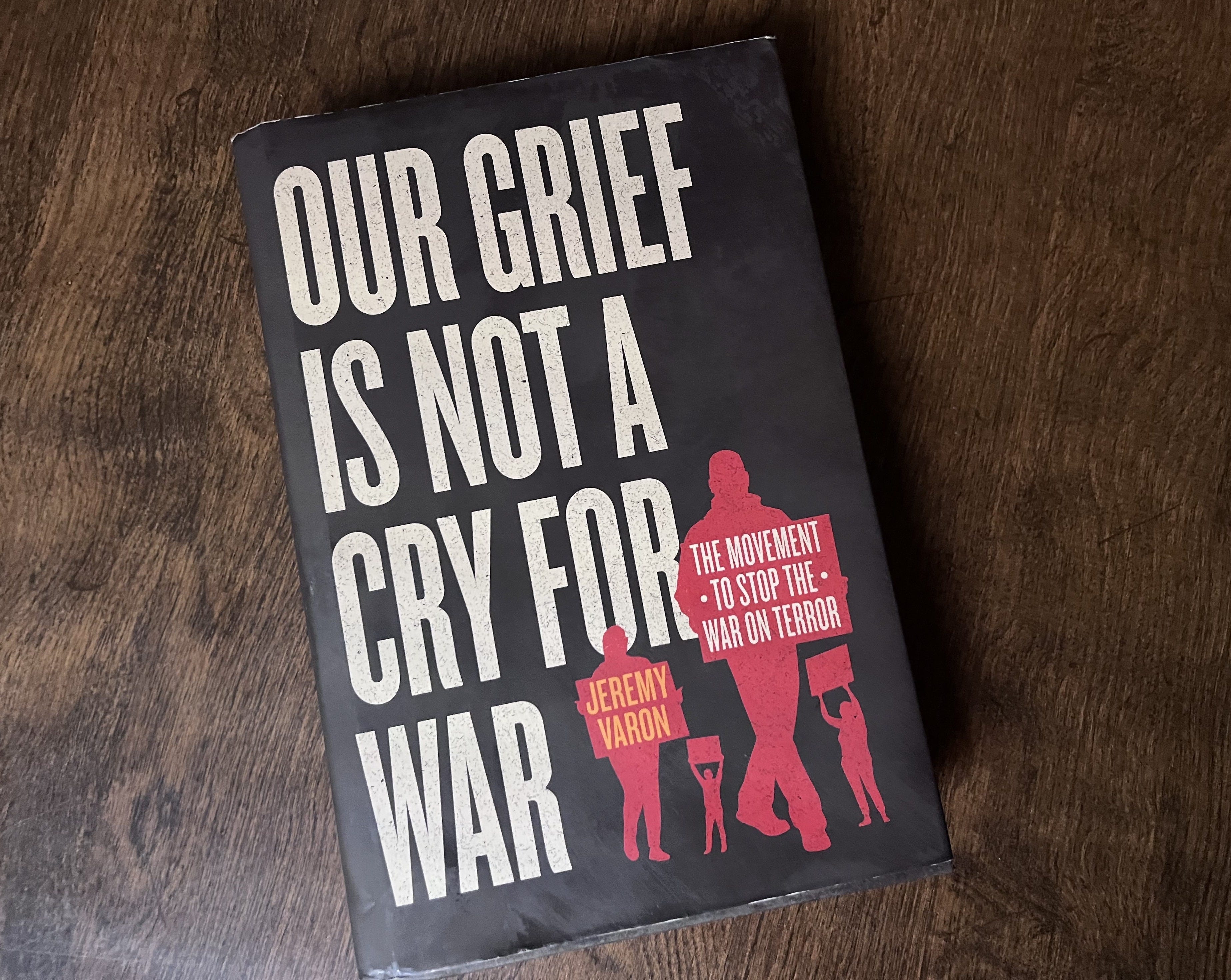
Jeremy Varon’s “Our Grief is Not a Cry for War” (University of Chicago, 2025) revisits many of these familiar tableaux and brings not only them to life, but the outrage and resistance they provoked.
Varon’s accounting of the unequal and opposite actions and reactions of history in “Our Grief is Not a Cry for War” provides an essential history of the counter-events during the invasions of Afghanistan and Iraq.
Choosing the point from which history begins is a political act, and Varon begins his history, tellingly, not with the indelible images of the two World Trade Center towers falling into smithereens of smoke against a blue September sky, but rather, with the violence that met violence.
His story begins on September 14, 2001, as President George W. Bush, surrounded by firefighters, addressed television cameras and vowed vengeance upon the masterminds behind the terrorist attacks. Bush chose to wage a bloodthirsty “war on terror" to avenge death with death, to take a life for a life. This war was presented to Americans as the only possible national response. Mercy was not even on the table.
Not from the powers-that-be, at least. But, even as Bush claimed God’s vengeance as the provenance of the United States’ military—”Operation Infinite Justice” was the original name of Operation Enduring Freedom—other voices begged for peace. Family members of the victims of the September 11 attacks called for the memory of the dead to be honored with peace rather than vengeance, humanity rather than barbarity.
Varon’s book amplifies the still, small voices that consistently called for peace, even as they were screamed down by warhawks. The anti-war essays of Arundhati Roy, Slavoj Žižek, or Noam Chomsky were certainly not making it to the television screens of families in the heartland, but their words shaped a national counter-response.
Varon’s book takes in intimate, rather than 30,000-foot view of the Iraq War resistance, he tells history through a microscope rather than a panorama. He pulls out the strands of counter-cultural voices who demanded the grief of the American people not be distorted into a “cry for war.”
Varon, a contributor to The Catholic Worker and a member of Witness Against Torture, an ally group of Maryhouse Catholic Worker, has created a clear and thorough history of this peace movement that was created in response to the violence of September 11, 2001.
Varon’s patient, careful book charts the story of the years after the September 11 attacks, and a careful account of the war-mongering that followed in the years preceding the invasion of Afghanistan in October 2001 and the invasion of Iraq in March 2003. And, even as war was mounting, a global, populist cry for peace mobilized millions in response.
Varon’s book is a fascinating historical entry: the threads of history he covers are still unraveling in current events. Varon carefully chronicles the trajectories of the diverse peace groups that came into being—and, although they were working for the same goal, peace, Varon is a careful observer of their differing philosophies and sometimes—well—warring tactics. Varon’s story is recent, tangible history, and yet it is perhaps most remarkable for how ancient it seems. Despite being only 20 years ago, reading is a reminder of how simple the world seemed several world-historical epochs ago, before the invention of the smartphone and its transformation of the world into a global village market by increasingly mechanized warfare.
Roots of the Anti-Iraq War Movement
Varon’s book begins by connecting his history with other histories of earlier peace movements, from when “victory” was declared at the end of the Vietnam War in 1975, to the first Gulf War in 1900. He tells the story of how the United States metamorphosed from a nation in the grip of “Vietnam Syndrome” to a global superpower waging “forever wars” in the oil fields of the Middle East.
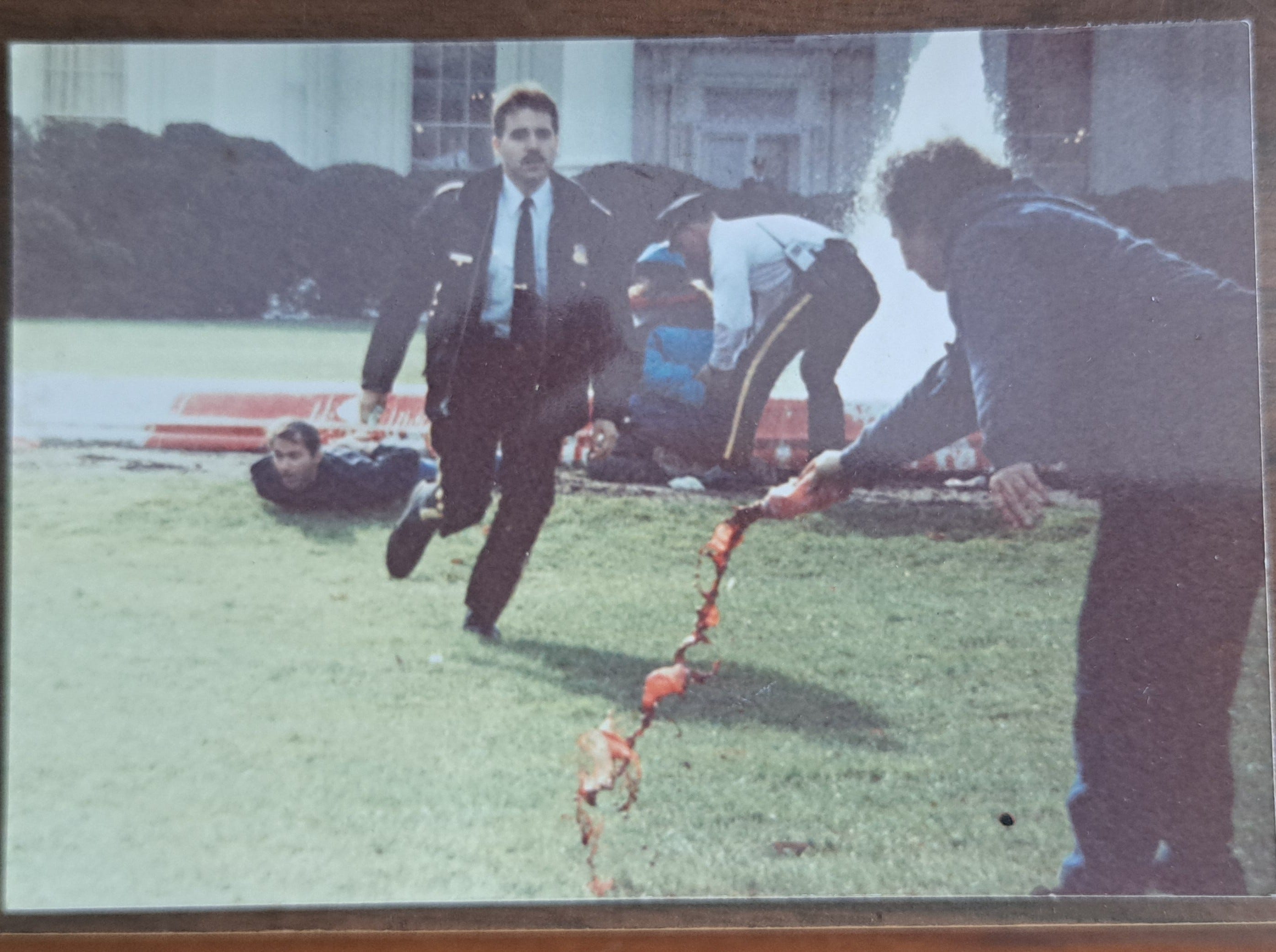
Catholic Workers continued witnessing for peace throughout the 1980s and 1990s. Kathy Kelly, a long-time friend of the Chicago Catholic Worker, is a central character in Varon’s story for her work raising awareness for Iraqis with Voices in the Wilderness during the first Gulf War. Art Laffin, of the Dorothy Day Catholic Worker in Washington D.C., along with 10 others, participated in a “Leap of faith” over the fence, onto the White House lawn, pouring their blood onto the lawn and in the fountain, to protest the first Gulf War.
This spirit of resistance came into full flower in the grassroots movement against the Iraq War. On February 15, 2003, anti-war protests marched in nearly 800 cities around the world, in more than 70 countries. “We can stop this war,” was their rallying cry. Surely the Bush Administration would not wage a globally unpopular war in Afghanistan?
That Saturday, Varon estimated between 15 and 30 million citizens of the world protested for peace, on all seven continents. “The world says no to war,” the marchers declared.
The largest U.S. march was in New York City, where 500,000 people, from Catholic Workers to Wall Street brokers, took to the streets. In Rome and London, more than a million protesters marched for peace. “Surely the voices of the world, rising in a vast chorus on a single day might prevail,” Varon writes.
Varon describes the desolation many activists felt after Bush moved forward with the invasion of Iraq one month later, despite vocal, widespread opposition to the war. Although Bush waited for Congress to authorize the Iraq War, Varon writes that, privately, Bush said that he would proceed with military action, regardless. The degradation of the democratic process in the intervening decades is striking: Bush’s successors have dispensed with the trappings of democratic proceedings of war-waging altogether.
Palestinian Solidarity
As the “quagmire” of the Iraq War set in, Varon described the reactions of activists on the ground in the United States. Many of them felt defeated by the 2004 election that gave George W. Bush his second term. One activsit, Nancy Krikorian of Code Pink, a women’s peace group, became “obsessed,” Varon writes, with tracking the war’s casualties on the website “Iraq Body Count.”
The website Iraq Body Count remains online. A banner at the top of the site notes that its work is “currently focused on Gaza” and invites readers to follow them on Substack. Although the Iraq War protesters were divided on whether or not
Varon notes the Battle of Fallujah, in which the U.S. laid siege to a city outside of Baghdad in March 2004, was a disturbing mirror image of the Israeli Army’s invasion of Jenin Refugee Camp two years earlier. Eyal Weizman, an Israeli architect, writes of how the Israeli military blasted through apartment walls, using private homes as tunnels to move throughout the city. In Fallujah, the U.S. Army made its way through the city in grueling urban warfare—the distinction between citizen in her home and insurgent cast aside—and killed more than 200 Iraqis.
“The US Army’s collective punishment of the residents of Fallujah, the nature of the siege imposed on the town, the overwhelming use of firepower against civilians, the ceaseless Apaches strikes, the targeting of ambulances trying to evacuate the wounded, the blocking of journalists and more, were all tactics exploited by Israeli forces in Jenin,” journalist Ramzy Baroud wrote in 2004, during the invasion of Fallujah and two years after the destruction of Jenin Camp. “This has indeed been the collaboration between the two countries’ militaries that the media warily alluded to,” he concluded.
It feels churlish to critique such a diligently researched book for what it leaves out—no book can or should say everything. But Varon leaves a tantalizing analysis on the table: the transformation of the digital media landscape and how it transforms reporting on armed conflicts. How did one of the most disorienting and rapid media developments of the human race—the hand-held “smart phone” equipped with camera, internet, and keyboard that has made each person a reporter and publisher of their own experience—transform Americans’ engagement with their own military’s actions overseas?
In the two decades since the shock and awe invasion of Iraq, the smartphone has democratized daily news. Corporate media no longer gatekeeps information that the public sees; broadcasters no longer create the story for viewers. The internet has become a commons where stories from across the world—Kyiv, Khan Younis, the Congo—can be shared freely, even those that live on the margins of American consciousness.
Activists like Christian Peacemaker Teams, Voices in the Wilderness, Code Pink, and Not in Our Name tried to make the suffering of Iraqi women and children visible to the West, Varon writes. They tried to give the war a human face beyond “collateral damage.” But if the invasion of Iraq had been accompanied by the same algorithmic, on-the-ground coverage that the genocide of Gaza has been, would the outcome have been different?
While the Iraq War protests may have paved the way for the Arab Spring of 2011, as Varon notes in his conclusion, what is certain is that 140-character calls to action on the platform formerly known as Twitter mobilized the massive crowds of 2011.
Varon asserted that Iraq War protesters paved the way for mass American critique of Israeli genocide in Gaza, but he does not show how they contributed. It is an intriguing assertion—especially when the resistance to the Gaza genocide was largely contributed to by university students, many of them born after September 11, 2001, and most of them too young to remember the Iraq War, much less have protested it.
In fact, the question of Palestine seemed to tear apart the Iraq War protest movement — how broad a critique of empire, of colonial occupation, were red-blooded Americans willing to make?
Today’s Resistance
The breakdown of democracy and the rise of fascism that anti-war protesters saw on the horizon in 2003 have borne strange, violent fruit in 2026. In the past year federal ICE agents—their very existence a fruit of the “war on terror”— have shot and killed two Americans—Renee Good and Alex Pretti—who were standing in solidarity with immigrants when they were caught in the crossfire. Immigrants being hunted down for, as my friend in ICE detention said, for the “crime of being Latino.”
The rhetoric used to justify Guantanamo Bay detention center—holding the “worst of the worst”—is now used to justify imprisoning more than 70,000 immigrants in ICE “processing facilities,” detention centers, and federal prisons across the nation. The overwhelming majority of these detainees, far from being hardened criminals, have no criminal record.
Catholic Workers are a dedicated, dogged presence for peace running through Varon’s story of anti-Iraq War resistance. Among them, Frida Berrigan of Jonah House and Matt Daloisio of the New York Catholic Worker were arrested as part of the War Resisters League’s protests in New York City. Beth Brockman, Patrick O’Neill, and Mark Colville were also arrested protesting Blackwater mercenaries killing nearly 20 Iraqis in the 2007 Nisour Square massacre at Blackwater’s headquarters in North Carolina.
Matt Daloisio, a former Catholic Worker at Maryhouse, told Varon that he still fasts on Fridays for the closure of the Guantanamo Bay detention center. Witness Against Torture began its Friday fasts for the closure of “Gitmo” two decades ago. These fasts, Daloisio noted, have gone on much longer than the activists had anticipated. Despite efforts to close it for 20 years, the detention center remains open. “None of us thought we were making a lifetime commitment,” Daloisio told Varon.
The anti-war movement Varon chronicles, which largely saw itself as a failure, could provide an object lesson for anti-war movements today. Frida Berrigan joined up with the War Resisters League in search of a “bigger toolbox” and a “more strategic approach” to civil disobedience, according to Varon.
When reading Varon’s book, applying his lessons to the peace movement today, I wondered: what are the “strategic approaches” needed for the digital age? What messages will pierce through the haze of the digital bread and circuses on our phone screens? When the merchants of war also own the platforms on which news is shared, how can citizens of the world share their histories with one another?
“[Trump] never launched a war against [Iran]” throughout his whole first term, Varon notes. Trump’s isolationist ideals seemed to prevail in his first presidential term, despite his big-stick-wielding rhetoric and sabre-rattling tweets.
“Whether an ‘Iraq syndrome’ will hold in a second presidency of Donald Trump, still seething with martial bluster and nativist hatred, remains to be seen,” Varon writes.
The answer has, unfortunately, come to be seen in the year since Varon’s book was published, written clearly in the blood of the innocent. The BBC reported that more than 7,300 lives have been lost in Lebanon and Iran since Israel and the United States went to undeclared war in February 2026.
“Any time you’ve got the Pope and the Dixie Chicks against you, your time is up,” Michael Moore told George W. Bush in 2003. Different president, different pope, same condemnations of war-making. We seem to have been doomed to repeat the same 20 years of recent history. But Varon’s book offers some hope of an escape route from history’s recycling, if only because he gives us a much-needed opportunity to learn from it.

[ As the “quagmire” of the Iraq War set in, Varon described the reactions of activists on the ground in the United States. Many of them felt defeated by the 2004 election that gave George W. Bush his second term.]
Here is what Thomas Merton said about “activists” in 1968, a few weeks before he died:
“Most activists do not go in for naked violence yet, but they will.”
“Non-violence has become all fouled-up and is turning into a sort of semi-violence.” (Thomas Merton – Thomas Merton in Alaska – page 108 and 109)
“I am mad at my friends who are going around burning draft records. I think they are nuts…. They are ruining the whole thing they are trying to help….You have to get to a sort of meeting point where everybody can more or less agree.” Thomas Merton- quoted in “Signs of Hope” by Gorden Oyer—page 108]
It seems that the “activists” may be doing more harm than good. Here is a statement from another Catholic Worker:
“Thomas Merton pointed to the superficiality of much of what he saw coming out of the peace movement of the 1960s. The years since have seen worse. We Christians need to recover what our ancestors in the faith knew about peacemaking.” (Christian Nonviolence: Theory and Practice by Tom Cornell)