

The Dark Knight’s Bright Light
An essay on how Dorothy Day inspired Batman comics, by the former coordinator of Dorothy's cause for canonization
By Jeffry Odell Korgen
When DC Comics invited Denny O’Neil to become Batman’s head writer in 1969, the 29-year-old jumped at the chance. It was his dream job, and it came with a coveted assignment: Make Batman Dark Again.
The 1966-68 television show Batman had made a national joke out of the Caped Crusader (“Holy Guacamole, Batman!”)1 while selling $75 million worth of merchandise in the first year alone. The money was in the bank, and it was time for a reboot.
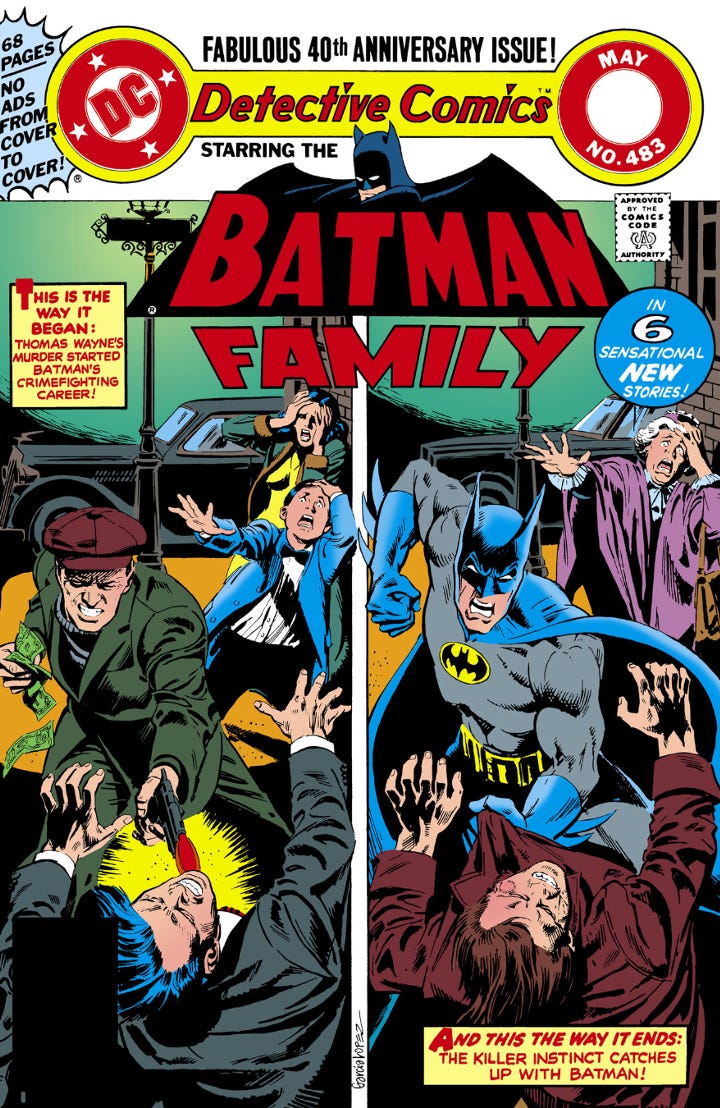
Batman was always a strange dude. O’Neil grew up with this darker Batman, The Batman, a martial artist, criminologist, and inventor named Bruce Wayne, whose parents had been gunned down in an apparent robbery that was indeed a mob hit. The family tragedy inspired young Wayne to fight crime as a masked adventurer under cloak of darkness. Without proper help and healing, a person like that might grow up into a crazed vigilante, an outcome hinted at by the more recent Batman movies.
Just as he took the assignment, O’Neil began to volunteer at the Catholic Worker’s two New York’s houses, St. Joseph’s House and Maryhouse, where Dorothy Day lived. Preparing meals for Catholic Worker guests gave him an opportunity to interact with Day and other Catholic Worker luminaries, like Tom Cornell. Catholic Worker values like personalism and nonviolence began to sink in. After three years, O’Neil did the unthinkable—he became a pacifist.
In a December 2018 interview with me, 18 months before his death, O’Neil shared his consternation. “How could a pacifist script such a violent comic book?” he asked himself—incessantly.
O’Neil looked at the options. He considered quitting this dream job. He contemplated renouncing nonviolence. Ultimately, he arrived at a third possibility. In 1970, he introduced a new character to the Batman pantheon, Dr. Leslie Thompkins, based on Dorothy Day. She delivered a message of nonviolence—to The Batman, but also to the reader.
Dr. Thompkins had inherent credibility with Bruce Wayne, as the woman who mentored the frightened boy after his parents’ murders. Only a person who had helped form Wayne would have the credibility to tell The Batman to renounce violence, O’Neil reasoned.
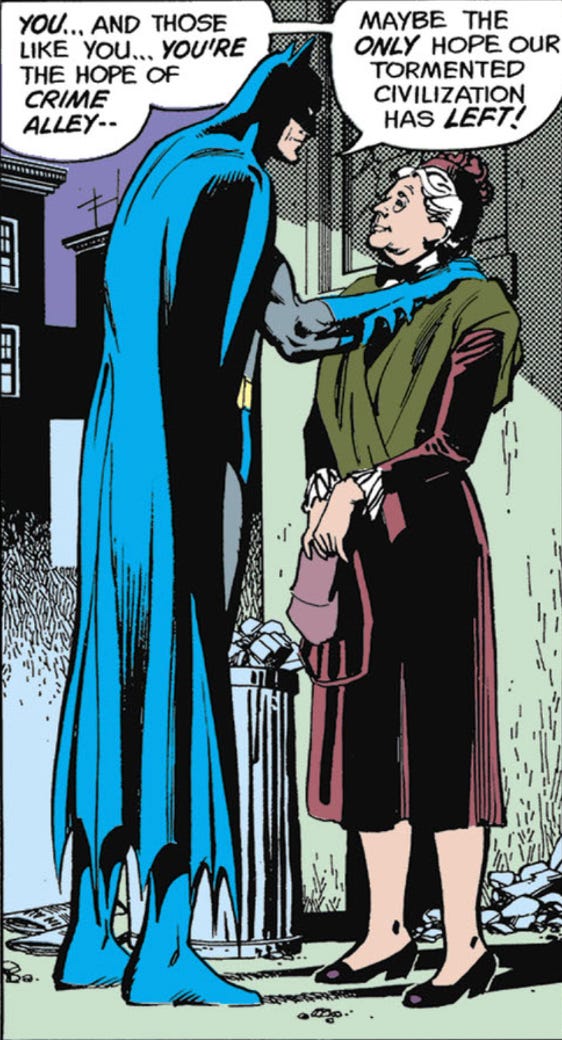
And so she did. In one encounter, she responds to The Batman’s suggestion that the violent neighborhood in which she attends to the poor is cursed. She replies “No, Batman! If there is a curse, it lives in human hearts, including yours! When we have the wisdom to use mercy and compassion instead of force—we human creatures will finally be on the path to perfection!”2 While The Batman never seems to internalize her message, Leslie’s example helps him keep hope. “Leslie Thompkins is proof…that man can rise above his instincts, become something better,”3 he muses to himself on a 1984 return trip to Crime Alley.
In the original 1970 Leslie Thompkins story, he speaks admiringly to her, “You…and those like you—you’re the hope of Crime Alley. Maybe the only hope our tormented civilization has left.”4 Holy Saints, Batman—that’s Denny O’Neil speaking to Dorothy Day!
Other writers upped the ante. Ultimately Dr. Thompkins/Dorothy Day upbraided The Batman for “throwing children into dangerous situations” (referring to Robin—something that disturbed me as a nine year-old).5 And in a 2002 appearance, she teaches The Batman about forgiveness as she helps a supervillain reform (despite the Dark Knight’s dismay and skepticism).6
Denny O’Neil’s experience is representative of many who have had personal experiences with the saints, the blesseds, the venerables, and the servants of God.
Their heroic virtue gets under your skin, make you question your commitments, and ask “What am I doing here?” The Batman hasn’t yet embraced active nonviolence, but he’s thinking about it, and perhaps, if we have our own personal encounter with Dorothy Day through her writing and example, there’s hope for the rest of us.

Writer and comics creator Jeffry Odell Korgen coordinated the local phase of the canonization process for Dorothy Day, Servant of God for the Archdiocese of New York.
He is the author of Dorothy Day: Radical Devotion (Paulist Press, 2024), a graphic biography for adults illustrated by Christopher Cardinale.
Season 2, Episode 26.
Detective Comics #483, p. 12 (1979).
Batman Special #1, p. 25 (1984).
Detective Comics, #457, p. 12 (1975).
Detective Comics #944, p. 19 (2016).
Batman: Gotham Knights #32-36 (2002-2003).
Interesting crossover. Thank you for taking the time to share it with us. The thing I think of the most about Batman is that he will, no matter how hard he fights, not find relief through his choices.