

The Catholic Worker Mourns Two Deaths
From the December 2025 Issue of The Catholic Worker: Obituaries for Monica Ribar Cornell and Eugene Solt.
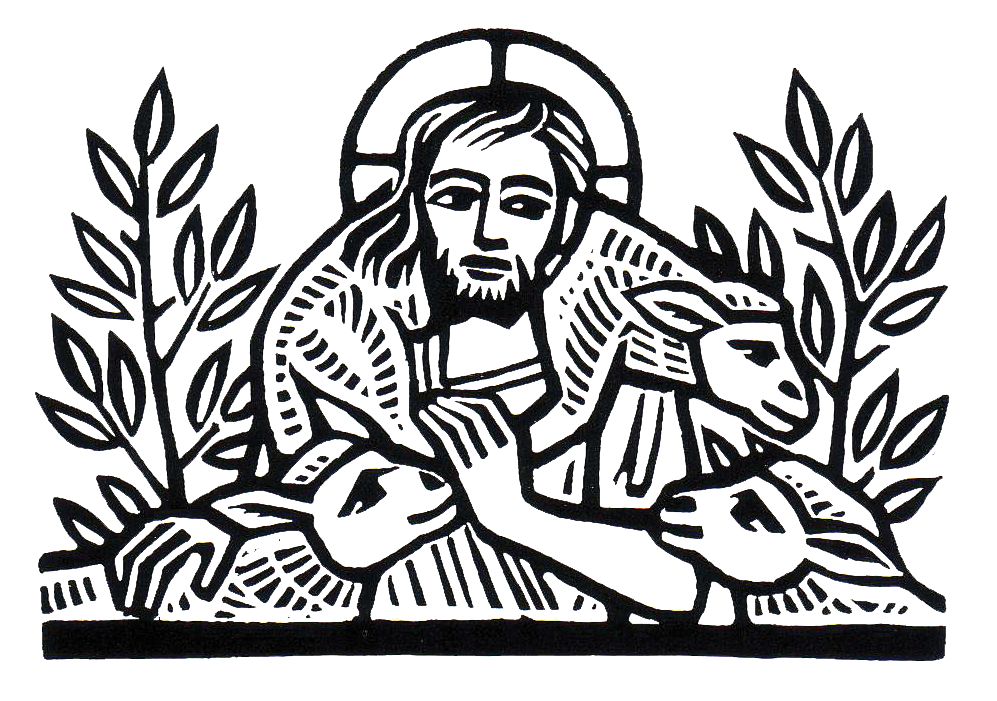
At this joyful time of the turning of the year, many people mark the sorrowful mystery of the death of loved ones. Either anniversaries from years past or fresh losses from the previous year. The December 2025 issue of The Catholic Worker featured two obituaries for long-time community members of the New York Catholic Worker family. We share them here to honor them, and in memory of the beloved dead you may also be remembering these days.
peace,
Renée

“The Mary part of her had been there all along”: In Memory of Monica Ribar Cornell (1942-2025)
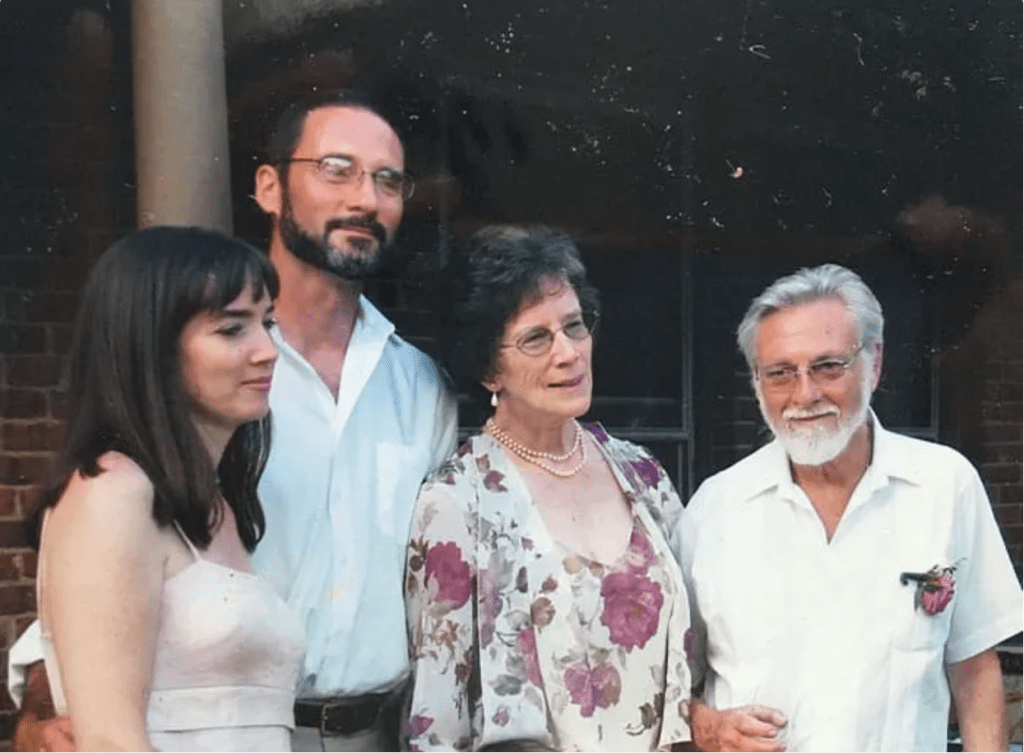
By T. Christopher Cornell
There are people in any group who are not high-profile personalities, but who keep things going behind the scenes. Monica was certainly one of them. She arrived at the Catholic Worker at twenty-one in 1963, married our father, Tom Cornell, in 1964, and dove headfirst into a family life centered in and around the movement. We are planning to hold an event in memory of their Catholic Worker life together. But her story deserves to be told in its own right.
Born in northern Ohio just six weeks after Pearl Harbor, Monica Mary Ribar grew up in a strict Catholic household. Her parents had met at church in Cleveland. They prayed the rosary daily. There were monsignors on both sides of the family. Her earliest memories were of the small village where her father bicycled to work in a steel foundry, but the family moved “to town,” so that she and her younger sister could attend Catholic school.
She admired the heroic lives of the saints, especially those who had founded religious communities. After high school, she entered Maryknoll as a postulant, hoping to go overseas as a missionary. “I had always wanted to see the night sky in Africa,” she said wistfully, but within a year it was agreed by all that it was not her calling.
Monica had grown up with The Catholic Worker in the house, and in September of 1963, she bought a one-way ticket on a Greyhound bus to New York City. She arrived at the Catholic Worker with one suitcase and a twenty dollar bill on Birmingham Sunday, when four girls were killed by a bomb while at church.
Something galvanized in her immediately.
Although she relished her time as “the new girl” at the Worker, when we pressed her for stories she inevitably deflected attention from herself. Whiskers (the inimitable Richard Harper, of blessed memory remembered with absolute conviction that “she was the only person in the history of the Catholic Worker who ran the soup line and the clothing room at the same time.” My mother laughed at that, and said it was an exaggeration. Bob Gilliam, a more reliable source, said, “She was a vivid presence in any room...prominent, but not dominating. I was her sidekick at Christie Street. Ed Forand used to give her a little more money for groceries, because he knew she wouldn’t waste it, and would return every unspent penny....
She did miracles
with stretching meager supplies into meals.
After their wedding, Monica supported my father in his ongoing work and the risks he took such as marching at Selma, burning his draft card at Union Square, and launching the Catholic Peace Fellowship. When they moved from the Lower East Side to a larger apartment in Brooklyn, they began offering their own family-oriented form of hospitality. It seemed there was always at least one person living with us, if not more.
People came because of Tom; they stayed because of Monica.
In 1972, my parents bought an abandoned Victorian house on the edge of a working class neighborhood in the distressed city of Newburgh, New York. At first, only the front part was habitable, but my mother threw herself into loving and saving this grand old house. Soon they were hosting visitors, and fancied themselves as having a salon where politics, religion, and the world of ideas were debated in a lively atmosphere. Mike Harank remembers “her flour-drenched hands kneading dough that would become delicious warm bread for the evening meal. We often talked while sipping red wine while the bread baked in the oven. A Eucharistic moment. A blessed peacemaker, she brought peace to the often tumultuous household. “And there were books...and more books. Monica’s cookbook collection grew, the pages marked with sharp comments, and ranked with stars or X’s. My father claimed she never served the same meal twice. The circle of hospitality grew from peace movement activists and visitors to also include neighborhood youth and our childhood friends.
During the 1980s our family ran two soup kitchens for a local council of churches in Waterbury, Connecticut, while supporting a small Catholic Worker community that provided staff for the soup kitchens. It was exhilarating work, but draining. Monica worked as usual behind the scenes keeping things from fall-
ing into chaos while forging respectful and lasting relationships with guests, church vol-unteers, seminarians on summer internships, and, most notably, a crew of neighborhood characters assigned to “workfare.” In classic Catholic Worker fashion, the lines between staff and guests blurred. Love is indeed harsh and dreadful, but love it was. That’s when ! became a Catholic Worker myself. It’s now over thirty years later, and one of those characters is here today as I write, having come to the farm to check on me. He, too, feels he has lost another parent.
In 1993, Monica and Tom returned to the New York Catholic Worker at Peter Maurin Farm in Marlboro. Monica had always been a fan of Peter Maurin, his Easy Essays, and the entire idea of going back to the land as a return to Christ. She, too, yearned for a society built on small crafts, voluntary associations, and labor as gift. Reflecting on the last thirty-two years, it seems to me that her time at the farm was an expression of her own convictions as well as Peter’s. To practice frugality and thrift for the sake of peace and justice, and yet to live well, was the craft she had been developing since that day in 1963. Cooking, cleaning, mending, sewing, growing food and flowers, dealing with people, welcoming visitors, maintaining faithful correspondence with old friends, while having time for one’s interior life-when viewed as a whole, these integrated acts of skill, concentration and perseverance become the central, most essential craft of all. “Hospitality is my vocation,” she told Jack Doyle, who accompanied us during the final months.
Monica began her cancer journey on New Year’s Eve. True to her way of being, the illness was more manageable and less immediately traumatic than my father’s, but equally dramatic.
“Globlastoma is its own modality...it’s a bad actor. Get ready,” the oncology team told us. Steroids and limited chemotherapy would reduce the secondary symptoms and allow her some quality offlife...until they did not work anymore. During treatment, there were flashes of a woman vaguely remembered from my childhood, a little more wilful
Jesus, Martha and Mary
and impulsive, more out in front, before the demands of motherhood, marriage, and the heavy responsibilities she carried for the sake of so many others. She was finally the star of her own show. She charmed the nurses and hospital crew of the whole floor. The little girl who had wanted to be a missionary was now visited by people from Africa, Asia, India, Central and South America and Eastern Europe.
The world had come to her. As they cared for her, she cared for them, too, engaging them freely about their lives and future plans. With curiosity, I wondered what she might have done in life, given her prodigious drive and tenacity, if she had chosen a career path, one fueled by ambition and adrenaline.
For the next seven months at home, we cherished every meal, every conversation, every visitor and every good, strong cup of tea. She lost the ability to cook, to sequence any kind of tasks, and eventually could not read. She turned her energy now into Tum-nating,” as she put it, and tried to embrace the process she was in: neither fighting nor giving up, but receiving love and help rather than giving it, and practicing radical accep lance of the outcome of each stage.
The end came quickly and along the lines of the doctors’ warnings. After another round in the hospital and forty hours in a rehab facility, we got her home with hospice care through a series of minor miracles. She was fading fast and had begun to suffer. The family gathered. She who never prayed the rosary after leaving her parents’ house died as we finished praying the Salve Regina.
For the funeral Mass, we chose the passage from Luke’s Gospel about Martha and Mary. She had worked so hard and so long through her life that we had always seen her as a Martha, the busy household manager immersed in the grinding details of hospital-ity. In the last months of her life, that part of her identity had been stripped away, and we realized that she had an immense store of the fruits of contemplation. The Mary part of her had been there all along. She never got to see the stars in Africa. But she herself provided the warm light of hearth and home to so many others. Her life was surely a visible sign of God’s presence, as clear as that early vision of the night sky.
T. Christopher Cornell lives at Peter Maurin Farm in New York.
“He was sui generis”: In Memory of Eugene Solt (1944-2025)
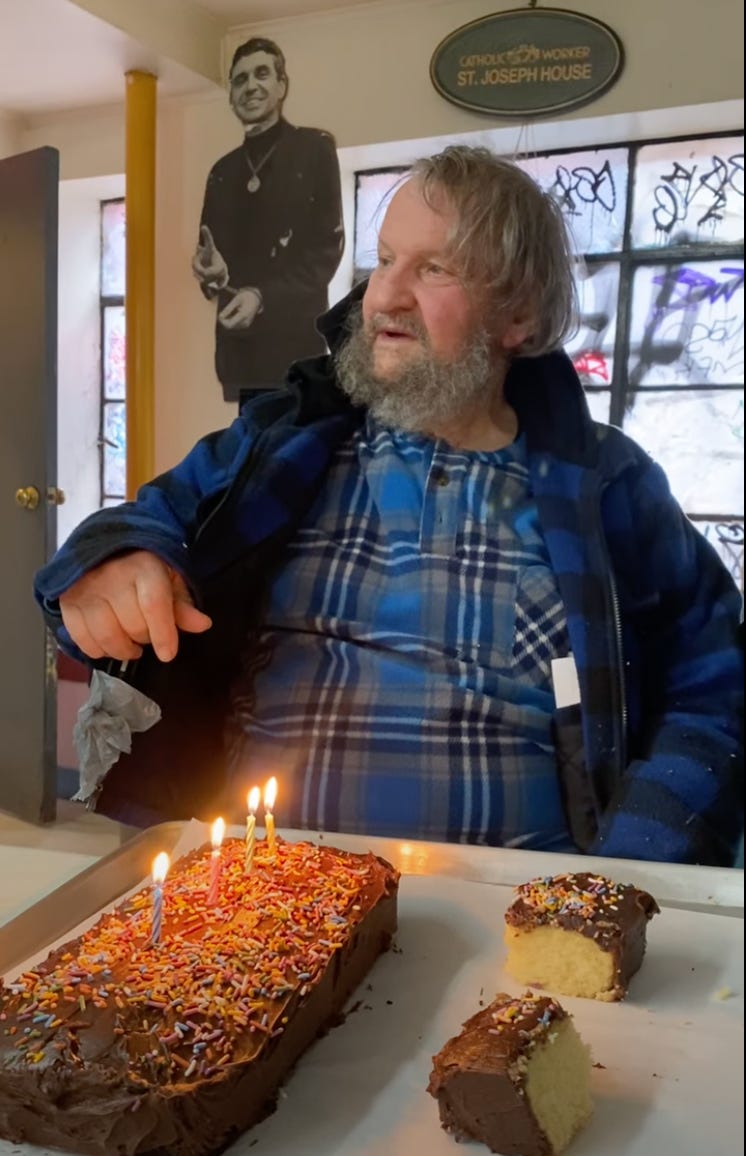
By Geoffrey Gneuhs
Eugene was a Dickensian, larger than life character. Picture W.C. Fields as Mr. Micawber in the 1935 classic film David Copperfield.
They even looked alike. Eugene had the gift of gab, non-stop, and like Micawber could talk himself out of any situation, scrap, or mishap—some of his own making!
Some years ago volunteers at St. Joseph House on East First Street dubbed him “the Genius.” James Murphy and Philip Basile made several short YouTube interviews with him titled “Solt of the Earth.” He referred to them as the “orderlies.”
His presence filled the room. Visitors were always amused with him, even mesmerized (although for some living in the house 24/7 he tested their patience). Eugene had a way with words and wordplay. I loved to engage him. He was not a conversationalist, although he would have liked that “ten-dollar word,” he would say, and put out his hand and give me a hearty, strong handshake. He made me and others laugh. I recall the writer Umberto Eco’s observation that “laughter is the basis of freedom”—and Eugene was a free spirit.
He was sui generis. He was a kind of savant, commenting on anything and everyone. He loved to talk of all the old radio and TV shows of the 1940s and 50s as well as Broadway shows and movies. When he was talking he gestured with his hands and his face. When I bested him on a name of some actor or movie he would thrust out his hand and shake mine. Sometimes he let out a whistle, “Whrrrr...” as a kind of exclamation. He was a gabber. Recall the famous comic team Burns and Allen, Eugene was the male version of Gracie, telling stories in a very elliptical, meandering way of his sixteen uncles and aunts. At Mass, wearing his signature rosary-plastic-around his neck, he would chime in at the prayers of the faithful and was unstoppable.
He liked to tell the story that he was a preemie, weighing 3.2 pounds at birth. He grew up in Elmhurst, Queens, with an older brother and sister. He finished high school and then had a slew of jobs, usually not holding any for too long, although he did work at a Burger King on Northern Boulevard for six years. For a while, he loaded trucks and was proud to be “a Teamster.”
Along the way he picked up some electrical skills. He loved cars and at one time had nineteen. I asked him how could he afford them, and he leaned forward, “Weellll...you might say I ‘borrowed’ them”!!! He had an Edsel with 80,000 miles on it. He parked them throughout his neighborhood. His mother, who doted on him, kidded him saying he was married to his cars.
Apparently both he and his mother were incessant talkers. I asked him how either of them could get a word in edgewise. He laughed. His father was not so amused. When Eugene was in the hospital for two weeks for tonsillitis, his father, he told me, was “sooo happy”!
He called Eugene an “operator, a conniver, a lay-about” as he would tell me. Surprisingly, he revealed to me that one Christmas his sister had been given a violin and then suddenly weeks later it was missing. “Eugene, you didn’t, did you?!!!” With a wink, he let out one of his long “Weeelll…”
His mother, who worked at Bloomingdales, took him to shows and movies; she was a “great dresser.” I smile, thinking of Eugene the tyke, all dressed up going about with his mom.
Eugene first visited St. Joseph House in 1978 for a day and then, in the middle of a night in 1998, was let in by Whiskers and became a fast friend of Whiskers, Joe Foth, and Brad—”a great cook”—along with Roger O’Neil. He stayed twenty-six years. He was a pack rat. I referred to his eight by twelve room as Fibber McGee’s closet, of course he knew the old radio show reference and was quite pleased. It was packed to the ceiling, even with stuff on his bed. “How do you sleep?” Another long “Weeelll….”
Eugene was an inveterate bike rider. Every day he rode throughout Manhattan. One of his chores for the houses was to pick up the mail at Maryhouse—which sometimes involved some mishap for which he was ready with one of his “explanations.” He was a fan of the renowned actor Jerry Orbach of renowned actor Jerry Orbach of Broadway’s “The Fantasticks,” and of TV’s “Law and Order.” Eugene would follow the television crew around the city.
As the years went on, Eugene met a woman living on the street. Her name was Dina, she a waif to his substantial figure. They became inseparable. Every day they were out in the neighborhood, going to parks or to a nearby senior center, getting coffee or a soda, engaging and befriending those they met along the way. Dina’s dream was that they would get married and she would take him out of St. Joseph House, which, in her opinion, wasn’t feeding him properly and she was going to help him lose weight.
By now, Eugene’s legs were bad and had to be dressed daily, by Tom Heuser and Dan Mauk, among others. He had to use a walker but he and Dina pressed on regardless.
Then, each fell ill. Dina went to a hospital on Staten Island and Eugene uptown to Mary Manning Walsh nursing home. Each day they talked on the phone and sent cards to each other. Dina sent Eugene a little Teddy Bear.
In mid-September of this year, Eugene got pneumonia. One Tuesday, my normal day for playing piano at the home with Eugene listening to Orbach’s famed melody “Try to Remember,” he wasn’t there but already in the hospital. He was still conscious, but with all the tubes he could not talk, but he thrust out his large, strong hand and grapsed mine for the next half hour. The next day he was sedated.
Uncannily (or providentially?), in the morning I was watering my flowers in the window box and looking out saw Dina with her walker. She had come in from Staten Island. I explained to her that Eugene was ill and brought her up to the hospital. She stood next to him patting his forehead and caressing his cheek. “Eugene, don’t die! I love you, I love you....” She stayed for hours.
Some days later Cathy Breen, Tanya Theri-ault and Matt Vogel were with Eugene the day he passed peacefully.
And so Eugene, “Try to remember the kind of September when you were a tender and callow fellow…”
Geoffrey Gneuhs is an artist in New York City. He pursued postgraduate studies at Yale, writing his thesis on Peter Maurin, the mentor of Dorothy Day, co-founder of the Catholic Worker movement. He was chaplain at Mary House in the 1970s and presided at Dorothy Day’s funeral Mass in December 1980.