

Cultivating Nonviolence in Study and Practice
Inside: a book review of Jeremy Varon's "Our Grief is Not a Cry for War"; part two in our series on Christian nonviolence; a Juneteenth reflection and summertime news from Catholic Worker communities
The Divine Vision, the Divine Weapon

We repeat, there is nothing that we can do but love, and dear God—please enlarge our hearts to love each other, to love our neighbor, to love our enemy as well as our friend.
Dorothy Day, Love is the Measure (1946)
This week, as the U.S. bombed Iranian bridges—a series of attacks the United Nations called “unacceptable”—it seems unbelievable to me that there is still a suicidal commitment to war, a widely encouraged dependency upon the economy of destruction. The President of the United States boasted of this expensive, destructive commitment this week at the war college down the highway from us here in Harrisburg.
As much of the eastern United States was covered in a toxic smog from Canadian wildfires and endured continued extreme heat, it seems unbelievable to me that fossil fuel companies still block the green energy transition. It seems unbelievable we can still think of our fuel consumption, water consumption, our individual treatment of the earth as something that has no impact on our neighbor.
As the President of the United States attacked the U.S. election system on primetime television, it seems unbelievable to me that the will of the mighty can run roughshod over the will of the community. It seemed unbelievable to me, even as I was reading Jeremy Varon’s history of resistance to the Iraq War, that millions across the world could stand against an unpopular war and the machine of war still churned out its wanton destruction and suffering.
“It grows ever harder to talk of love in the face of a scorning world,” Dorothy Day wrote in 1950, surveying the news of her own day:
We have not begun to learn the meaning of love, the strength of it, the joy of it. And, I am afraid we are not going to learn it from reading the daily papers or considering the struggles that are taking place on the other side of the world, and in the United Nations halls here at home.
As Colin Miller writes in his ongoing essay series on the theology of Jesus’ nonviolence, Jesus’ Good News announces that “another way of being human is possible because this violent vision of the world is a lie.”
Perhaps that’s why I can’t quite find the chaos, competition and greed that the destruction business exports into the world believable. This violent vision of the world our leaders encourage distorts the world’s true nature—our true identity as love.
We may not read a lot about love in the newspapers of the week, but I hope you will find a lot of stories about the “divine weapon” as Dorothy calls it, here in Roundtable. It is hard to talk of love, to love others, as Day writes, love in action is not always easy, but it gives us a true vision of the world—it reminds us of who we truly are.
Renée
In the face of the approaching atom bomb test [… ]in the face of an approaching maritime strike; in the face of bread shortages and housing shortages; in the face of the passing of the draft extension, teen-agers included, we face the situation that there is nothing we can do for people except to love them.
Dorothy Day, Love is the Measure (1946)

FEATURED
CWReads: Learning from the Movement to Stop the War on Terror
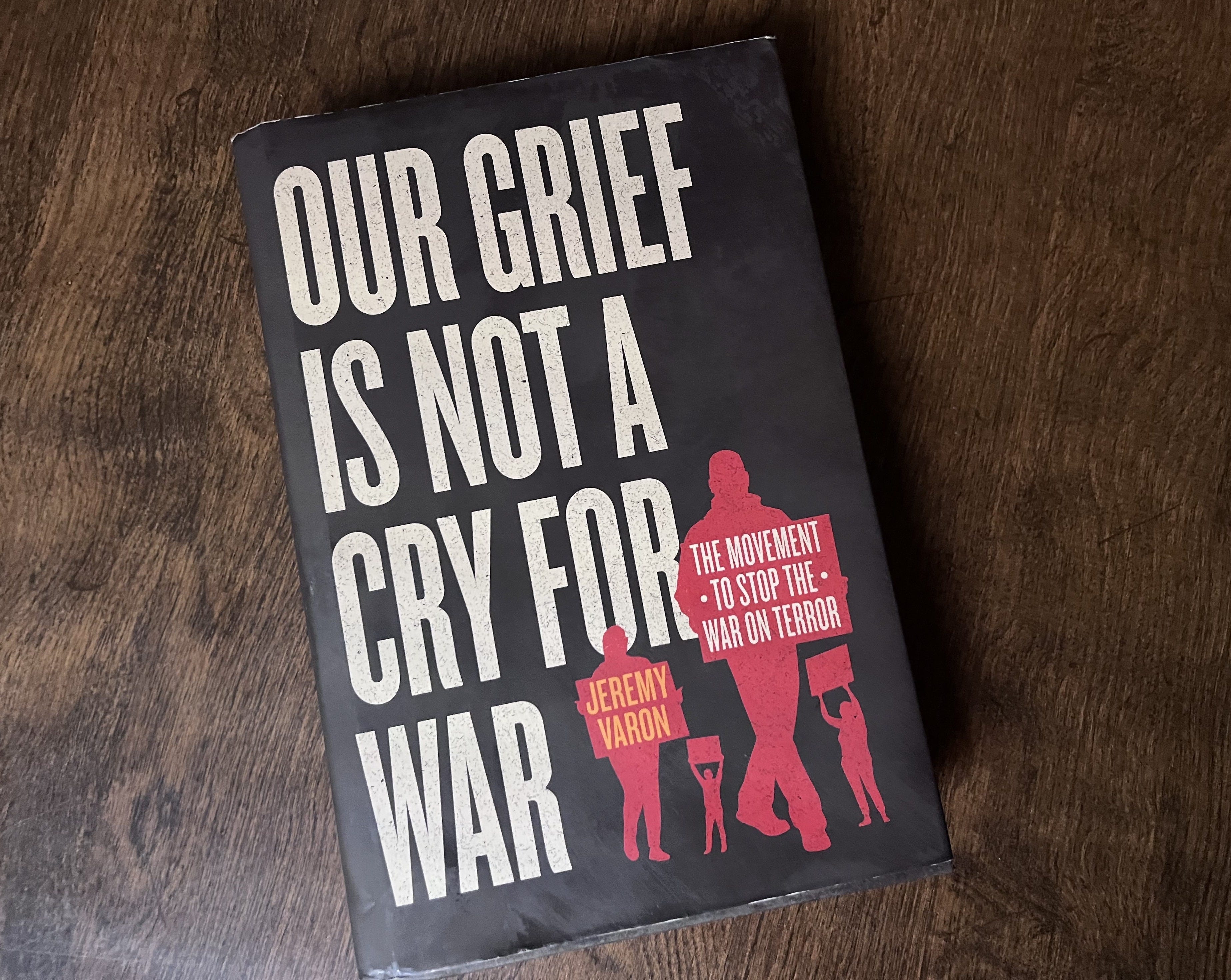
For CWReads, Roundtable editor Renée Roden reviews “Our Grief is Not a Cry for War” by Jeremy Varon, which offers a history of the antiwar movement during the period surrounding the Iraq War in 2003. Roden writes:
Varon’s book takes in intimate, rather than 30,000-foot view of the Iraq War resistance, he tells history through a microscope rather than a panorama. He pulls out the strands of counter-cultural voices who demanded the grief of the American people not be distorted into a “cry for war.”
Varon, a contributor to The Catholic Worker and a member of Witness Against Torture, an ally group of Maryhouse Catholic Worker, has created a clear and thorough history of this peace movement that was created in response to the violence of September 11, 2001.
Varon’s patient, careful book charts the story of the years after the September 11 attacks, and a careful account of the war-mongering that followed in the years preceding the invasion of Afghanistan in October 2001 and the invasion of Iraq in March 2003. And, even as war was mounting, a global, populist cry for peace mobilized millions in response.
Read the full review at CWReads.
CWReads: A Theology of Jesus’ Nonviolence, Part Two
This week’s CWReads featured the second part of Minnesota Catholic Worker Colin Miller’s long-form essay on Christian nonviolence. In this second part, Miller examines the importance of the cross in the theology of nonviolence:
The second key to understanding the uniqueness of Jesus’ revolution is that the cross is the supreme Christian symbol because it is the supreme embodiment, not just of Jesus’ death, but of the way of life he lays out for his communities. On the cross he is putting into action the nonviolent revolution we briefly outlined above. On the cross his kingdom platform is on display for all the world to see. Or, as Origen of Alexandria, the early Church father, said, Jesus is the “kingdom-in-person” (autobasileia): the law he gave to his Church and expected of his disciples, he was the first one to live out.
Read part two in CWReads here. If you missed it, part one is available here.
COMMUNITY NEWS & NEWSLETTERS


Catholic Worker Summer Camp Educates and Entertains Youth
Mustard Seed Catholic Worker in Worcester, Massachusetts, is hosting a summer camp for third and fourth graders, offering fun and educational opportunities.
From Facebook:
These children come from all walks of life and are truly incredible young people. They come from families at or below the poverty line. We provide them with a camp that includes field trips to places like the Museum of Science and Southwick’s Zoo and academic intervention in math, science, reading and science/innovation. Everything is funded through grants and the public’s generosity.
Our staff once again trying to give these students a “leg up” as school begins. We are collecting funds/items to make backpacks and provide some new clothing for the start of school. We need to raise over $3500 to do this project.
To learn more or support this program, visit the Mustard Seed Facebook page.
The Illuminator Opts for Artistic Intelligence, Not Artificial
In the July 2026 issue of The Illuminator, a newsletter dedicated to covering the Catholic Worker artist community and praxis, Sarah Fuller pulled out a relevant section on art from Pope Leo XIV’s new encyclical Magnifica Humanitas. Art, she writes, helps humans remember “what path we want to follow.” This issue features an interview with Roundtable Art Editor Monica Welch, who shared her own spiritual and artistic path with Bex McIntyre and Sarah Fuller:
She was always “the crazy pacifist” growing up in Washington DC, she said, and didn’t understand how Christians could be involved in institutions like the military. … Monica grew an audience for her art, and that audience was mostly conservative Catholics. However, Monica was starting to struggle with the differences she began to perceive between some of Catholicism’s ideals and the more U.S. “culture wars”-style themes that she began to see being emphasized in Catholic spaces in her Texas community.
The interview features several pieces of Monica’s digital art, many of them created for Roundtable. Read the full issue and subscribe to The Illuminator here.
Iowa City Catholic Worker Asks for Volunteers to Accompany Immigrants
In an email to subscribers, the Iowa City Catholic Worker mourned the recent shootings by ICE agents. In one week, ICE agents shot and killed two men in both Maine and Texas. Another man in Florida was struck by a tractor-trailer truck this week while escaping ICE agents. “The past two weeks have shown both the human cost of today’s immigration enforcement and the power of organized communities,” Emily Sinnwell of Iowa City Catholic Worker wrote.
As the surge in detentions continues, with ICE charting close to 1,500 daily arrests in July, Sinnwell noted that the community had witnessed to immigration enforcement overreach with the detention of 10 immigrants caught up in Iowa State Patrol traffic stops. “None had criminal records,” she writes. “They were working, studying, raising families, or seeking asylum.”
Sinnwell wrote that the Iowa City Catholic Worker and Escucha Mi Voz organizing team is receiving roughly 50 calls a day from immigrants seeking justice in the workplace, from landlords and from immigration officials. They hosted a Mass and a potluck dinner for volunteers assisting the community on Friday. They invite volunteers to help them by accompanying vulnerable families to high-risk ICE check-ins. Visit their website to learn more here.
New Issue of “Via Pacis” Covers Peacemakers Across the Country
The July issue of the Des Moines Catholic Worker’s Via Pacis is available online and in subscribers’ inboxes. The issue shares the powerful testimony of Mike Miles from his experience at the Midwest Faith and Resistance Retreat in April. Bill Douglas shares his story as an itinerant peacemaker in the 1970s, when the way of peace took him from Fresno, California, to Leavenworth, Kansas, to Iowa City and Des Moines. Bob Mulqueen gives readers a glimpse into one day at Dingman House, where the revolution is happening over well-scrubbed pots and pans. Mulqueen shares some colorful portraits of regulars—it’s certainly not the kind of revolution you’ll see on television screens. Finally, the paper shares excerpts from Paul Magno’s and Frank Cordaro’s roundtable on the legacy of Dan and Phil Berrigan at Dorothy Day House in Washington, D.C., last month. Paul shared:
One grouchy old guy confronted Dan says, “You know, you’re complaining about the church so much. You have so much you don’t like about it. You’ve been telling us about that for the last half hour. If you have so much trouble with the church, why don’t you just leave?” And Dan’s answer stayed with has stayed with me forever. He said, “Look, have you listened to the people I’ve been talking about? The activists in jail, the people who are trying to resist nuclear weapons and understand that it’s immoral, and it’s threatening the future of the planet. That if these weapons are left alone and given any honor whatsoever, they will burn down the planet. These people that I’ve been talking about and myself, and my other friends, are people of sacrament and prayer. And that is the very center of what it means to be a Catholic. We are at the center of it and they [the bishops] are not, and we’re not leaving. If they want to, they’re welcome, but I’m not going anywhere.” And that just blew me away.
Read these and more at the full Via Pacis issue online here.
Coffee with Catholic Workers Podcast Features Kombucha-Brewing Workers
The latest episode of the Coffee with Catholic Workers podcast features Paul and Sarah Freid of the Lake City Catholic Worker in Minnesota sharing their journey to creating a Catholic Worker farm. They talk about first meeting the Catholic Worker’s radical vision of Gospel nonviolence at an Atlantic Life Community protest in Washington, D.C. as college students, building a straw bale house on their farm and starting their kombucha brewing business on their farm—John the Baptist Brewing Company. Listen here.
Canonization Update from Dorothy Day Guild
The Dorothy Day Guild sent out an update on her cause for canonization. They included a report on the status of Dorothy’s positio, the formal brief the Dicastery for the Causes of Saints writes to summarize her life and work:
Currently, Dr. Waldery Hilgeman and his colleagues are at work on the informatio, the section of the positio which addresses Dorothy’s legacy, her heroic life, and additionally contains a record of all of the favors that were obtained by the faithful through her intercession. They hope to complete the positio in its entirety by the end of the summer and present the final version to the Dicastery by the close of 2026.
Once the dicastery approves the positio, the path is open for Pope Leo to declare Dorothy Venerable!
View Dr. Hildeman’s video update or read the full newsletter here.
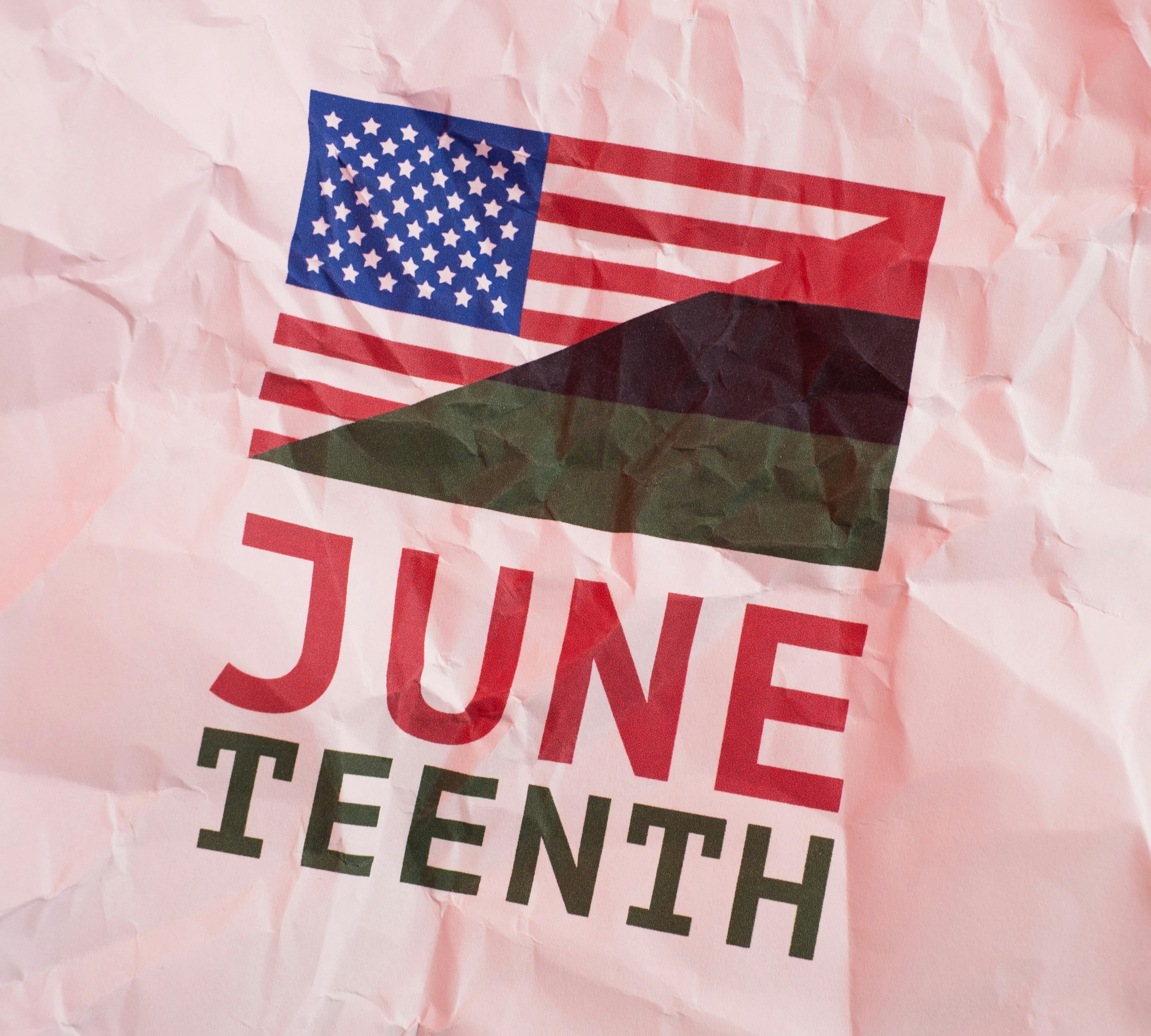
Casa Maria Catholic Worker on Juneteenth: Corporate America & Liberation
In a Facebook post, Michael Komba of Casa Maria Catholic Worker called out the hypocrisy of the corporate entities present at Milwaukee’s Juneteenth celebration and the problems they have created in their community:
Milwaukee’s Juneteenth Celebration is always a wonderful and important event that I love to attend every year. This year, there were so many great organizations present, but also some that are causing harm.
I first noticed Maximus, a global leader in the privatization of public services. We have had countless black families stay with us who became homeless after Maximus wrongfully denied them services or financial support. Maximus was also responsible for the child protective services (CPS) case of 8-year-old Gabriel Fernandez. He died horrifically after Maximus refused to take him out of the care of his tremendously abusive mother and her boyfriend. (See the Netflix documentary.) In an internal report, Maximus referred to kids in foster care as “revenue generating mechanisms” and has been sued for race and gender discrimination by their own workers.
Next I noticed Kroger, which owns Pick ‘n Save, Metro Market and Roundy’s. Year after year, farmworkers have exposed slavery rings tied to Kroger, yet Kroger still refuses to join the Fair Food Program.
Then came JPMorganChase, which has basically given up even the pretense of caring about real renewable energy investments since Trump took office. […]
I pray that by next year's Juneteenth celebration God has touched the hearts of some of those involved in these wrongs and they start their path to redemption.
Read the full post on Facebook.
Former Interns Discuss Keeping Their Catholic Worker Experience Alive
Los Angeles Catholic Worker hosted a live-streamed Roundtable with former interns and Catholic Workers entitled “Taking the Catholic Worker With You,” discussing the lingering impacts of the Catholic Worker on their lives and work. Participants in the roundtable talked about how they talk about the Catholic Worker with conservative friends, skeptical Catholic friends, what they’ve learned about the Catholic Worker and their own politics, and what could change or improve about Catholic Worker life. Available to view on the Los Angeles Catholic Worker’s Facebook page.
St. Bakhita House Joins Thrive for Life Community
St. Bakhita Catholic Worker House in Milwaukee, Wisconsin, announced it will join a new network of communities for formerly incarcerated men and women. St. Bakhita House announced it is now a part of the Thrive for Life Community, a Jesuit ministry offering educational opportunities, spiritual formation, and trauma-informed care in a residential community to formerly incarcerated individuals. Rev. Zach Presutti, SJ, founded the first Thrive For Life residential community near Fordham University in the Bronx in 2016. Anne Haines, founder and Executive Director of St. Bakhita Catholic Worker, wrote:
In the spirit of solidarity and with a desire to ensure that we serve as many women as possible, we are becoming a part of the Thrive for Life community! We are beyond excited that those in community at St. Bakhita House will now accompany highly committed and motivated women who want to continue their education post incarceration while living in a supportive living community. This of course folds in, yet expands, our current support of women survivors of sexual exploitation.
More information available at the Thrive for Life website.
Harrisburg Catholic Worker Calls for Extension of TPS for Haitians
On Facebook and its website, St. Martin de Porres Catholic Worker in Harrisburg, Pennsylvania, shared a message encouraging followers to ask their senator to pass the Senate bill S. 4814, which would extend Temporary Protected Status (TPS) for Haitians and Syrians in the United States until 2029.
This would ensure that the more than 300,000 Haitians who have relied on TPS to flee from harrowing threats to their life could stay safely in the U.S. The Supreme Court decision in Mullin v. Doe in June, however, means that more than 300,000 Haitians could be vulnerable to deportation, starting in the next few weeks. Learn more and send a message to your state representative at this link.
Art Laffin Writes on Pentagon 27 Witness, Magnifica Humanitas
Art Laffin of the Dorothy Day Catholic Worker in Washington, D.C. wrote an essay for Shane Claiborne’s Red Letter Christians on the witness of the Pentagon 27 and Pope Leo XIV’s call for peacemakers in the new encyclical “Magnifica Humanitas.” Read Art’s full essay here.
CW IN THE MEDIA
Tacoma Catholic Worker Reports on Growing Movement for Migrant Rights
Cory Johnson, of Tacoma Catholic Worker, writes for FāVS News on how local organizing by Catholic leaders brought hundreds of parishioners together in acts of witness and solidarity. Johnson writes:
So a group came together to plan a series of events throughout the region that would show solidarity for migrants and give people of faith a sense of purpose and place to demonstrate their belief in a God that welcomes and dignifies all people.
From November through May, 950 Catholics and allies showed up at events throughout the Puget Sound. A candlelight vigil in a downpour outside Seattle’s federal courthouse told detained migrants that when one member of the Body of Christ suffers, all believers suffer.
A Stations of the Cross event during Holy Week offered an invitation to see Jesus clearly in the immigrant experience. The stations related Jesus’ story of being condemned, falling under the weight of the cross, stripped of dignity and ultimately crucified to stories of modern migrants in the community forced to leave their homes, to live in uncertainty and to prove that they are worthy of existing. One station asked: ““How many people in our community carry crosses of displacement, deportation, detention, disenfranchisement, forced assimilation, isolation, hiding, and unfair labor?”
Read full article at FāVS News.
Arms Control Today Highlights Prophetic Stance of Pacifist Catholic Worker
In “The Pope’s Historic Encyclical: Disarming AI and Building a Just Peace,” Maryann Cusimano Love credits the Catholic Worker movement with helping move the Catholic Church away from just war theory.
All popes since World War II have called for a greater emphasis on building a just peace, noting that almost all conflicts do not meet the criteria for a just war. Catholic peace groups such as Pax Christi USA and Dorothy Day’s Catholic Worker call for going farther by totally eliminating the just war tradition, in the same way that the Catholic Church changed its position from supporting to opposing the death penalty. It is more likely that Leo the Augustinian will restore St. Augustine’s emphasis on just peace, rather than jettison the just war tradition entirely. He mentions “peace” 67 times in Magnifica Humanitas, and “just war” only once.
Full text available at Arms Control Today.
Ohio Teen Learns From Tutoring at Akron Catholic Worker
The Record, a Catholic publication from central Kentucky, reports on the volunteer experiences of local teens, including Julia Leneghan, who spoke about her time tutoring immigrant children at the Akron Catholic Worker in Akron, Ohio. Leneghan told The Record:
“I wanted to expand my thought process about refugees in different cities and from different areas,” said Julia, noting that they tutor children from Mexico, Guatemala and El Salvador. In Louisville, she is learning about refugees from other places, such as Congo and Cuba. “It’s way different from what we’re used to.”
Read the full article at here.
Genealogies of Modernity Profiles Catholic Worker Artist Fritz Eichenberg
Genealogies of Modernity, a Magazine and Substack, shared an essay on Catholic Worker artist Fritz Eichenberg in a recent issue.
A German–Jewish immigrant, he converted to Quakerism after fleeing the Third Reich with his family and the unexpected death of his wife. One of the world’s foremost wood engravers, his prolific output spanned a range of subjects that included illustrations of literary classics by figures such as Dostoevsky, Tolstoy, and Poe. His conversion drew him more deeply into religious themes, and although he didn’t share Maurin and Day’s Catholicism, Eichenberg found in their movement a place to express his own commitment to peace and Christian ethics.
Read the full essay here.
MARK YOUR CALENDAR
Magnifica Humanitas Virtual Roundtable
Virtual Event — Claire Lewandowski from the Los Angeles Catholic Worker and Jessica Gerhardt, Catholic artist, are offering a virtual roundtable reading group on the new encyclical, Magnifica Humanitas, on Sunday, July 26 at 5:00 p.m. Pacific Time. Learn more and RSVP on Instagram here.
Ozark Foothills Catholic Worker Farm to Host In-Person Roundtable Discussion on Magnifica Humanitas
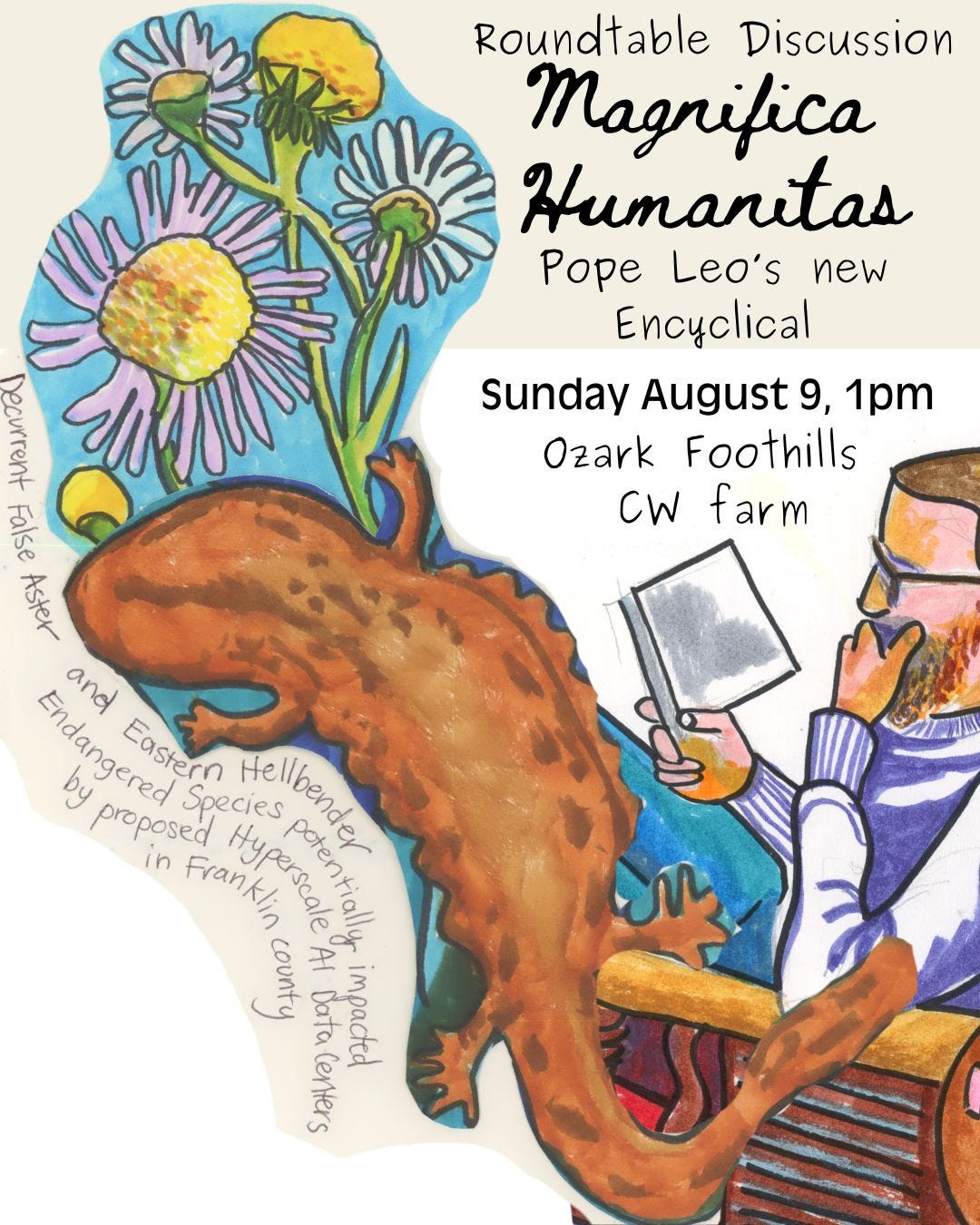
Catawissa, MO — Ozark Foothills Catholic Worker will host an in-person roundtable discussion on Pope Leo’s recent encyclical Magnifica Humanitas. On Sunday, August 9. There will be a simple meal around 12:00 p.m, and the discussion will start at 1:00 p.m.
Learn more by signing up for the Ozark Foothills Catholic Worker Farm newsletter or visiting their CW.org page here.
SAVE THE DATE: Sugar Creek Catholic Worker Gathering
Sugar Creek, Iowa—The Midwest Catholic Worker Gathering at Sugar Creek, Iowa, will take place the weekend of September 10-13, 2026. Mark your calendar and stay tuned for more information! You do not have to be living in an existing Catholic Worker community to attend.
SAVE THE DATE: “One Hundred Angels Delegation” to El Salvador
Frank Cordaro of the Des Moines Catholic Worker is organizing an eight-day delegation to El Salvador from October 11–19, 2026, in honor of Rev. Bob Cook, a good friend of the Des Moines Catholic Worker. They plan to bring a delegation of between five and 15 participants to visit the communities in El Salvador that Cook developed a relationship with—they plan to “visit rural communities, learn about ongoing water and infrastructure projects, share meals with local families, and experience the culture and beauty of El Salvador.”
Cordaro shares that the purpose of the delegation is to “deepen relationships, witness the impact of community-driven projects, and continue the spirit of solidarity that Bob championed throughout his life.” Interested parties should reach out to Frank Cordaro at the email below to learn more: frank.cordaro@gmail.com.
SAVE THE DATE: Mary’s House Retreat
Birmingham, Alabama—Mary’s House Catholic Worker in Birmingham, Alabama, will offer an Advent retreat entitled “Building a New Society in the Shell of the Old” with Brian Terrell and Betsy Keenan from December 4-5, 2026, leading reflections on building community and resisting the evils of the day. More information at maryshousebham.com.
WORDS FROM THE ELDERS
From “The Message of Love”
by Dorothy Day, from the December 1950 issue of The Catholic Worker
It grows ever harder to talk of love in the face of a scorning world. We have not begun to learn the meaning of love, the strength of it, the joy of it. And, I am afraid we are not going to learn it from reading the daily papers or considering the struggles that are taking place on the other side of the world, and in the United Nations halls here at home.
We are the little ones, and we can only pray to the saints of our days, the little saints, to disclose to us this hidden world of the Gospel, this Hidden God, this pearl of great price, this kingdom of heaven within us. It is only then can we learn about love and rejoicing, and it is the meaning of life and its reward.
We talk of one world, and our common humanity, of principles of justice and freedom which befits the dignity of man, but from whence does one derive this dignity but that one is the child of God?
The one lesson which is reiterated over and over again is that we are one, we pray to be one, we want to love and suffer for each other, so let us pray and do penance in each little way that is offered us through the days, and God will then give us a heart of flesh to take away our heart of stone—and with our prayers we can save all those dying each day, knowing that God will wipe away all tears from their eyes.
Lest these words which I write on my knees be scorned, know they are St. John’s words, the Apostle of love, who lived to see “charity grow cold” and who never ceased to cry out “my little children, love one another.”
It is the only word for Christmas when Love came down to the mire, to teach us that Love.
Read the full column here.