

This Pentecost: Catholic Workers on Fire for Peace
Inside: Dorothy Day on Pentecost; Two Catholic Workers on (non-) violence in the Church; a Vietnam War Veteran decries the depersonalized language of war; and two Catholic Workers on "Rededicate 250"


This Pentecost, Reclaim the Trinity
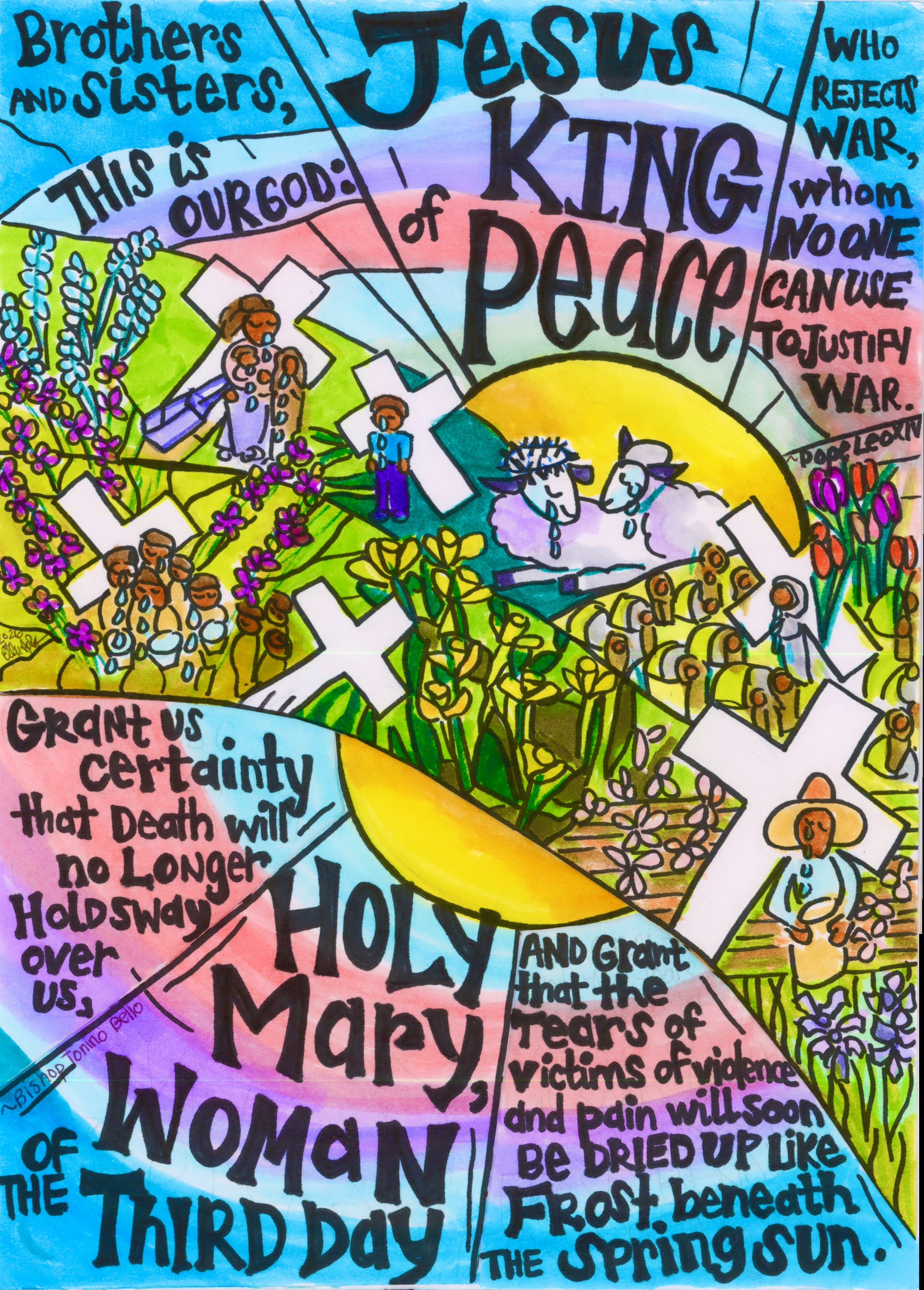
This weekend the United States celebrates Memorial Day and the Church celebrates Pentecost. The calendar seems to be mixing civil and religious worship in much the same way as the recent spectacle of Rededicate 250, a Christian Nationalist prayer gathering in Washington D.C. The projection of stained-glass windows decorated the speakers’ stage, centering a white cross with revolutionary war soldiers behind, flanked on either side by federal style columns.
This Rededicate 250 event served to further the Christian Nationalist narrative where patriotism, Christian faith, and American identity are fused into one—offering a different type of trinity. As if God authored the Declaration of Independence to create a country by and for white Christians.
On Pentecost, the Church celebrates the third person of the Christian Trinity coming among us. The Holy Spirit descends, and this imagery is fire. Flames come to rest on the apostles’ heads, giving them the gift of tongues. Now spoken into different languages, the Gospel message is ablaze and ready to travel. It’s almost as if Christ’s message wasn’t exclusive to one people or one nation, that Christ came for all.
This message of Love gets so perverted. Christian Nationalism is on full display right now, but we’ve lived with the “giant triplets,” as Martin Luther King Jr. called them, of racism, extreme materialism and militarism for a long time. But this moment calls us to reject these triplets as they are offered anew as articles of faith.
In CW Reads this week, we have two works of powerful witness to Christian nonviolence. Edward Speed of the San Antonio Catholic Worker writes of Body of Christ wounded in war, and the risk of sterilizing the reality of war through language. Ellen and Shane Hughes, of Ozark Foothills Catholic Worker Farm, write about the alarming normalization of violence, even finding it in their church bulletin. Additionally, Art Laffin writes with a personal report of his protest vigil outside Rededicate 250.
This Pentecost, let us pray that the Spirit will keep moving among us, changing hearts and guiding us in Truth.
Till next time - peace!
Ashley

FEATURED
CW Reads: War is Not Sterile
Edward Speed, a volunteer at the San Antonio Catholic Worker wrote about his horror at the clinical language used for modern warfare that hides the violence being done to real, human flesh and blood. His essay was shared in CWReads on Thursday (subscribe to CWReads in your account settings here). Speed, a Vietnam Veteran writes about his reaction to the first sickening days of the U.S. strikes on Iran:
We hear about targets, tactics, blast zones, and precision strikes, capabilities degraded and strategic assets eliminated. War is discussed as if it were primarily an engineering problem.
Then the conversation quickly shifted. Within hours the focus moved to economic impact, the safety of shipping lanes, and what might happen to oil and gas prices. The conflict begins to be measured largely through the lens of supply chains and energy costs.
But something important can quietly disappear when war is discussed primarily in those terms.
Behind every “target” there are human bodies.
Behind every blast zone are people who woke up that morning, drank coffee, worried about their children, and went about the ordinary rhythms of life.
The language we use can create a kind of distance, as if what is happening were theoretical rather than something that tears into flesh and bone.
Before my life in finance and then theology, I was trained as an armor officer in the U.S. Army. I learned to use tank weapons designed not only to destroy but to, maim, wound and terrify. We trained with white phosphorus rounds that burn white hot and cling agonizingly to human flesh and with “flechette” rounds, which are anti-personnel “munitions,” carrying thousands of tiny steel darts, designed to shred human flesh. In live fire tank exercises the practice targets for those rounds were clusters of human silhouettes. The lesson was unmistakable.
Through grace and timing between wars, I never had to put another human being in my sights nor give the order for my tank company to fire.
When I hear the clinical language of modern warfare, I cannot hear it simply as strategy. I know, at least in some small way, what those weapons do to the human body.
Read the full editorial on CW Reads here.
CW Reads: The Church Needs Jesus’ Nonviolence, Not Militias
Ellen and Shane Hughes of Ozark Catholic Foothills Farm wrote about a 2024 incident at a nearby St. Louis parish in which the church bulletin published an advertisement for:
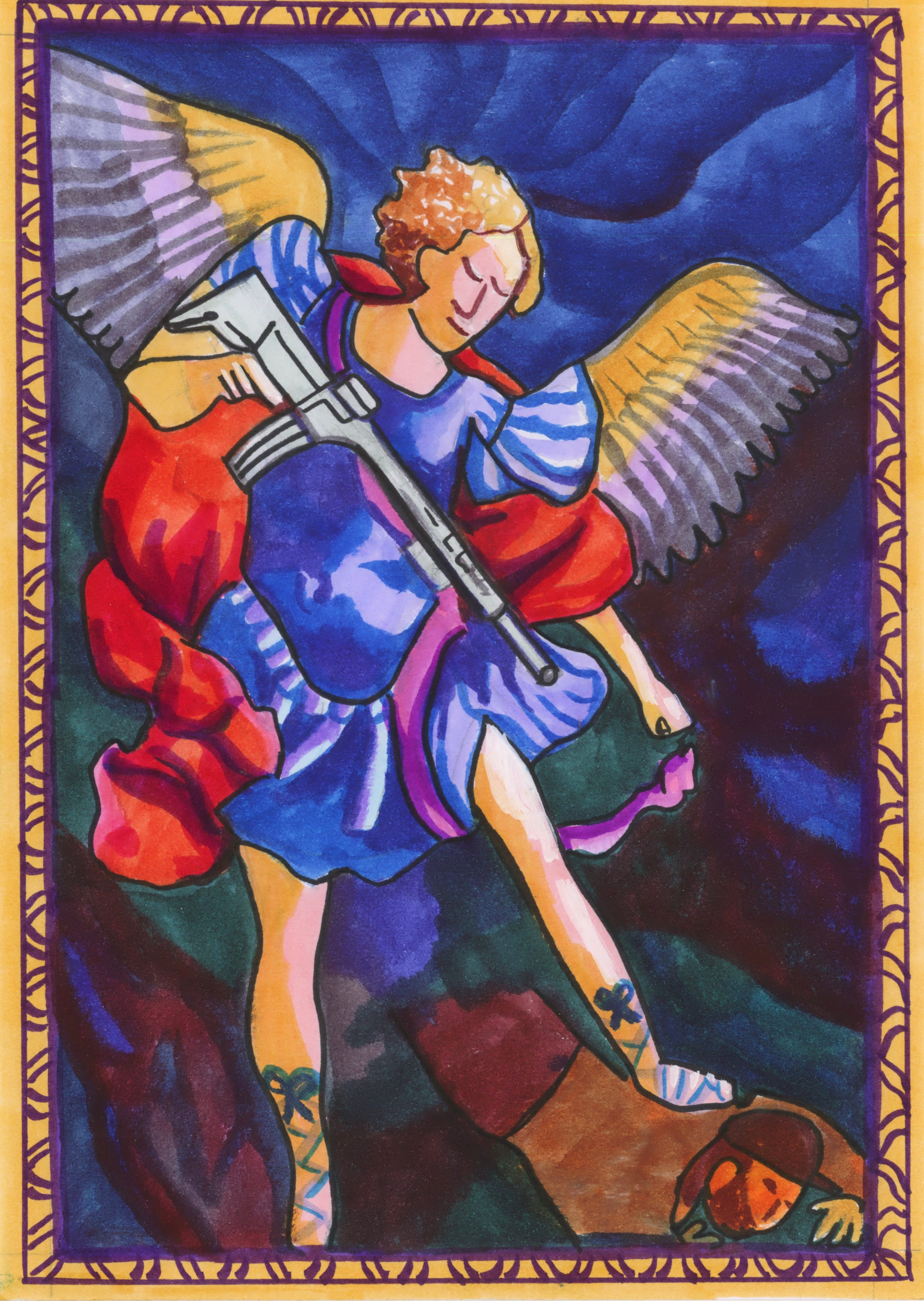
“young men between the ages of 18-29” to “form a militia dedicated to protecting the Holy Eucharist, our congregation, our clergy, and the church grounds.” It called for training in “strict physical fitness standards, classroom study, and instruction in military operations.” Since this would be the founding “Legion Council,” there was a specific need for men with expertise in a few key areas, including “Military (e.g. soldier, marine, sailor, airman).”
Once this got out on social media, there was intense backlash. The local Catholic church pulled the copy of the bulletin off the website and issued the following statement:
“the suggestion that our community might require a militia in order for us to celebrate the Eucharist is both inappropriate and unhelpful.”
“Please be assured that there have been zero threats against our community,” it asserted.
Shane and Ellen, in their first essay for their new journal, Miramiguoa, and republished in CWReads, The parish’s response to the announcement was “most telling in what it lacked: a denunciation of violence.” They write:
Its assurance that there was no credible threat—as if to say, we don’t need a militia at the moment—implied that perhaps, were there real threats in the future, the announcement could return. It meant the proposal was “inappropriate and unhelpful” not in its inherent message but in its timing and context, in its reading of the current environment. Notwithstanding where we might be tempted to point in the Old Testament, Christ’s message in the Gospels is quite clear about violence. The Sermon on the Mount calls us to “offer no resistance to one who is evil,” to “love your enemies, and pray for those who persecute you.” We are to “turn the other cheek” when struck, and told to “be perfect, just as your heavenly Father is perfect” (Matthew 5:38-48).
When Jesus encounters injustice and adversity, he responds not with violence but with compassion. Many of his most subversive acts in life are in healing and forgiveness: the man with the withered hand (Mark 3:1-6), the woman caught in adultery (John 8:3- 11), and the crippled woman on the Sabbath (Luke 13:10-17). He rebukes his followers when they suggest violent retaliation: when James and John call for the destruction of an inhospitable Samaritan village (Luke 9:52-55) and when one of the Twelve attack the high priest’s servant with a sword (Matthew 26:51-52).
Read the full essay here.
Featured: Catholic Worker Vigils Outside “Rededicate 250” as Part of “Redirect 250”
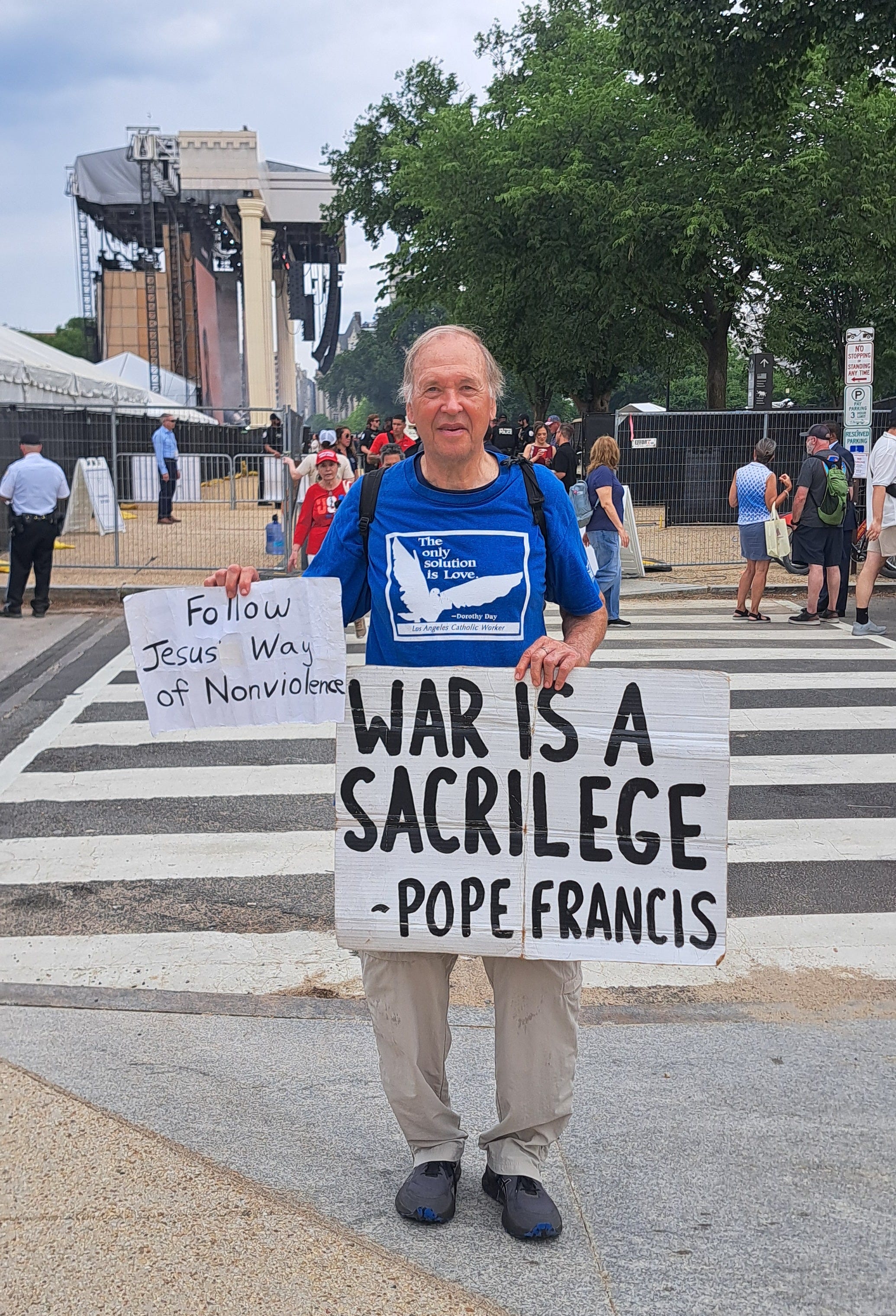
Art Laffin, of Dorothy Day Catholic Worker in Washington, D.C., shared his perspective from outside the “Rededicate 250” prayer event that took place on the National Mall on Sunday, May 17. Laffin noted it was the 58th anniversary of the Catonsville Nine’s burning of draft cards in Maryland. Laffin writes that he participated in two protests to the Christian nationalist-flavored event:
One was a virtual forum of faith leaders that responded as “a moral counterpoint As a moral counterpoint to this Christian nationalist sponsored event,” called Redirect 250. Laffin also began a solo vigil for 45 minutes outside the National Mall:
I held two signs: “Follow Jesus’ Way of Nonviolence” and a quote from Pope Francis, “War is a Sacrilege.” Despite a heavy police presence and some National Guard patrolling the area, and as many people walked by, most of whom were there to attend the event, I was never approached by police, nor was I asked to leave my vigil spot. During the time I was there, a number of people affirmed my signs and several voiced their support. At one point I could hear from the stage the song “Let My People Go.” I kept wondering if people could apply this song of faith-filled resistance to Egypt’s Pharoah to today’s current Pharoah(s).
I view this small witness as an act of intercessory prayer, as a call to all people of faith and conscience to confront and repent for the wrongs of 250 years of the U.S., a nation whose origins are rooted in genocide and slavery. As I vigiled, I prayed for the conversion of my own heart to be a more faithful follower of Jesus, and that the rulers and all who ascribe to Christian Nationalism will have a change of heart and follow the nonviolent Jesus who commands us to love one another--including our enemies, to renounce idolatry, killing, oppression and empire, to be merciful, to aid the poor, to set captives free, to feed the hungry, to welcome the immigrant, to forever put away the sword (from guns to drones to nuclear weapons), and to establish God’s reign of love, justice and peace. Deo Gratias for all who are working tirelessly to make the reign of God and the Beloved community a reality.
You can read more about Redirect 250 and Laffin’s witness at Red Letter Christians here.
COMMUNITY NEWS & NEWSLETTERS
Sacred Tent and Nativity House Newsletter is Buzzing with News
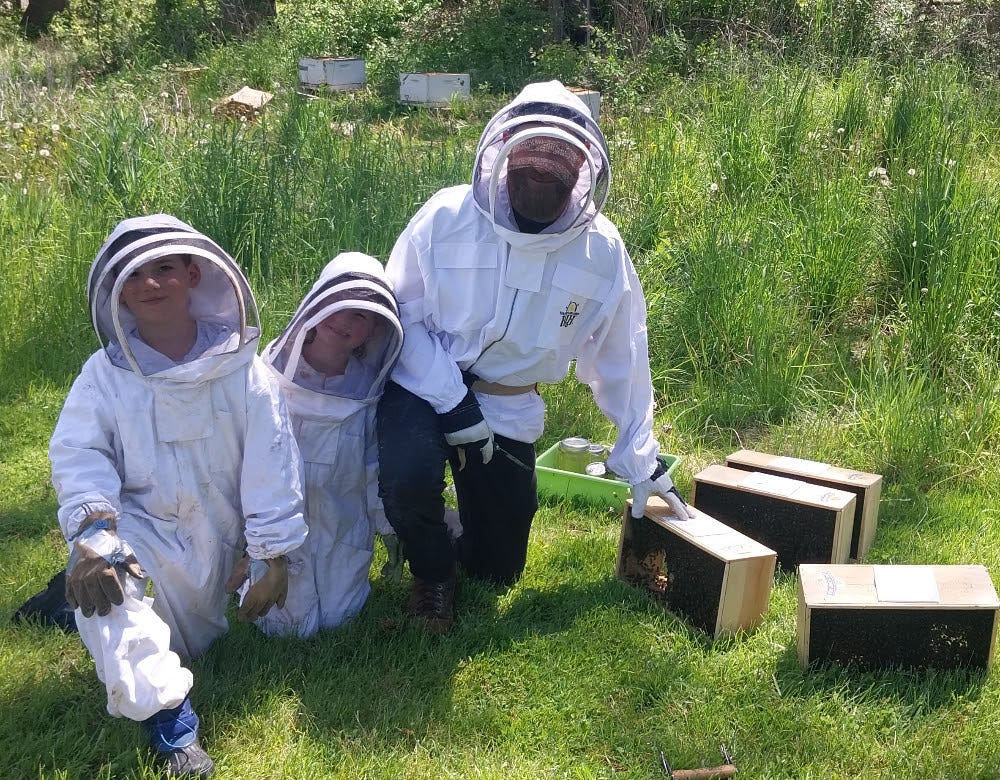
During the summer, the Sacred Tent and Nativity House communities in Illinois, steward the garden at the Abbey of St. Procopius, in Lisle, Illinois, where Dorothy Day was an oblate. The communities will be hosting garden workdays on Tuedsays after 5 p.m., inviting all to join them for vespers with the monks at 7 p.m. They also have been introducing new pollinators into their community in the form of
They write: “We would love to see you there! Even if you have no prior gardening experience please come to learn and connect with others in our community.”
Subscribe to the newsletter on their website here.
Mary’s House in Alabama Seeking Hospitaller
Mary’s House Catholic Worker in Birmingham, AL seeks live-in community member to serve as House Caretaker or Hospitaller. We’re looking for the right person (or people!) to come live at Mary’s House to help us maintain the premises and enable us to continue offering hospitality to our neighbors in need.
Catholic Workers may be few and far between in the Deep South, but the area offers unique opportunities to continue the work for peace and justice in the birthplace of the civil rights movement. Visit their website for more information here.
Mustard Seed Catholic Worker Spring Updates
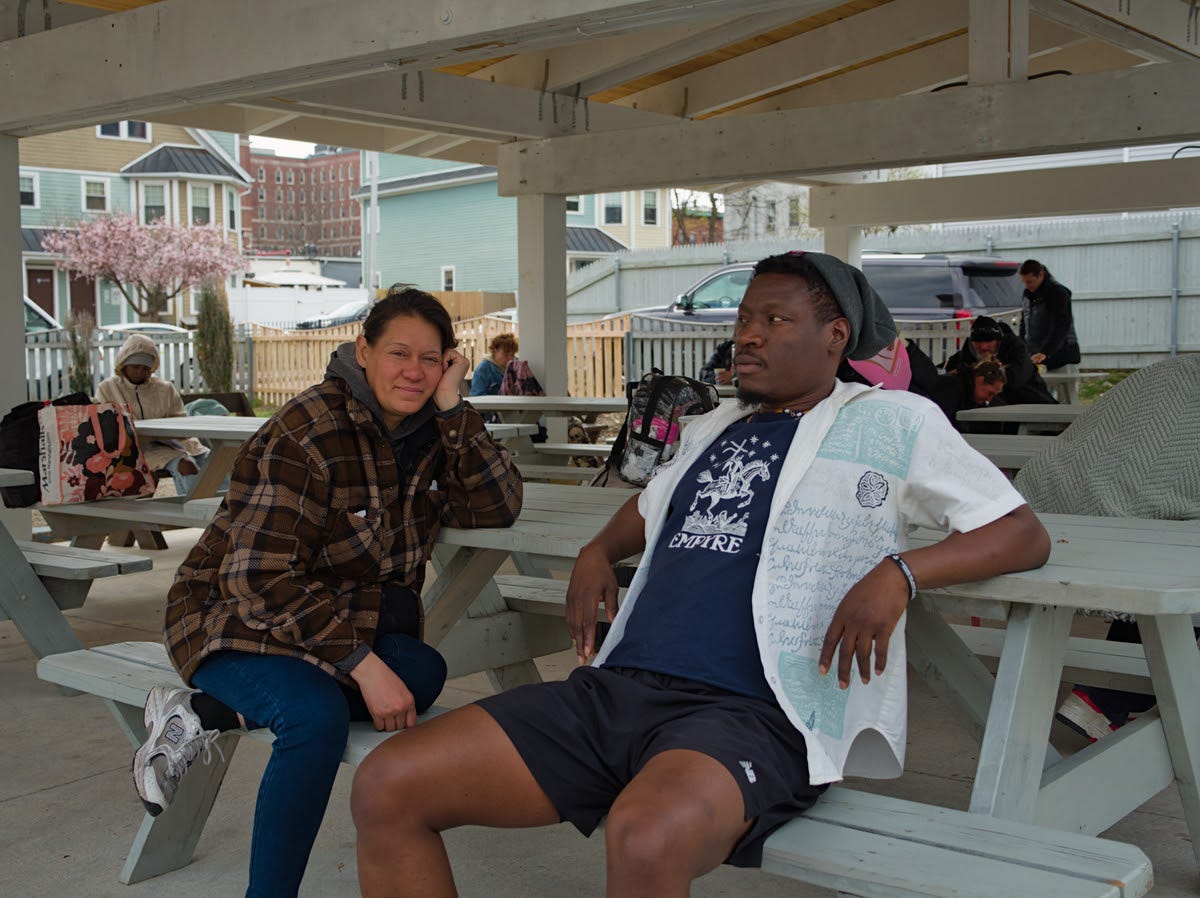
Mustard Seed Catholic Worker (Worcester, Massachusetts), renovated their pavilion for hospitality during the warm months.
In a recent newsletter mailed to subscribers, Mustard Seed shared that they will have an upcoming painting workday to renovate the house on Saturday, June 6. They are continuing to ask for coffee (ground) for their daily meal, jelly, past, baby formula and grocery store gift cards. They are also offering two opportunities for “clarification of thought.”
Mike Boover’s discussion series on Christian mystics continues Saturday, May 23, at 2pm. The topic will be Francis de Sales’s The Art of Loving God. Refreshments will be served.
The Mustard Seed book club will meet both Friday, May 29, and Thursday, June 4, at 7pm at 93 Piedmont. We’re returning to Ellis Amdur’s 2011 book on de-escalation Grace Under Fire.
Get in touch with the house for volunteer opportunities, upcoming house Mass, reading groups or more:
Visit their website or email house@mustardseedcw.org for more information.
London Catholic Worker Offers New Form of Hospitality
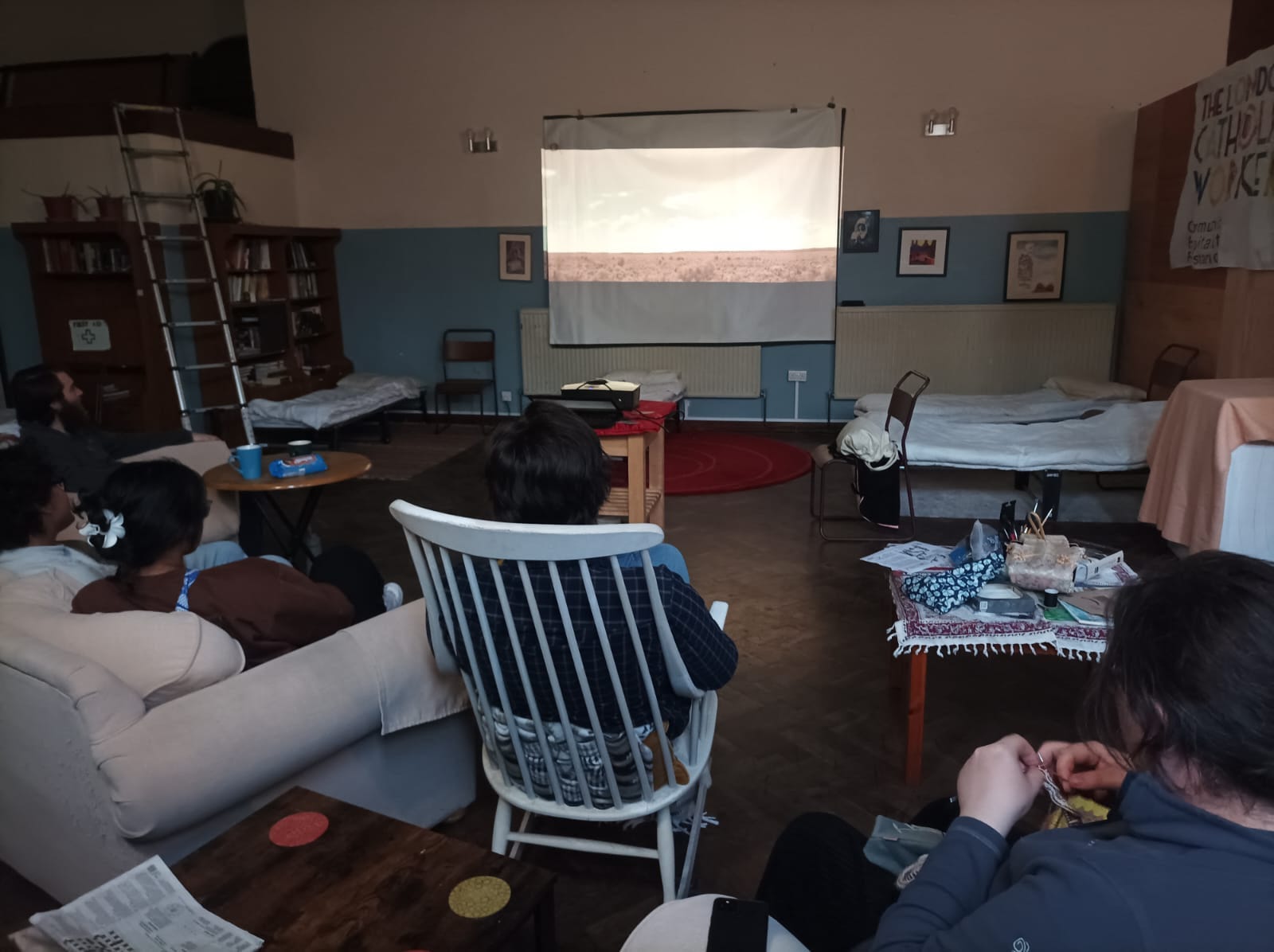
The London Catholic Worker invites community members into a new form of hospitality in their church hall. They write:
Now our winter night shelter has closed, we are offering a free events space to local people and groups who are broadly in sympathy with the goals and values of the Catholic Worker movement. Please get in touch for more information.
In a recent newsletter, the community also shared a fundraiser for the Rashid family, who are trapped in Gaza. They write: “All donations go towards the upkeep of his wife and three children, who need food and clothing, with the long term plan of rebuilding his home that was destroyed by Israeli bombardment.” Click here to donate or share.
Read more at the London Catholic Worker’s website here.
San Diego Catholic Worker is Hosting Pasta Dinner
The organizers of the San Diego Catholic Worker shared an invitation in their local news for their annual fundraiser on Saturday. Their pasta dinner will be prepared by Father Gil, flying in from New York. The silent auction is their main fundraiser for the year, they write:
San Diego Catholic Worker is a non-profit charitable organization, serving those in need through a variety of activities and works. These include weekly provision of prepared meals for the homeless at several locations, distribution of clothing and toiletries, and distribution of donated food to local families who depend on our help.
Support for our work comes entirely from our annual fundraiser dinner proceeds, charitable donations, including the silent auction items donated by local businesses, organizations, and individuals. We cannot do our work without our donors, and we are so thankful for their generosity.
Read more in KPBS here or contact Lillian (traveljunkie2003@hotmail.com) or Debra O’Leary (deboleary1@icloud.com) at the San Diego Catholic Worker.
Ames Romero House Welcomes “Missionaries”

Ames Romero House in Ames, Iowa, is welcoming missionaries into their “Yellow House” and seeking mattresses and other bedroom furniture to furnish the rooms. Visit their website to learn more here.
CW IN THE MEDIA
Catholic Worker Printmaking at Our Lady of the Road in South Bend
Catholic Worker artist Rachel Mills contributed a portrait of Dorothy Day to a recent conference at the Institute for Social Concerns at Notre Dame. She also helped lead a printmaking workshop at the St. Peter Claver Catholic Worker’s drop-in center, Our Lady of the Road.
“I am a printmaker because of the Catholic Worker, which is to say: I am a printmaker because of Dorothy Day,” said Rachel Mills, a printmaker living and working at the St. Peter Claver Catholic Worker House who created the portrait of Day for the project. “I began creating prints in dialogue with the tradition of printmaking in the movement and continue to find creativity in this lived conversation.”
You can read more about the workshop and the conference at the Institute for Social Concern’s website here.
Former Catholic Worker Volunteer Dies
Robert “Elzy” Cogswell died on Saturday, May 16, at the age of 86. A native of Texas who spent most of his life in the capital city of Austin, he spent two formative years at St. Joseph’s House in New York City with Dorothy Day in 1969 and 1970.
He was a lifelong member of the Lutheran and Episcopal churches and held two master’s degrees. His obituary says:
Elzy was a liberal yellow-dog Democrat who supported the role of government in taxing people to be sure that everyone has good education, healthcare, food, clothing, housing, transportation and safety from violence. He abhorred the expenditure of money on war, prisons or other means for harming people, specifically court-authorized killing of people for vengeance. Elzy thought that through our strength in democracy we should deprive corporations of their status as legal persons and their influence over government. Individuals should always bear personal liability for actions they take, whether or not they take them on behalf of corporations or government. He thought government should abolish tax deductions for advertising and other subsidies for corporations.”
Read more about Robert in his obituary here.
Martin Sheen on Meeting the Catholic Worker and Catholic Activism in America Magazine
Martin Sheen, a long-time friend of the Catholic Worker, shares the impact of Dorothy Day and the Catholic Worker on his life on Rev. James Martin SJ’s podcast. He first encountered the Worker as a young actor being paid $5 a week doing political, avant-garde theatre in New York. His friend told him about the Catholic Worker’s breadline down on Chrystie Street. He said people often ask if he ever met Dorothy Day, and he responds he could have but he genuinely does not know. “I didn’t go there to meet Dorothy Day,” Sheen said, “I was there to eat.” After hanging around for six months, he offered to help and a Worker asked him to help fold the newspapers on Saturday. Sheen was also featured in an article in America on the Catholic Committee of Appalachia’s 50th anniversary, that described the work that the committee has done to reverse and heal environmental destruction in Appalachia. Read more here.
Oxbow Catholic Worker in article on Hard Freeze
Farmers—Catholic Worker farmers included—have been bedeviled by bad weather this spring. A hard frost arrived in the mid-Atlantic immediately after planting season began, endangering many seedlings and slowing down growth. John and Julie Dougherty of Oxbow Farm were featured in an article on the April freeze, sharing the impact that the freeze has had on their peach, pawpaw, and nut trees. Read more at the National Catholic Register here.
Catholic Worker Ordained A Bishop in the Catholic Woman Priest Movement
A former volunteer and long-time friend of the Los Angeles Catholic Worker (and mother of Catholic Workers as well), Kathleen Bellefeuille-Rice was consecrated a bishop in the Roman Catholic Woman Priest (RCWP) movement last month. According to Jolt News:
Bellefeuille-Rice has been a devout Catholic all her life, and has been active in the Catholic Worker Movement, whose aim is to “live in accordance with the justice and charity of Jesus Christ.” Her dedication led her to work in religious education, social justice, healing prayer, and services to the homeless. This sense of service led Kathleen to connect with RCWP.
Read more about the consecration here.
MARK YOUR CALENDAR
Catch the Final Maurin’s Easy Essays Seminar!
The Maurin Academy is hosting a four-session online seminar on Peter Maurin’s Easy Essays, led by Deacon Christopher May. The seminar examines Maurin’s ideas on the crises of liberal modernity and the prevailing economic order, placing them in conversation with thinkers from across the Catholic tradition, from the Middle Ages to the post-conciliar pontiffs. The series began May 5; three sessions remain, meeting Tuesdays at 6:30 p.m. Central (4:30 p.m. Pacific): May 12, May 19, and May 26. The seminar is held via Zoom (follow this link to join). Visit the Maurin Academy’s website for registration and details.
SAVE THE DATE: September 10-13 - Sugar Creek CW Gathering
The Midwest Catholic Worker Gathering at Sugar Creek, Iowa, will take place the weekend of September 10-13, 2026. Mark your calendar and stay tuned for more information! You do not have to be living in an existing Catholic Worker community to attend.
WORDS FROM THE ELDERS
“A Reflection on Baptism and Pentecost”
by Dorothy Day, from From Union Square to Rome, Chapter 11
These pages are hard to write. The struggle was too personal. It was exceedingly difficult. The year passed and it was not until the following winter that the tension reached the breaking point. My health was bad, but a thorough examination at the Cornell clinic showed only nervous strain.
Finally with precipitation, with doubts on my part at my own unseemly haste, I made the resolution to bring an end to my hesitation and be baptized.
It was in December, 1927, a most miserable day, and the trip was long from the city down to Tottenvile, Staten Island. All the way on the ferry through the foggy bay I felt grimly that I was being too precipitate. I had no sense of peace, no joy, no conviction even that what I was doing was right. It was just something that I had to do, a task to be gotten through. I doubted myself when I allowed myself to think. I hated myself for being weak and vacillating. A most consuming restlessness was upon me so that I walked around and around the deck of the ferry, almost groaning in anguish of spirit. Perhaps the devil was on the boat.
Sister Aloysia was there waiting for me, to be my godmother. I do not know whether I had any other godparent. Father Hyland, gently, with reserve, with matter-of-factness, heard my confession and baptized me,
I was a Catholic at last though at that moment I never felt less the joy and peace and consolation which I know from my own later experiences religion can bring.
A year later my confirmation was indeed joyful and Pentecost never passes without a renewed sense of happiness and thanksgiving. It was only then that the feeling of uncertainty finally left me, never again to return, praise God!
Read the full chapter here.